Industries / Mining and materials / Mining and quarrying
Salt and mineral extraction
Salt and mineral extraction takes salt, potash, soda ash ore, lithium-rich brines and other non-metal minerals from buried beds, salt lakes and the sea, and refines them for food, roads, fertilizer, glass, chemicals and batteries.
c. 6050 BCE
At a salt spring at Poiana Slatinei, near Lunca in Romania, Neolithic people evaporated brine over fires and molded the salt into hard cakes in pottery containers. The excavators, Olivier Weller and Gheorghe Dumitroaia, call it the oldest salt exploitation site in Europe "and probably the world".
34
Milestones achieved across 6 domains.
11
To watch for: announced, not yet confirmed outside.
12
Open deliverables. Nobody has shipped them.
In one minute
Where it started
People were making salt from spring brine at Poiana Slatinei in Romania between 6050 and 5500 BCE, by its excavators' radiocarbon dates. Bronze Age miners dug rock salt at Hallstatt in Austria, and salt makers at Zigong in China drilled a brine well to 1,001 m by 1835. Potash became an industry at Stassfurt, Germany, in 1861, and lithium brine went into production at Clayton Valley, Nevada, in 1966.
Where it stands
Salt, potash and trona, the ore of soda ash, are mined underground or dissolved out with water, and lithium brine is concentrated in desert ponds in Chile, Argentina and Nevada. Sorbents, materials that hold lithium and let other salts pass, have pulled lithium from brine in Argentina since the late 1990s, and Eramet says its Argentine plant using its own sorbent process reached its rated output in October 2026. Floods and collapses at Retsof in New York (1994), Berezniki in Russia (2006), Bayou Corne in Louisiana (2012) and Maceió in Brazil showed how water and dissolving salt can bring down the ground above.
What is open
Much of the open work is measuring and checking. Open jobs include testing the US government's lithium map for Arkansas against new samples, a shared lab test for lithium sorbents, a record of flooded salt and potash mines, radar checks of the ground over mines and brine fields, output forecasts from satellite images of ponds, and one water count for every lithium brine operation. Most can be done at a desk or in a university lab, with free satellite images and public reports.
Domains
AchievedWatch forOpen
Domain
Progress
Last achieved
Watch for
Open
Finding deposits
Finding deposits is the search for buried beds of salt minerals and for brines, underground water heavy with dissolved salts, and the work of measuring how much of each mineral they hold.
5 · 1 · 2
Last achievedLithium held in the rock2025
Watch forA second Smackover lithium field
2
openRock salt and potash mines
Dry mining digs solid rock salt, potash and trona out of buried beds with machines or explosives and hoists it up a shaft, much as coal is mined.
7 · 2 · 2
Last achievedEsterhazy's old shafts closed2021
Watch forBHP's Jansen potash mine
2
openSolution mining and brines
Solution mining dissolves salt or potash underground with water and pumps the salty water, called brine, to the surface, and brine wells also pump up natural brines that hold lithium, bromine and other elements.
7 · 3 · 2
Last achievedMaceió's sinking neighborhoods2019
Watch forDLE at full rate
2
openEvaporation ponds
Evaporation ponds are shallow basins where sun and wind dry out sea water or brine until salt, potash or a lithium-rich concentrate is left behind.
5 · 1 · 2
Last achievedDredging a rising pond2020
Watch forAtacama beyond solar ponds
2
openPurifying
Purifying turns raw salt, potash or lithium brine into a product that meets a buyer's specification, such as table salt, fertilizer or battery-grade lithium.
5 · 2 · 2
Last achievedTwo refineries stop short2025
Watch forTesla's acid-free refinery
2
openWater and land
This work tracks what pumping brine, dissolving salt and mining soluble rock do to rivers, lakes, the ground and the people nearby, and sets limits on it.
5 · 2 · 2
Last achievedGreat Salt Lake record low2022
Watch forAI reads radar for sinkholes
2
open
Narrower industries
Figureheads
3 people

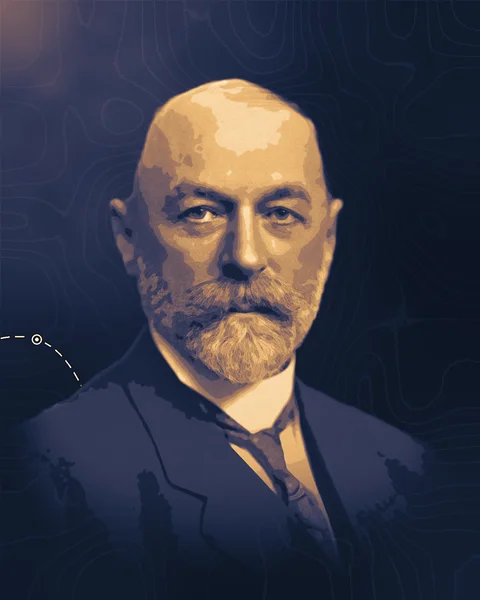
Adolph Frank
1834–1916
He worked out how to make potassium chloride from the potash salts that Stassfurt's rock-salt miners threw away, and opened the potash works of 1861 that began Germany's potash industry.
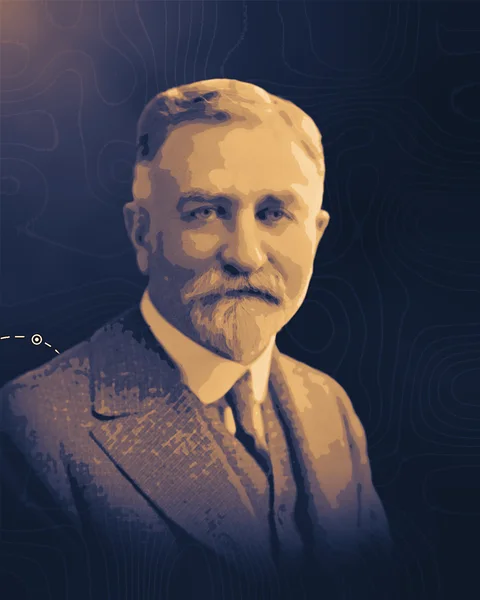
Herman Frasch
1851–1914
He mined sulfur through wells by melting it in the ground with superheated water and lifting it with compressed air, the Frasch process that ended Sicily's hold on the world's sulfur.
Herbert H. Dow
1866–1930
He found cheaper ways to pull bromine, and then chlorine and other chemicals, out of the brine pumped from wells under Michigan, and built a company on what the brine held.
Open in salt and mineral extraction
3 of 12 open deliverables
Open · Finding deposits
Score the lithium map
A public test of the USGS lithium map for the Smackover Formation. Run the survey's published model unchanged, then compare its predicted lithium at each well with lithium measured in brine samples taken after the model was built. Use wells inside southern Arkansas where they exist, and wells across the state lines in East Texas and northern Louisiana as a test outside the model's area.
Built with what exists
The USGS data release for the map (DOI 10.5066/P9QPRYZN), which holds the input files, Python and R scripts and prediction grids; lithium values from company technical reports filed on SEDAR+ in Canada and EDGAR in the US; QGIS; Python.
Open · Rock salt and potash mines
A record of flooded mines
An open, sourced table of every known flood, collapse and major water inflow in underground salt, potash and trona mines worldwide, with the mine, country, date, depth, mining method, source of the water, inflow rate, what was tried, and the outcome.
Built with what exists
USGS and mine-regulator reports; CIM Bulletin papers on OneMine; newspaper archives; a language model to read scanned reports and pull out the fields, with a person checking each row (see the Note "Seven more flagged"); a spreadsheet; Zenodo to publish the table with a DOI.
Open · Solution mining and brines
Same brine, same scorecard
A public test for DLE materials. Write recipes for synthetic brines that match published analyses of four brine types (an Andean salar, a Smackover oilfield brine, an Upper Rhine geothermal brine and a Salton Sea geothermal brine), set one test procedure, and run at least three published sorbents through it.
Built with what exists
PHREEQC, the US Geological Survey's free water-chemistry program, to design the recipes; published sorbent recipes such as lithium manganese oxide and lithium aluminum layered double hydroxide; a university lab's ICP-OES instrument to measure the metals; the open dle-simulation model on GitHub to scale lab results to water and reagent use per tonne; a large language model such as Claude to pull past test results from papers into one table (see the Note "Seven more flagged").
Where it sits
Broader