Industries / Figureheads
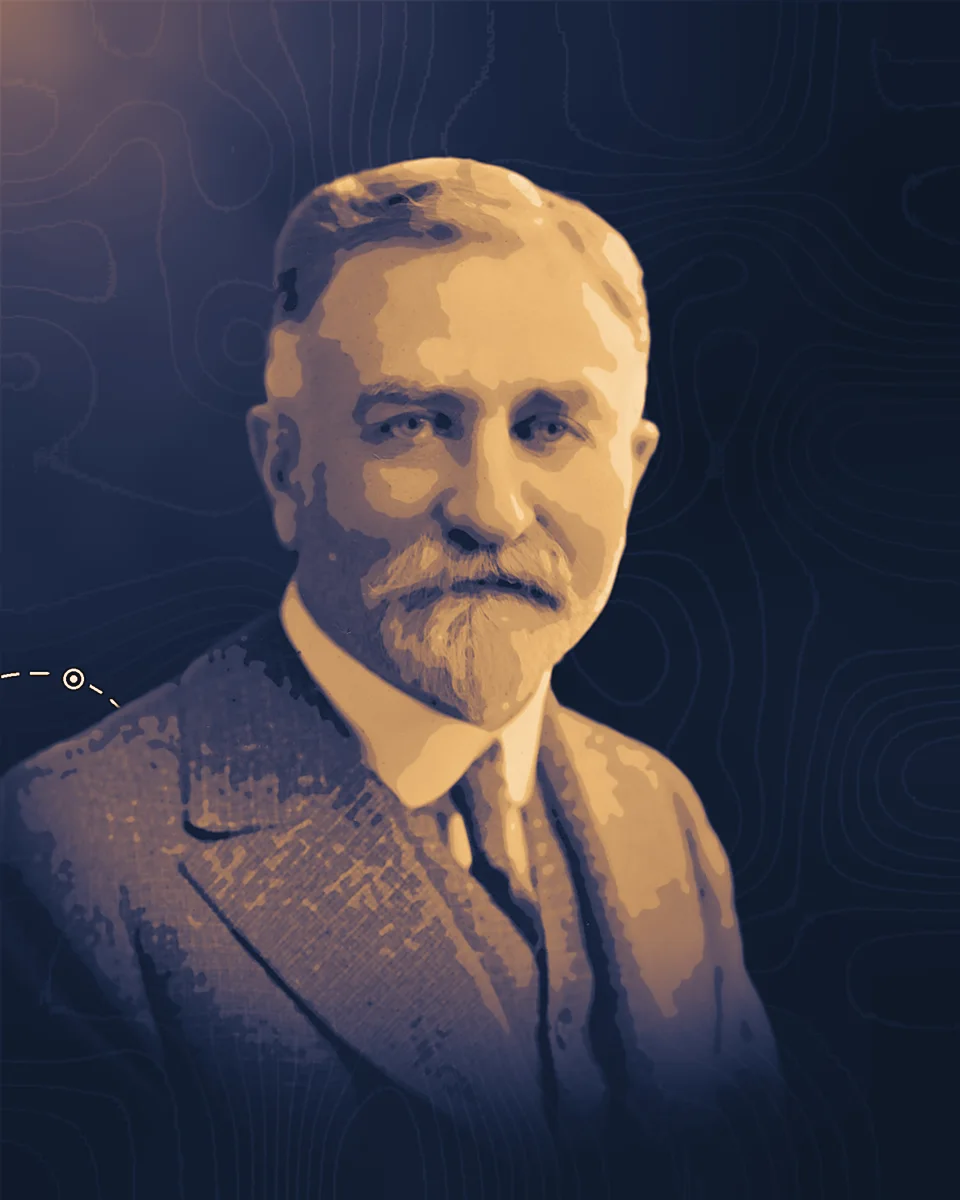
Herbert H. Dow
He found cheaper ways to pull bromine, and then chlorine and other chemicals, out of the brine pumped from wells under Michigan, and built a company on what the brine held.
1866–1930
What they changed
1889
Bromine blown out with air
Bromine makers boiled brine down over fires of waste wood, then distilled the bromine off. In Canton, Ohio, Dow freed the bromine while it was still in the brine with bleaching powder, trickled the brine over burlap and blew the bromine out with a current of air, then caught it on iron as iron bromide. The method saved the fuel.
1891
Bromine by electricity
On 4 January 1891, in a rented flour mill in Midland, Michigan, Dow freed bromine from the local brine with an electric current instead of a chemical, using a secondhand 15-volt generator turned by the mill's steam engine. The American Chemical Society calls his cell the earliest built specifically for chemical manufacture and made the site a National Historic Chemical Landmark in 1997.
1897
Chlorine from the same brine
The Dow Chemical Company, formed in 1897, used Dow's chlorine cell to make bleach from the brine. Chloroform, calcium chloride, Epsom salts and, during the First World War, magnesium metal followed from the same wells. The landmark plaque says his processes "led to an increasing stream of chemicals from brines."
1905
The bromine cartel retreats
In 1905 the Deutsche Bromkonvention, the German-led world bromine cartel, flooded the US market with cheap bromides to drive Dow out. Dow bought the cheap bromides in secret, repackaged them and sold them in Europe at the cartel's own high price, and the Germans withdrew from the US market. By 1909, in the society's account, Dow was the leading maker of bromides.
1934
Bromine from the sea
When General Motors' chemists needed more bromine than the world made, Dow told them, "Then we'll have to go to the oceans for it," calling sea water a diluted brine. He was ready to build a plant by 1929 but died first. His son Willard H. Dow finished the work, and the company opened its first sea-water plant in North Carolina in 1934.
Life
Herbert Henry Dow was born in Belleville, Ontario, on 26 February 1866. His father, J. Henry Dow, was a master mechanic and inventor who earned his living improving small factories in Connecticut and Ohio, and Herbert grew up in Cleveland. He studied chemistry at the Case School of Applied Science, now Case Western Reserve University, and graduated in 1888. His senior thesis analyzed the salt brines of northern Ohio and, in the Science History Institute's account, samples from the wells around Midland, Michigan, whose brine held bromine.
His first firm, the Canton Chemical Company of 1889, failed because the process did not pay. In 1890 he moved to Midland and set up the Midland Chemical Company in a rented grist mill that gave him both brine and power. When he turned to making chlorine as well, his backers refused to pay for it and fired him in 1894. He went back to Ohio, formed the Dow Process Company with money from the Case faculty, and in 1897, with Cleveland supporters, the Dow Chemical Company, which took over the Midland firm in 1900.
Dow kept working at the bench and was granted 107 patents. In his lifetime the company drew bromine, chlorine, sodium, calcium and magnesium from the brine of the old sea buried under Midland. During the First World War it made magnesium metal from the brine and was the first in the United States to make the dye indigo synthetically.
The bromine he planned to take from the sea was wanted for leaded petrol. Charles Kettering and Thomas Midgley of General Motors had developed tetraethyl lead, an additive that stopped engines knocking, and it needed ethylene dibromide in quantity. The UN Environment Programme calls tetraethyl lead in petrol, used from 1922 until Algeria stopped selling it in 2021, "a catastrophe for the environment and public health", a cause of heart disease, stroke and cancer and a harm to children's brains.
Dow died on 16 October 1930, by the American Chemical Society's account, and his son Willard succeeded him as president. Bromine is still taken mostly from brines. In 2019 the US Geological Survey named the United States, China, Israel and Jordan as the four leading producers: the US output came from brine wells in Arkansas holding 4,000 to 4,600 parts per million (ppm) of bromine, and Israel's and Jordan's from the Dead Sea, against about 65 ppm in sea water.
Read more
5 accounts
First Commercial Production of Bromine in the United States, American Chemical Society, 1997.
The booklet for the National Historic Chemical Landmark at Midland, with the plaque text, the cartel story and a reading list.
web.archive.org
Herbert Henry Dow, Science History Institute, undated. A short scientific biography that explains the blowing-out method step by step.
sciencehistory.org
Herbert H. Dow: Pioneer in Creative Chemistry, Murray Campbell and Harrison Hatton, Appleton-Century-Crofts, 1951.
The book-length life.
archive.org
Growth Company: Dow Chemical's First Century, E. N. Brandt, Michigan State University Press, 1997.
A history of the company by its own historian, with the founder's years in detail.
archive.org
The Dow Story: The History of the Dow Chemical Company, Don Whitehead, McGraw-Hill, 1968.
An earlier narrative history of the firm and its brine.
archive.org