Industries / Figureheads
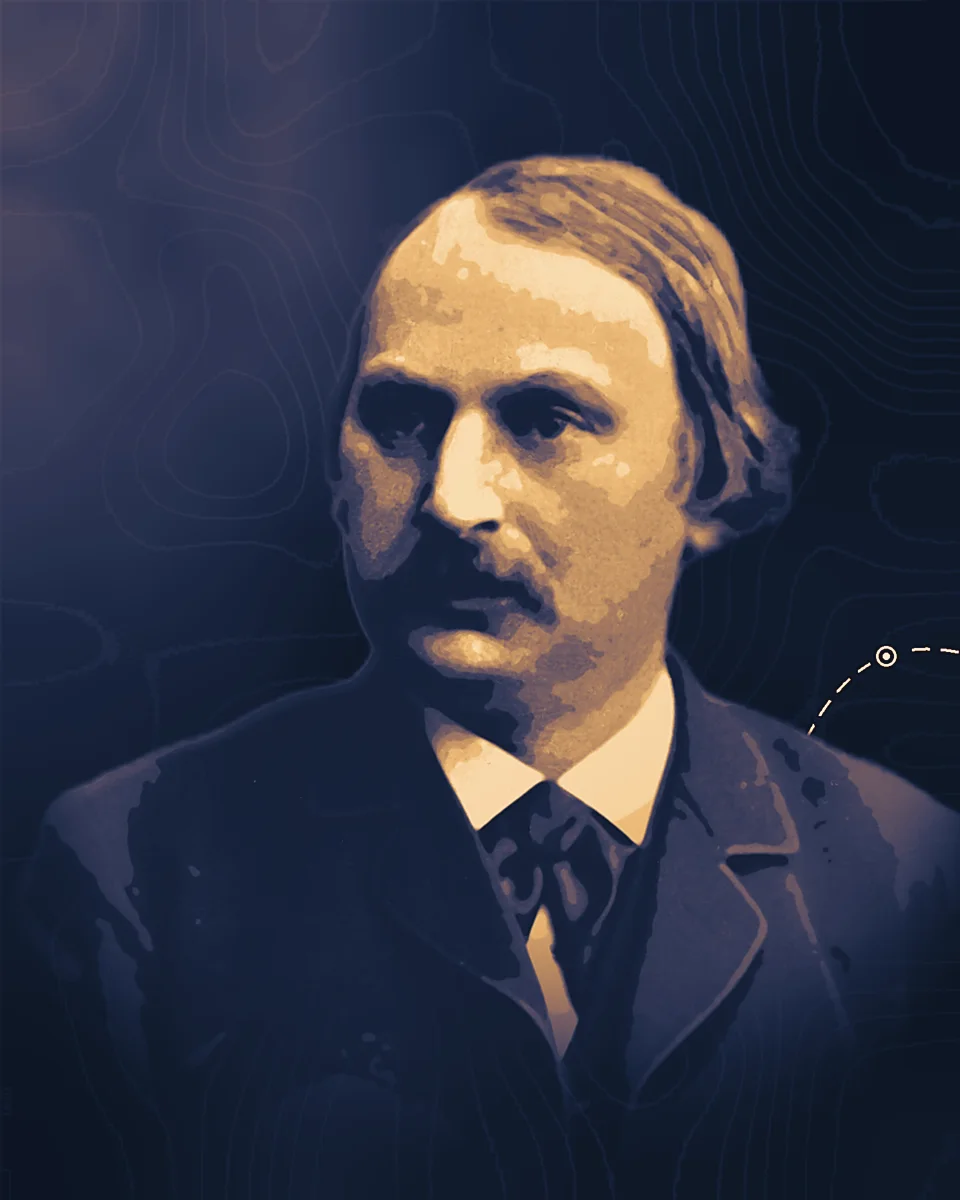
Adolph Frank
He worked out how to make potassium chloride from the potash salts that Stassfurt's rock-salt miners threw away, and opened the potash works of 1861 that began Germany's potash industry.
1834–1916
What they changed
1861
Potash from waste salts
At Stassfurt the potassium and magnesium salts that lay over the rock salt were treated as waste, the Abraumsalze or "overburden salts". Frank, then a chemist at a Stassfurt sugar factory, made the first thorough trials of getting potassium chloride from them, and in 1861 took a patent on separating potassium chloride from magnesium chloride to make it from carnallite, the main potash mineral there.
1861
The first potash works
Frank left his post in 1860 to build a potash factory, which opened in 1861 beside the Stassfurt to Förderstedt railway. Germany's Extractive Industries Transparency Initiative calls the factory commissioned at Stassfurt in 1861 the world's first potash factory and the start of 150 years of German potash mining. Other firms built more works in Stassfurt and nearby Leopoldshall from 1862 to 1864, and by 1872 there were 33.
1860s
Potash sold as fertilizer
By the late 1850s Frank had seen that potash salts could restore soils worn out by sugar-beet growing. He soon sold beyond Germany and exported potash salts in large amounts to the United States, and in 1867 and 1868 he promoted potash for fertilizing moorland in place of burning it off.
1865
Bromine from the leftover liquor
The liquor left after potassium chloride crystallized out still held bromine. In 1865 Frank was the first to make bromine and bromine compounds from these mother liquors in his works, by the account of his biographer in the Neue Deutsche Biographie.
Life
Adolph Frank was born on 20 January 1834 in Klötze, in the Altmark, the son of a Jewish merchant, Salomon Frank. He was apprenticed to an apothecary from 1848. During his military service in 1854 and 1855 he was posted as lecture assistant to the chemist Gottlieb Erdmann in Berlin, then studied natural sciences until 1857, when he passed the state examination in pharmacy and joined the sugar factory of Bennecke, Hecker & Co. at Stassfurt.
At the sugar works he cleaned beet juice with alumina soaps, brought in bone charcoal and superphosphate, and took his doctorate at Göttingen with a thesis on losses in making raw sugar: in 1862 by the Neue Deutsche Biographie, in 1861 by the history pages of Evonik, a successor of one of his later firms. Potash took him out of sugar. After the first works came a merger of potash factories, the Vereinigte Chemische Fabriken at Leopoldshall, which he ran as general director until 1876.
He then ran a glassworks at Charlottenburg near Berlin, where his biographer credits him with the first brown beer bottles, made to keep out light and heat, and in 1883 he promoted Thomas slag, a by-product of steelmaking, as a fertilizer. From 1885 he was a consulting chemist and engineer: he pressed for peat-fired power stations, helped build sulfite pulp mills in Germany and abroad, and advised the Nobel dynamite company from 1896.
His last large work was on nitrogen. From 1895 to 1899, with the chemist Nikodem Caro and later his son Albert Frank, he worked out how to bind the nitrogen of the air to calcium carbide, making calcium cyanamide, a fertilizer. In 1898 or 1899 he founded the Cyanid-Gesellschaft with Siemens & Halske, the Deutsche Gold- und Silber-Scheideanstalt and the Deutsche Bank, and the first cyanamide factories opened in Italy in 1904 and in Germany in 1908.
He received an honorary engineering doctorate from Dresden and the Liebig medal, and died at Charlottenburg on 30 May 1916. The industry he began is still working: in 2023 Germany produced about 5.8 million tonnes of potash and potash salt products, about 5% of world output, from five potash mines and one solution-mining plant, and 8,398 people worked in German potash mining, by the transparency initiative's figures.
Read more
4 accounts
Frank, Adolph, Kurt Ziekursch, Neue Deutsche Biographie, vol. 5, pages 337 to 338, 1961.
The national biography's account, with his patents, firms and a list of older sources.
deutsche-biographie.de
Adolph Frank, H. Grossmann, Angewandte Chemie, vol. 29, 1916, pages 373 to 377.
An obituary by a fellow chemist, printed with his portrait.
doi.org
Adolph Frank und das Preisausschreiben der Liebig-Stiftung über die Verwendung der Kalisalze aus dem Jahre 1876, H.
Grossmann, Angewandte Chemie, 1919. On Frank and an 1876 prize essay competition on the use of potash salts.
doi.org
Salts, German Extractive Industries Transparency Initiative report, undated. German salt and potash mining today, from the 1861 works to the mines and figures of 2023.
d-eiti.de