Industries / Figureheads
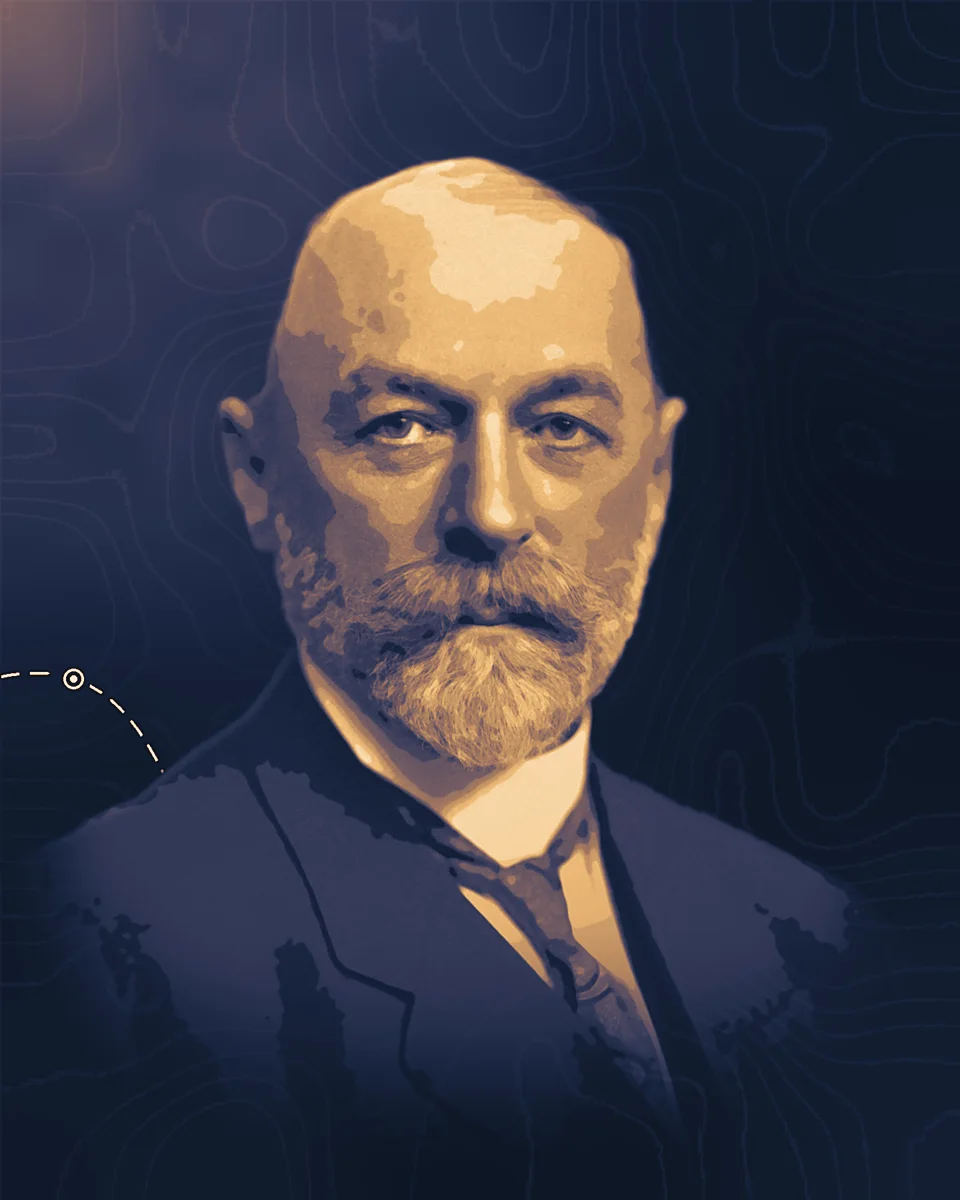
Herman Frasch
He mined sulfur through wells by melting it in the ground with superheated water and lifting it with compressed air, the Frasch process that ended Sicily's hold on the world's sulfur.
1851–1914
What they changed
1890
Melt the sulfur in place
A rich bed of native sulfur lay about 1,000 feet under Calcasieu Parish, Louisiana, beneath quicksand that had beaten every attempt to mine it; a shaft sunk with a shield was lost, and men died from water carrying hydrogen sulfide. On 23 October 1890 Frasch applied for the first of ten patents on melting the sulfur where it lay with superheated water sent down a well and pumping it up as a liquid through an inner pipe.
1894
The first well pumps sulfur
At his first trial, by his own account, twenty 150-horsepower boilers heated water to 335 °F (about 168 °C) under 100 pounds per square inch, and after 24 hours of pumping it into the ground the engine began lifting molten sulfur, more than the forty barrels set out could hold. The US Geological Survey dates the first attempts to late 1894.
1890s
Lifting with air
Liquid sulfur wore out the valves of ordinary oil-well pumps. Frasch blew compressed air into the column of sulfur in the well, two parts air to one of sulfur, so the pressure of the water in the ground pushed the lightened mixture to the surface with no pump in the sulfur at all. He also pumped sawdust in with the hot water to seal the channels through which cold ground water reached the melting zone.
1903
Sicily loses its monopoly
The process first paid in 1903 at Sulphur Mine, Louisiana. Frasch said the mine produced 35,000 tons that year and enough for the whole United States in 1904, when the country had been buying almost all its sulfur from Sicily and Japan. The USGS says 95% of the world's sulfur came from Sicily before the process, and US output passed Italy's in 1913.
2000
The last US well closes
By the USGS's count, 8 companies ran 36 Frasch mines in the 20th century, and US output peaked at more than 8 million tonnes in 1974. Sulfur recovered from oil and gas overtook it in 1982, and the last US Frasch mine closed on 31 August 2000. In 2019 the survey still recorded Frasch sulfur from Poland's last operating mine.
Life
Herman Frasch was born in Gaildorf, in the German kingdom of Württemberg, on 25 December 1851. He trained in a pharmacy, went to the United States in 1868 at 17, and worked in the laboratory of Professor John M. Maisch at the Philadelphia College of Pharmacy. By the mid-1870s he had a laboratory of his own, applying chemistry to industrial problems.
His first fortune came from oil. In 1876 he sold a process for refining paraffin wax to a Cleveland company tied to Standard Oil, and moved to Cleveland in 1877. In 1885 he bought a refinery at London, Ontario, and found how to take the sulfur out of the foul-smelling Canadian and Ohio crudes by distilling them with copper oxide. Standard Oil bought his patents in 1888, and Ohio crude, which had sold at 14 cents a barrel as fuel, rose to about a dollar.
He came to sulfur by way of salt. The chemist who presented his Perkin Medal in 1912, Charles F. Chandler, listed five patents of his on making salt, filed between 1882 and 1899, including a process to bring rock salt to the surface by dissolving it through borings, and four on the ammonia-soda process. Frasch himself said he took on the Louisiana sulfur with "a great deal of experience in drilling and mining petroleum and salt."
The method left its mark on the ground. Every melted well eventually caved in, and to keep the pressure that stopped the hot water turning to steam, the space left by the sulfur had to be refilled with earth: Frasch said a dredge moved 4,000 cubic yards a day, and the ground had sunk so far that where his house once stood was 80 feet below the old surface. His Louisiana sulfur also undercut the Sicilian mines and the people who lived by them. He told how he broke an Anglo-Sicilian selling company in a price war, and how the Italian state then formed a compulsory sulfur consortium in 1906. The USGS says Italian native sulfur production ended completely in 1985.
Frasch organized the Union Sulphur Company. By Chandler's account in 1912, ninety per cent of its stock was held by Frasch, the estates of three partners and one living partner. When its patents ran out, other firms used the method from 1912 at Bryan Mound in Texas, and later in Mexico, Poland and Iraq. He received the Perkin Medal in 1912, retired to Paris and died there on 1 May 1914.
Read more
4 accounts
Perkin Medal Award: presentation address by C. F. Chandler and address of acceptance by Herman Frasch, Journal of Industrial and Engineering Chemistry, vol. 4, February 1912.
His own account of the first well, the air lift and the fight with the Sicilian sellers.
archive.org
Materials Flow of Sulfur, Joyce A. Ober, US Geological Survey Open-File Report 02-298, 2002.
The rise and end of the Frasch industry in the United States, with a diagram of a Frasch well.
pubs.usgs.gov
Brimstone: The Stone That Burns, Williams Haynes, Van Nostrand, 1959.
A history of the Frasch sulfur industry by a historian of American chemical industry.
archive.org
Sulfur, US Geological Survey Minerals Yearbook 2019, 2021.
Where the world's sulfur comes from now, and the last Frasch mine.
pubs.usgs.gov