Industries / Figureheads
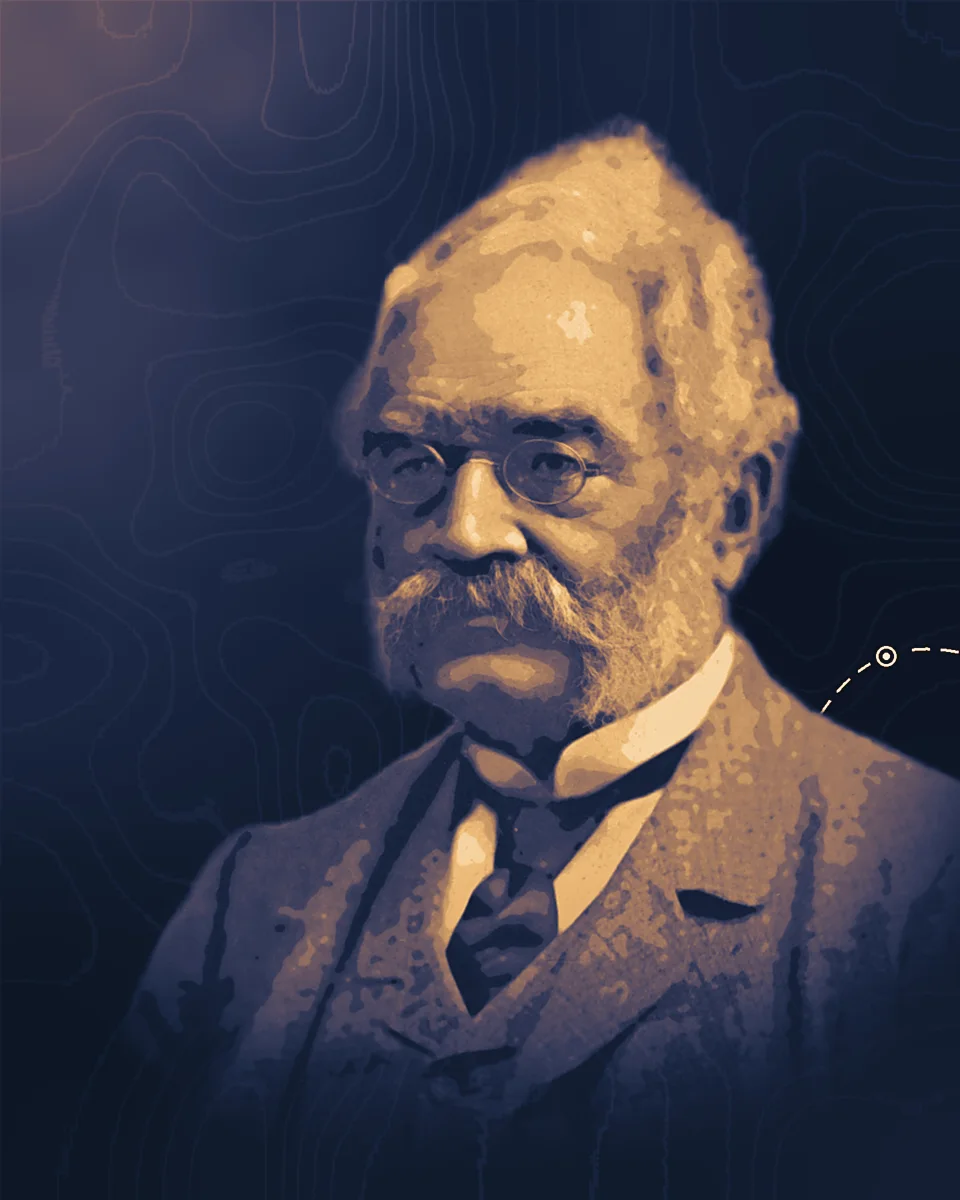
Werner von Siemens
He showed that a generator can raise its own magnetic field from the current it makes, which freed electric machines from weak permanent magnets and from batteries.
1816–1892
What they changed
1847
A telegraph firm in Berlin
Siemens built a pointer telegraph that worked more reliably than those in use, and on 1 October 1847 founded the firm Siemens & Halske in Berlin with the instrument maker Johann Georg Halske. Its first large state order, in 1848, was a telegraph line from Berlin to Frankfurt am Main.
1866
The self-exciting dynamo
In the autumn of 1866 Siemens found that an electric machine turned by outside force could build up its own field. The little magnetism always left in its iron cores starts a small current, the current strengthens the magnets, and the stronger magnets raise the current. Earlier generators relied on permanent steel magnets. He showed the machine to Berlin physicists in December 1866, and it was described to the Berlin Academy of Sciences on 17 January 1867.
1867
Patents and a name
He patented the principle in Germany and England in 1867 and called the device a "dynamo-electric machine", the name that was shortened to dynamo. His firm's history says that after about ten years of development the dynamo was ready for series production in 1875.
1879
Current put to work
With cheap current to sell, the firm showed an electric railway and arc-lamp street lighting in Berlin in 1879, an electric lift at Mannheim in 1880, an electric tramway at Berlin-Lichterfelde in 1881 and a trolleybus in 1882. The German national biography says Siemens coined the word Elektrotechnik, electrical engineering, in 1879.
Life
Ernst Werner Siemens was born on 13 December 1816 at Lenthe, near Hanover, the fourth of fourteen children of a tenant farmer. The family was short of money. He left school in Lübeck in 1834 without a leaving certificate and joined the Prussian artillery to get an engineering education, which he had at the artillery and engineering school in Berlin from 1835. After his parents died he took charge of his younger brothers and sisters. His first Prussian patent, in 1842, was for a way of gilding by electroplating.
The firm he started with Halske began as a small workshop making telegraphs, railway signal bells, water meters and wire insulated with gutta-percha, a rubber-like gum. When its work for the Prussian telegraph office ended in 1851 it turned abroad. It built the Russian telegraph network from the Baltic to the Black Sea, under his brother Carl, and his brother William made and laid submarine cables from England.
The dynamo principle was in the air, and the credit was contested at once. When his brother William showed the machine to the Royal Society in London on 15 February 1867, Charles Wheatstone showed a similar one at the same meeting, and Samuel Varley said he had ordered such a machine in the autumn of 1866 and filed a provisional patent. Siemens's own memoirs record both claims and say that his printed account for the Berlin Academy settled the matter in his favour. The German national biography adds that the Dane Søren Hjorth had patented a dynamo in 1854, of which Siemens probably knew nothing. The firm's own history says that what set him apart from the others working on the problem was that he saw its commercial value and patented it.
Inside the firm he paid a bonus for employees' suggestions from 1866 and in 1872 set up a pension, widows' and orphans' fund, more than a decade before Germany had old-age insurance by law. The German Historical Museum notes that the fund also served to bind workers to the firm. He joined the new Imperial Patent Office in 1877, helped found the Electrotechnical Society in 1879, and in 1887 gave money and land for the Physikalisch-Technische Reichsanstalt, the national institute for physical standards.
He was raised to the nobility in 1888 and became "von Siemens". He left the firm formally in 1890 and kept a deciding influence until he died at his house in Charlottenburg, near Berlin, on 6 December 1892.
Read more
4 accounts
Personal Recollections of Werner von Siemens, Werner von Siemens, translated by W. C. Coupland, 1893.
His memoirs, finished shortly before he died, with his own account of the dynamo on pages 329 to 333.
archive.org
Siemens, Ernst Werner von, Wilfried Feldenkirchen, Neue Deutsche Biographie, volume 24, 2010.
The German national biography's entry, by the historian of the firm.
deutsche-biographie.de
Werner von Siemens 1816–1892, Dorlis Blume, Deutsches Historisches Museum, undated. A year-by-year life from the German Historical Museum.
dhm.de
1865–1896: Company history, Siemens Historical Institute, 2017.
The firm's own short account of the dynamo and what followed it.
assets.new.siemens.com
Industries
Power generationGeneratorsRailPublic transitElevator and escalator servicesWire and cable