Industries / Finance and business services / Advertising and marketing
Graphic and web design
Graphic and web designers decide how a client's name, printed matter and websites look and read, from the logo and the page layout to the files a printer prints and the screens a developer builds.
1922
The American typographer William Addison Dwiggins used the words "graphic design" in "New Kind of Printing Calls for New Design," an article in the Boston Evening Transcript of 29 August 1922. Britannica's entry, written by the design historian Philip B. Meggs, says he "coined the term graphic design to identify the emerging field." David Preston, writing in the journal Visible Language in 2026, says the article uses the phrase "just once, and only inadvertently," and cites the historian Paul Shaw's finds of the two words together in US newspapers from 1842, 1856 and 1888.
40
Milestones achieved across 6 domains.
17
To watch for: announced, not yet confirmed outside.
17
Open deliverables. Nobody has shipped them.
In one minute
Where it started
In the late 1800s new printing methods split the designing of a poster or page from its production, and advertising agencies, book publishers and magazines began hiring art directors to plan how their pages looked, in Philip Meggs's account for Britannica. In the 1900s companies began to plan their whole appearance as one system, as AEG did with the architect Peter Behrens from 1907 and IBM with the designer Paul Rand from 1956. Websites joined the work after Tim Berners-Lee put the first one online at CERN in 1991.
Where it stands
In the United States, jobs designing for screens are growing and graphic design jobs are not. O*NET, the US Labor Department's job database, counted 253,100 graphic designers in 2025 and projects their number to fall by 2035, while it counted 132,700 web and digital interface designers and projects growth of 5 to 6%. On one large freelancing platform, posts for image-making jobs fell 17% after AI image generators arrived, by the measure of Ozge Demirci, Jonas Hannane and Xinrong Zhu (Management Science, 2025). Laws in the EU and the US now require accessible websites, yet WebAIM found text below the standard contrast on 83.9% of a million home pages in February 2026.
What is open
Most of the open jobs are public tests the trade does not yet have: of how well trademark image searches find clashing logos, whether AI tools follow a brand's rules, keep its design tokens and hand back files a designer can still edit, whether signed records of who made an illustration survive upload, and how well automatic PDF tagging and alt text serve blind readers. Others put AI site builders and layout tools against working designers on the same brief, with the votes published. AI models that read images and write code, agents that work inside design programs such as Figma and Scribus, and free checkers such as veraPDF and Lighthouse put most of them within reach of a small team.
Domains
AchievedWatch forOpen
Domain
Progress
Last achieved
Watch for
Open
Brand identity
Brand identity is the work of designing a client's logo, colors and typefaces, and the rulebook, called brand guidelines or a graphics standards manual, that keeps them the same wherever they appear.
6 · 3 · 3
Last achievedCracker Barrel restores Old Timer2025
Watch forUSPTO image search for marks
3
openLayout and type
Layout is arranging words and pictures on printed pages such as posters, brochures, reports, magazines and books, and type is choosing the fonts and setting them, down to the grid of columns and where each line and page breaks.
6 · 3 · 3
Last achievedLayout for non-designers2013
Watch forCanva's design model
3
openIllustration
Illustration is drawing and making the pictures that go into a client's brand, publications and website, by hand, in drawing software, from stock libraries or with AI image generators, and settling who owns the result.
7 · 3 · 3
Last achievedAnti-AI cloaks shown removable2025
Watch forEditable SVG from a prompt
3
openWebsites
Website design is planning how a client's site looks and is laid out (type, color, spacing, pictures and menus), making it rearrange itself for phones and large screens, and checking that it loads quickly.
7 · 3 · 3
Last achievedSpeed counts in search2021
Watch forAgents that build whole sites
3
openHandover to developers and printers
Handover is the step where a finished design leaves the designer as files, measurements, named values and packed folders that a developer can build from, or a printer can print from, without guessing.
7 · 2 · 2
Last achievedA shared format for tokens2025
Watch forCode Connect trims agent work
2
openAccessibility
Accessibility in design is making brands, documents and websites usable by people with disabilities: readable color contrast and type, written descriptions of images, and PDFs and pages that screen readers and keyboards can work through.
7 · 3 · 3
Last achievedEU law reaches private services2025
Watch forAI alt text in InDesign
3
open
Advances to build with
2 research notes
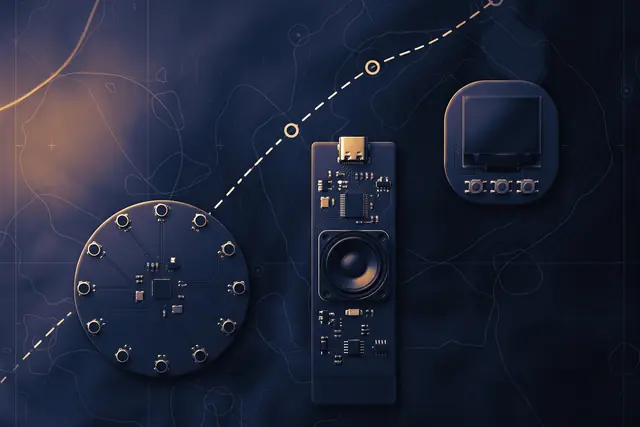
Claude Fable 5.2
Three working devices
Anthropic says its AI model Claude Fable 5.2 designed three prototype devices that worked without electrical modifications, with no outside test reported.

Mistral Large 4
A trillion open parameters
Mistral published its Large 4 AI model, a trillion numbers by its count, free to download and sell, though firms that rent out models need a separate license.
Open in graphic and web design
3 of 17 open deliverables
Open · Brand identity
A scorecard for logo search
A public test of the free trademark image searches, the USPTO's beta and the World Intellectual Property Organization's Global Brand Database, on US cases with known outcomes. The cases are decisions of the Trademark Trial and Appeal Board (TTAB, the USPTO's tribunal) from 2025 and 2026 in which the owner of an earlier mark tried to block a new one, called an opposition, and both marks include a design. For each case, upload the newer logo and record whether, and at what rank, the earlier mark appears. Publish case numbers, serial numbers, query dates and ranks, not the logo images.
Built with what exists
USPTO trademark search (free account); WIPO's Global Brand Database, free, with image search since 2019; public TTAB decisions; a spreadsheet or a short Python script for scoring. Queries run by hand or within each site's terms of use.
Open · Layout and type
Blind test of AI-made reports
A public test in which AI tools and human designers lay out the same 16-page report from the same brief, using the same openly licensed text and images and fonts under the SIL Open Font License. Each delivers an editable layout file and a PDF, and working designers rate the PDFs without knowing who made them.
Built with what exists
Scribus, a free layout program, with scribus-mcp, an open-source connector that "lets Claude drive Scribus" through about 125 commands, including paragraph styles, text flow, PDF export and a preflight check; a Claude model such as Claude Fable 5.2 to drive it (see the Note "Three working devices"); InDesign 22.0 with the AI Assistant beta and Canva's AI tools as other entrants; Google Fonts; text and images under CC BY or in the public domain; a simple web form for ratings.
Open · Illustration
A tracing test for drawings
A public test of tracers, tools that turn a scanned drawing into vector paths, on about 100 openly licensed or public-domain hand drawings. Score each tracer's output for fidelity, how closely it matches the original by two standard image-similarity measures (SSIM and LPIPS), and for editability: the number of paths and anchor points, stray fragments, and the minutes working illustrators need to make each file ready for a client.
Built with what exists
VTracer (MIT license), Potrace, Illustrator's Image Trace, Vectorizer.ai and the open StarVector-1B and StarVector-8B models on Hugging Face; Python scripts that render each SVG and count its path commands.
Where it sits
Broader