Claude Fable 5.2
Three working devices
Anthropic says its AI model Claude Fable 5.2 designed three prototype devices that worked without electrical modifications, with no outside test reported.
Models · Checked 13 Nov 2026 · 9 sources · 9 min
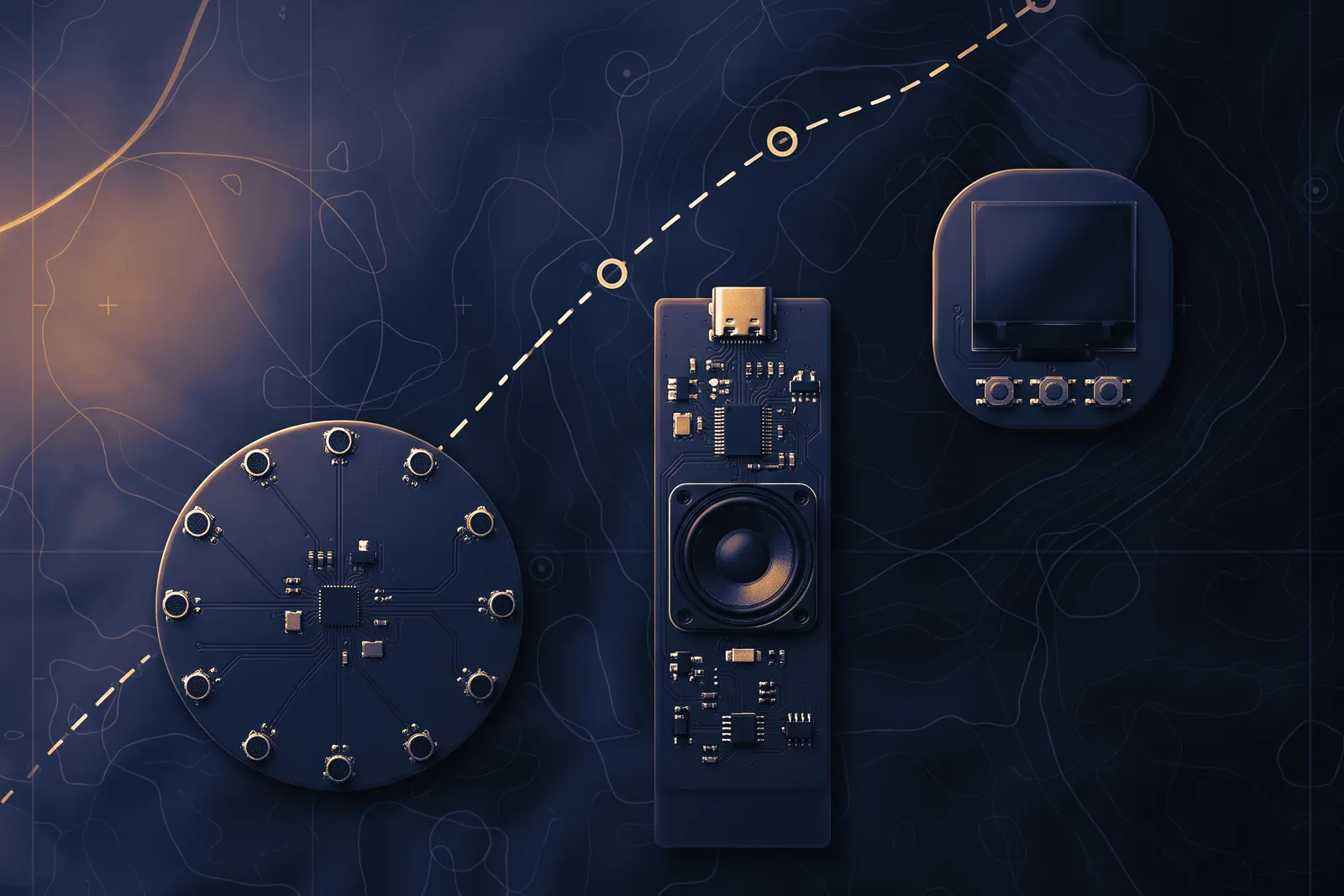
Inside a doorbell, a television remote or a talking toy there is a thin board, usually green, with small parts soldered to it and fine lines of copper running between them. The trade calls it a printed circuit board, or PCB, and the lines are its wiring. A factory makes them all at once from a drawing, and once made they stay put. If the drawing was wrong, the repair is done by hand, with a sharp knife to cut the line that should not be there and a strand of wire, soldered on, to make the line that should.
Nobody wants to sell a product patched like that, so the usual course is to correct the drawing, order new boards and wait. Software has no such wait. A program that fails can be changed and run again in seconds, and an AI model, the kind of software that answers a typed request with text of its own, can write programs that way: run what it wrote, read the error, fix the line. A circuit board cannot be run until it has been built. Whatever is wrong with it gets found while it is still a drawing, or it gets found in copper.
On 9 November 2026 Anthropic released an AI model called Claude Fable 5.2 and reported that it had designed three electronic prototypes: a home voice-assistant hub, a USB speakerphone and a handheld virtual pet. Each, the company says, has its own circuit board, 3D-printed case and software. Diode Computers, a circuit-board maker with which Anthropic discloses a commercial relationship, built and assembled them under the model's direction. By Anthropic's account, all three worked without electrical modifications, meaning no change to the circuit after the boards were made: the knife stayed in the drawer. No test by anyone outside the two companies has been reported.
A puck with microphones
The speakerphone began as a short piece of writing. Anthropic's research post on the project describes a brief request for each design, which the field calls a prompt, naming the device and its main hardware requirements. (The announcement speaks instead of "a one-paragraph prompt" for three devices.) The post quotes the speakerphone's, which asks for a USB-C puck with microphones, a speaker, and Bluetooth through an antenna formed on the board. By Anthropic's account the model chose the components, worked out how to connect them and decided where each would sit.
The first decision is what connects to what. Every chip has metal contacts called pins, and before thinking about copper a designer draws the circuit as pure logic: this pin of one chip goes to that pin of another, this one to the power supply. Where the parts sit does not matter yet. The drawing is called a schematic. Anthropic says the model drew the schematics and selected its components from US distributors, checking that the parts were in stock.
The second decision is where everything goes. Each connection in the schematic has to become a strip of copper on the board, called a track. Two tracks that touch become one wire, so tracks on the same surface can never cross. Boards get round this with layers. All three of these boards have four: four sheets of copper pattern stacked like the floors of a building, with insulating material between them and small metal-lined holes for stairs. Even so, every track laid down is a wall in the way of those that come after. Finding a path for each one is called routing.
Suppose two chips sit side by side, each with four pins on the edge facing the other, and the schematic joins them in reverse order: the top pin on the left to the bottom pin on the right, and so on down. Drawn straight across, every track crosses the other three. One way out is to move some tracks to another layer. Another is to change the schematic. On some chips several pins can do the same job, so the connections can be reassigned until top meets top and the four tracks run side by side.
By the post's account the designs changed many times before anything was made. On the speakerphone the model reassigned signals to different pins on two chips. On the hub it rerouted connections dozens of times. It worked in design software that Diode provided, which ran the router built into KiCad, a widely used board-design program. A router is a program that draws the tracks, and for the hub the model also wrote one of its own.
Checked as a drawing, tested on a bench
A drawing can be tested without building anything, and the post describes the model doing so. One test asks whether the factory can make the board. Software compares the drawing with the factory's limits, such as how narrow a track can be and how close two can sit, and lists each place that breaks one. This is called a design-for-manufacturing check. On the hub these checks flagged six slivers of solder mask as too thin. Solder mask is the protective coating over the copper, with an opening wherever a part is to be soldered on, and the strip left between two close openings can be too thin to make reliably. The model widened the openings and moved no parts.
Another test asks whether the pieces go together. The model's own fit check found that the speakerphone's board could go in only at a tilt of about 25 degrees. By Anthropic's account, each board was ready for manufacturing in under a day.
Neither kind of test says whether a device will work. Each compares the drawing with something already known: the factory's limits, the shape of the case. Whether the circuit does its job depends on facts that are in neither. Suppose the maker of a microphone chip states, somewhere in a long document, that one pin must be fed a certain voltage, and the schematic feeds it a higher one. Every track is still wide enough, and the board still fits its case. The factory builds it exactly as drawn, and the microphone is dead. An error like that gets past both kinds of check. It shows when a real board is powered up on a workbench and measured.
The model could not do that part. It had no connection to test equipment. According to the post, Diode manufactured all three boards from the model's design files without back-and-forth over adjustments, and Diode's engineers built and tested the prototypes physically while the model guided the testing and assembly. Anthropic calls Diode's prompting of the model minimal, limited to short directives. What came off that bench is Anthropic's claim, made in the announcement, that all three devices worked without electrical modifications.
Who did what, by Anthropic's account
The model drew and checked, Diode built and tested
Schematic
The model chose the components and drew what connects to what
Layout
The model decided where each part sits and routed the tracks
Checks on the drawing
The model ran a manufacturing check and a fit check before anything was made
Manufacture
Diode made all three boards from the model's design files
Bench test
Diode's engineers built and tested the prototypes while the model guided them
That claim covers electrical changes after the boards were made, and it stops there. Whether the software or the cases were changed after assembly is not stated. Neither of Anthropic's pages defines how a device was judged to work. No design files, device software, full prompts or transcripts are published, and neither the cost of the model's work nor the number of attempts for each device is reported, a gap that commenters on Hacker News raised.
Anthropic draws a further line itself. It says the devices are still prototypes: they have not been through electrical validation, antenna tuning, thermal testing or certification, and were not designed for mass production. Those are steps between a device that works on a bench and one that can be sold, and one of them leads back to the speakerphone. Its prompt asked for a Bluetooth antenna formed on the board, which means a shape of copper doing the work of an aerial. How well such a shape performs depends on its dimensions and on whatever sits near it, the case included, so tuning is usually done on the built device, with instruments. Diode's own blog says AI models still trip up on RF design, the design of radio circuits, and on power delivery and high-speed routing.
The builder was also the tester
A test run by a party that gains from the result is weaker evidence than the same test run by a stranger, however honest the party. Whoever runs a test decides what counts as passing and which tries get written up, and nobody reading the account can tell a strict one from a generous one. Anthropic sells the model. Diode is not an independent tester either: besides the commercial relationship, Anthropic says it has worked with Diode's engineers on board design since 2025. An earlier Anthropic article with Diode, dated 12 December 2025, says Diode helped improve the training of an older model, Sonnet 4.5, and of later Claude models on circuit-board reference designs.
The system card, the long technical report Anthropic published with the model, contains no account of the device project. Launch reports from The New Stack and Ynetnews attribute the result to Anthropic and add no test of their own.
The research post also gives a score. Diode ran an internal test called PCB Gym, which takes boards whose layouts have been removed and scores how well a model places the components and reroutes the connections. The post reports 69% for Fable 5.2 against 25% for Fable 5, a comparison that skips the version just before this one, Fable 5.1. PCB Gym is not public, and the post's text gives no count of tasks and no scoring rule, so it leaves open what the percentages count.
PCB Gym, an internal test run by Diode
25% for Fable 5, 69% for Fable 5.2
PCB Gym is not public. The post gives no count of tasks and no scoring rule.
Fable 5Fable 5.2
- Score the post reportsFable 5: 25%Fable 5.2: 69%
The boards shown are four-layer designs carrying USB, Ethernet, Bluetooth, microphones, touch sensing and battery charging, and Anthropic lists denser, faster and more complex boards as work it plans to investigate. So the sources support no claim about boards with many more layers or much faster signals.
Anthropic offers Fable 5.2 to all users, but the research post does not publish the software that connected the model to its design tools, so an attempt from outside would need Diode's tooling or an equivalent setup that drives KiCad. If the account holds when someone outside the two companies repeats it, a board of this kind goes from a short description to files a factory can use in under a day, and the steps after the factory still need hands and instruments. Diode sells manufacturing, and its blog predicts that someone with no electrical-engineering background will soon get a working design from a description, "at least on paper".
Check it yourself
- Open Anthropic's announcement and find "Hardware engineering" under "Hardware and robotics" to confirm the three device names, the words "four-layer" and "under a day", and the claim of no electrical modifications.
- Read the research post through to its footnotes: footnote 1 discloses the Diode relationship, footnote 2 describes the human prompting, and the limitations paragraph lists the tests that were not run.
- Read the earlier Anthropic article with Diode, dated 12 December 2025, to confirm that Diode helped improve the training of Sonnet 4.5 and later Claude models on circuit-board reference designs.
- Read Diode's blog post to find what it says models still trip up on, and the prediction it qualifies with the words "at least on paper".
- Open the Hacker News discussion of the research post to see commenters raise the unreported cost and number of attempts.
- Download the system card PDF, about 23.9 MB, and search it for "Diode", which returns nothing.
- Open the pcb repository to see tooling that Diode publishes under the MIT license: it builds designs written in a schematic language called Zener into KiCad layout files, and the research post does not say Zener was used for these devices.
Sources
- Introducing Claude Fable 5.2 and Claude Mythos 5.2. Anthropic, 9 November 2026.
- Testing Claude on real-world electronics design. Anthropic, 9 November 2026.
- Hacker News discussion of the electronics research post. Hacker News.
- AI Hardware Design Gets Faster, Manufacturing Matters More. Diode Computers.
- Anthropic and Diode article on training Claude for circuit-board design. Anthropic, 12 December 2025.
- System Card: Claude Fable 5.2 & Claude Mythos 5.2. Anthropic, 9 November 2026.
- Report on Claude Fable 5.2, by Frederic Lardinois. The New Stack, 9 November 2026.
- Report on the Claude Fable 5.2 device result. Ynetnews, 10 November 2026.
- diodeinc/pcb. Diode Computers, GitHub.