Industries / Construction and property / Commercial and residential construction
ConTech
ConTech, short for construction technology, is the business of making and selling the software and machines that builders use to model a building, price it, schedule it, keep its records, record what has been built, automate site tasks and protect the workers.
1959
John Mauchly, a designer of the ENIAC and UNIVAC computers, left Sperry Rand and founded Mauchly Associates in Ambler, Pennsylvania, which sold critical path scheduling, a computer method for finding the chain of tasks that sets a project's finish date, as training courses, consulting and computer programs. A Times obituary of Mauchly says the firm "later introduced" the method "for construction scheduling by computer".
findingaids.library.upenn.eduhistory.computer.orgmathshistory.st-andrews.ac.uk
46
Milestones achieved across 7 domains.
20
To watch for: announced, not yet confirmed outside.
20
Open deliverables. Nobody has shipped them.
In one minute
Where it started
In 1959 Mauchly Associates began selling computer scheduling, and in 1964 IBM shipped a scheduling program it had developed with H.B. Zachry, a Texas builder. Desktop computers then brought estimating (Timberline's AccuBid, early 1980s), scheduling (Micro Planner, 1980) and building models (Graphisoft, 1984) to ordinary firms. In Japan, Shimizu and its rivals built robotic factories on the tops of rising towers from 1991, yet in 2018 a Shimizu executive said robots could do "just 1 percent" of building work.
Where it stands
Builders now keep drawings, questions to the designer and daily logs on shared online platforms: Procore, the largest listed one, reported revenue of US$1,323 million and 17,850 customers for 2025. Investors put about US$6.6 billion into ConTech start-ups in 2025 by Cemex Ventures' count, or US$6.1 billion by the Contech Roundup newsletter's, and Hong Kong and Singapore now require digital records, safety systems or cameras on large sites. Robots remain few and do one task each, and Katerra's bankruptcy in 2021, after more than US$2 billion of investment, showed what it costs to try to change every step of building at once.
What is open
Vendors now sell AI agents that draft questions to designers, check submittals, compare bids, draft schedules and measure progress, but almost every accuracy figure comes from the vendor. The common gap is a public test set with an answer key, scored by people: real clashes, bids, schedules, RFIs, submittals, progress walks and camera clips. Low-cost robot arms that learn from a few demonstrations put bench tests of site jobs such as setting ceiling tiles, pulling wire and sealing pipe gaps within reach of a small team.
Domains
AchievedWatch forOpen
Domain
Progress
Last achieved
Watch for
Open
Design and model tools
Design and model tools are the programs builders use to make a 3D model of a building before it is built, to check in that model that each trade's work fits with the others, and to turn the model into shop instructions for fabricators and positions for the site.
7 · 3 · 3
Last achievedCustomers push back on Revit2020
Watch forTekla's plain-language assistant
3
openEstimating
Estimating is the work of measuring a project's drawings to find how much of each material and task it needs (the takeoff), putting a price on those quantities, and turning the total into a bid, along with the software and online networks builders use to do it and to collect prices from subcontractors.
7 · 3 · 3
Last achievedBid invitations join one network2018
Watch forScope sheets drafted by AI
3
openScheduling
Scheduling software lets a builder list every task on a job, set the order the tasks must follow and how long each takes, work out the finish date, and then track what really happens on site against that plan.
6 · 2 · 2
Last achievedA schedule built to push2019
Watch forAI drafts the first schedule
2
openProject records
Project records is the software builders use to keep a job's paperwork in one shared place, on the web and on tablets and phones in the field: the drawings and each revision of them, RFIs (requests for information, the formal questions a builder sends the designer), submittals (the product data and shop drawings a subcontractor sends for approval), daily logs and punch lists (lists of unfinished or faulty work).
7 · 3 · 3
Last achievedAI pre-checks submittals2025
Watch forAgents that draft RFIs
3
openRecording site progress
Recording site progress means capturing what has actually been built, with cameras, laser scanners, robots and software, and comparing it with the plan, the schedule and the building model.
7 · 3 · 3
Last achievedHelmet cameras check the model2021
Watch forProgress checked by people
3
openRobots
This work is making, selling and renting machines that do a physical building task themselves, such as laying brick, tying steel bars, welding columns or walking a site to record progress, usually with a person nearby who loads, watches and checks them.
5 · 3 · 3
Last achievedKaterra goes bankrupt2021
Watch forHumanoids walk the site
3
openSafety
Safety technology is the equipment and software builders buy to warn, watch over and protect workers on site: tags, radar and cameras that sense people near machines, wearable sensors and exoskeletons, better helmets, and programs that read site photos and reports for hazards.
7 · 3 · 3
Last achievedSingapore requires site cameras2024
Watch forHong Kong credits smart sites
3
open
Advances to build with
6 research notes
Claude Fable 5.2
Three working devices
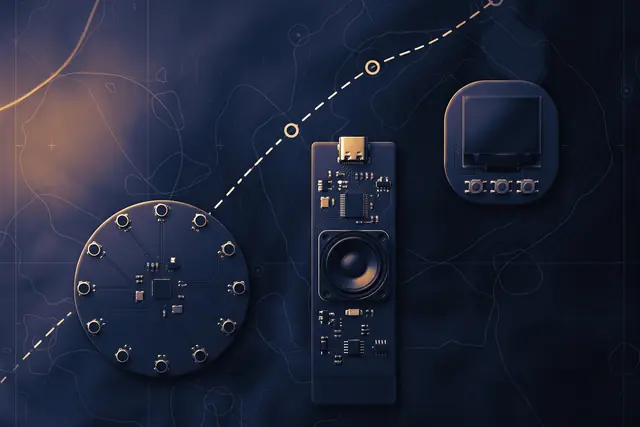
Anthropic says its AI model Claude Fable 5.2 designed three prototype devices that worked without electrical modifications, with no outside test reported.

NVIDIA GR00T 2
Five demonstrations per task
By NVIDIA's own test, its robot model GR00T 2 averages 95% success after five demonstrations of a task, on 50 tasks picked from those it learns that way.

Muse Ember
The jobs agents repeat
Meta's Muse Ember matched Claude Haiku 5.5 on an outside firm's tests at a third of the cost per task, though both list the same prices for text in and out.

Agentic robotics
Readable robot programs
A UC Berkeley lab has AI agents write readable robot programs, which scored below human-written ones in all twelve of its own test conditions on one simulator.

Microsoft ThinkingBox
All twenty times
By Microsoft's own count, 50 steps of training took an AI model from passing 38 of 507 test tasks on all 20 tries to passing 107.

Inkling 2 Small
Checked without being asked
The maker of Inkling 2 Small, Thinking Machines, says the AI model checks its work without being asked, a habit that no published test measures.
Open in contech
3 of 20 open deliverables
Open · Design and model tools
A shared clash test set
A public set of real clashes, each marked by human coordinators as "needs fixing" or "ignore", with a scoring script, so that any method for sorting clashes can be measured on the same data. Today a BIM coordinator decides which raw clashes are real problems; research programs try to copy that decision.
Built with what exists
the open Schependomlaan dataset, a real Dutch housing project with an Archicad model in IFC and the clash issues raised in a Solibri quality check, saved as BCF and shared for research use (DOI 10.17605/OSF.IO/NE2YU); IfcClash from the open-source IfcOpenShell project, which finds clashes in IFC models and exports them as BCF or JSON; and, as sorting methods to score, a fixed rule set, a low-cost classifier such as Gemini Decision 1 (see the Note "A thousand questions, one pass"), and a model that reads both the clash snapshot and its text, fine-tuned on one GPU as with Liquid LFM3 (see the Note "One GPU to fine-tune"). The advance is cheap classification and one-GPU fine-tuning of models that read images and text together.
Open · Estimating
A planted-gap bid-leveling test
A public test set for bid leveling. Take one public project's drawings and specifications and write about 30 mock subcontractor quotes across six trades. Plant known problems in them: exclusions, conditions, missing addendum acknowledgements, arithmetic slips like the Kokolakis formula error, and gaps that every bidder for a trade leaves out. Publish the quotes, a scope baseline and the answer key, then score tools against it.
Built with what exists
pdfplumber, an open-source library that pulls text and tables out of PDF quotes; general AI models from Anthropic (Claude), OpenAI and Google (Gemini); a small extraction model such as Meta Muse Ember (see the Note "The jobs agents repeat"); repeated runs to check that a tool gives the same answer each time (see the Note "All twenty times"); a spreadsheet for the answer key.
Open · Scheduling
Judge each schedule link
A reviewer that reads each task's name and its links in a schedule file and flags links that make no building sense, such as carpet laid before the doors it should follow. It would use a language model to judge each link and plain graph checks to trace what each bad link pushes or hides on the critical path. It would output a ranked list of suspect links, each with a reason.
Built with what exists
MPXJ, a free library that reads Primavera P6 (XER), Microsoft Project and Asta Powerproject files; a current language model such as Claude Fable 5.2 (see the Note "Three working devices"); the Python graph library NetworkX; and real project schedules from DSLIB, a public set of 231 real projects kept by Ghent University's Operations Research and Scheduling group. The advance that makes this possible is language models that know the usual order of building trades from task names alone.