Industries / Figureheads
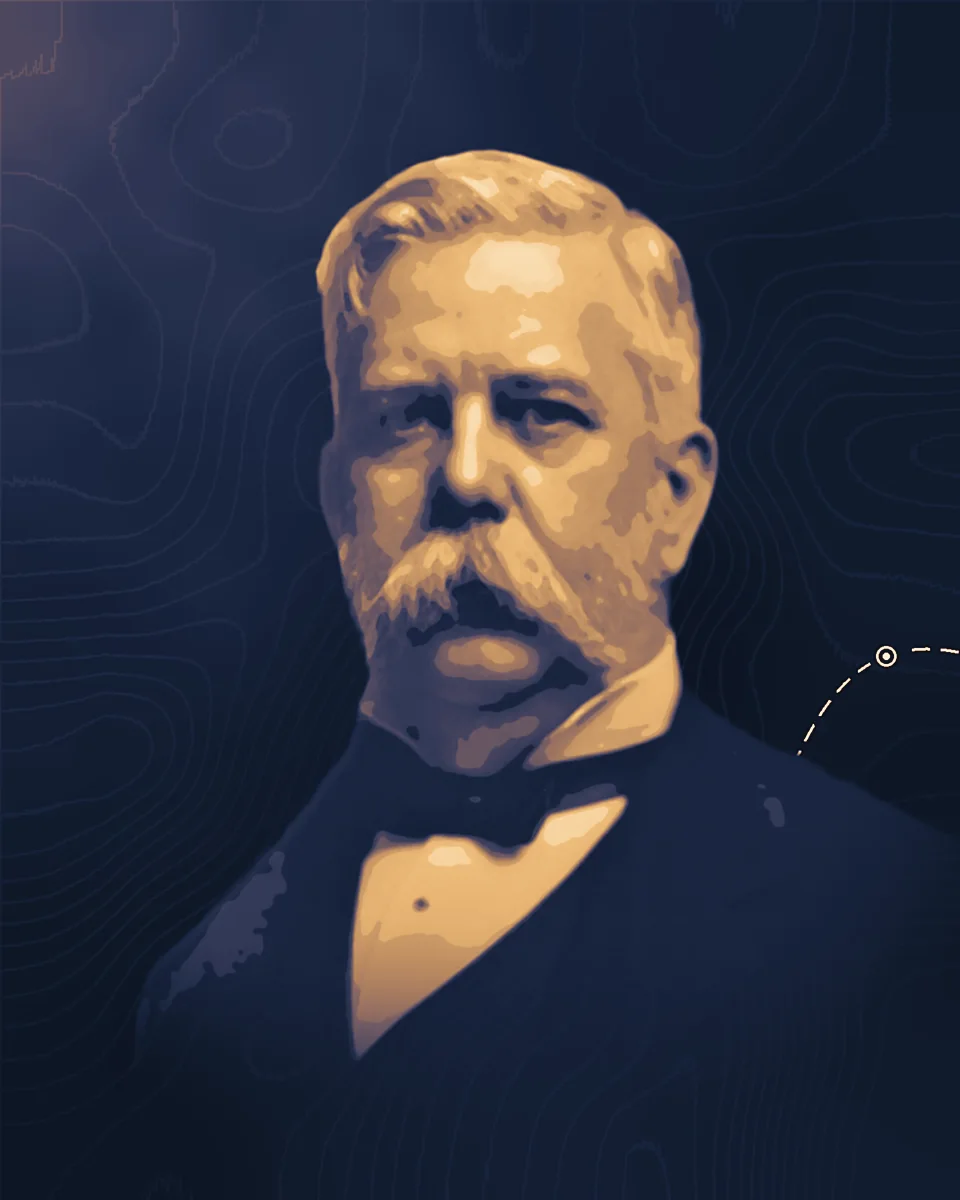
George Westinghouse
He put his company behind alternating current when American stations ran on direct current, and built the generators at Niagara Falls that settled the question.
1846–1914
What they changed
1869
Brakes worked by air
Westinghouse patented an air brake in 1869 and organized the Westinghouse Air Brake Company the same year. It let the engine driver work the brakes on every car from the locomotive. With automatic features added, it was made compulsory on American trains by the Railroad Safety Appliance Act of 1893.
1885
Alternating current comes to Pittsburgh
In 1885 he imported a set of transformers designed by Lucien Gaulard and John Gibbs and a Siemens alternating-current generator, and set up a system in Pittsburgh. A transformer raises or lowers the voltage of alternating current, so power can be sent far at high voltage and used at low. With three American engineers he improved the transformer and developed a generator that held its voltage steady.
1886
A company for alternating current
He incorporated the Westinghouse Electric Company in 1886. On 20 March that year William Stanley lit shops and offices in Great Barrington, Massachusetts, from a Siemens generator and transformers of his own design, in what IEEE calls the first practical system of electric lighting by alternating current with transformers.
1888
Tesla's patents
He bought Nikola Tesla's patents for an alternating-current motor and hired Tesla to fit the motor to the Westinghouse system.
1893
Chicago and Niagara
His company lit the World's Columbian Exposition in Chicago in 1893 and won the right to equip Niagara Falls with alternating-current generators. The Adams plant there began supplying power on 26 August 1895. IEEE calls it "a key victory for alternating-current systems over direct-current."
Life
George Westinghouse was born on 6 October 1846 at Central Bridge, New York, the eighth of ten children. His father made farm machinery, and the boy tried out his ideas in the shop. He served in both the Union army and the navy in the Civil War, and received his first patent, for a rotary steam engine, late in 1865.
Railroads made him rich. After the air brake he bought signalling patents, added his own, and built a complete signal system worked by electricity and compressed air. Britannica says that as the brake spread he saw the value of making all the equipment to one standard, so that cars from different lines worked together, and that he was among the first to adopt the practice. From 1883 he applied what he knew of air to piping natural gas safely, and took 38 patents for it in two years.
His part in electricity was that of organizer and backer more than inventor. The transformer came from Gaulard and Gibbs and was reworked with the help of three American engineers. The motor came from Tesla. What he supplied was the judgment that alternating current would win, the money and the factories. IEEE's history says he was "chiefly responsible for the spread of alternating current (AC) electricity in the United States."
The backers of direct current tried to discredit his system as a danger to life. Britannica records that they had a standard Westinghouse generator brought in as the means of executing death sentences in New York State. It did not stop the system from spreading.
By the turn of the century he had some 60 companies to his name, by the American Society of Mechanical Engineers' count. In the financial panic of 1907 the banks called in his loans and he lost control of the electric company. By 1911 he had cut all ties with his companies, and that year the American Institute of Electrical Engineers gave him its Edison Medal "for meritorious achievement in invention and development of alternating current systems and apparatus." He died in New York City on 12 March 1914.
Read more
4 accounts
A Life of George Westinghouse, Henry G. Prout, 1921.
The first full biography, written for the American Society of Mechanical Engineers by a railway engineer who knew him.
archive.org
George Westinghouse, IEEE History Center, Engineering and Technology History Wiki, undated. The electrical engineers' short life, with the Edison Medal citation.
ethw.org
Milestones: Alternating Current Electrification, 1886, IEEE History Center, 2004.
The record of Stanley's system at Great Barrington: the generator, the transformers and the voltages.
ethw.org
Milestones: Adams Hydroelectric Generating Plant, 1895, IEEE History Center, 1990.
The record of the Niagara plant.
ethw.org
Industries
Power generationRailRailcar manufacturingElectric transmission and distribution