Industries / Government, education and community / Government
Libraries
Libraries, as mapped here, are the public, school and university institutions that choose, describe, lend and keep books and other materials, run programs and classes, and give people free access to information and the internet.
1850
Britain passed William Ewart's Public Libraries Act. Moving the bill in the House of Commons on 14 February 1850, Ewart said it would let any town council set up a library and museum, pay for the building from a small local rate, and "admit the public gratuitously".
42
Milestones achieved across 6 domains.
17
To watch for: announced, not yet confirmed outside.
13
Open deliverables. Nobody has shipped them.
In one minute
Where it started
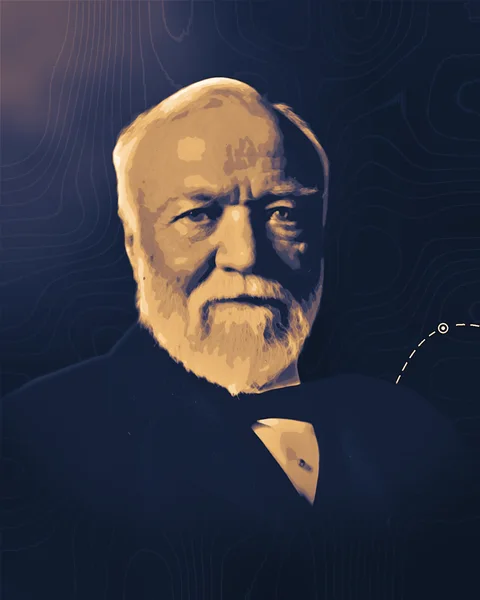
Libraries that anyone may use free, paid for by taxes, are younger than libraries themselves. The Digital Public Library of America dates "the first totally tax-supported library" to Peterborough, New Hampshire, in 1833, and Britain's 1850 Act let town councils open free libraries. Andrew Carnegie and his foundation then paid for 2,509 library buildings, 1,681 of them in the US, and the last building grants came in 1917.
Where it stands
In 2017 IFLA's Library Map of the World held data on about 2 million libraries in 99 countries, as reported by Japan's National Diet Library. Much of the work now runs on shared data and licences: WorldCat, the shared catalogue, holds about 610 million records, OverDrive counted 820.5 million digital loans from libraries in 2025, and publishers' licence terms decide how long a library may lend an e-book. Libraries are also contested ground. The American Library Association tracked 4,235 challenged titles in 2025, the British Library's research services were still not fully restored three years after a 2023 ransomware attack, and US federal library funding survived a 2025 shutdown order only through the courts.
What is open
Most open jobs here are public tests of the AI tools now being sold to libraries, for cataloguing, research help, book screening and reading handwriting, against answer keys that librarians check. Others are public counts nobody keeps: what programs libraries run, when they dropped fines, what universities pay for journals and which books are challenged in the UK. Each can be started this month with public data, open-source tools and current AI models, without touching any borrower's records.
Domains
AchievedWatch forOpen
Domain
Progress
Last achieved
Watch for
Open
Collections
Choosing, buying, licensing and removing what a library holds, and defending those choices when someone objects.
7 · 2 · 3
Last achievedA province orders removals2025
Watch forLimits on e-book contracts
3
openCataloguing
Describing and classifying each item, a book, journal or recording, so that people and computers can find it.
7 · 3 · 2
Last achievedAI merges duplicate records2023
Watch forLC's machine-drafted MARC records
2
openLending
Getting items to people and back: checkout and return, fines, loans between libraries, outreach vans, self-service machines and digital lending.
7 · 3 · 2
Last achievedCourt rules against scan-and-lend2024
Watch forHumanoid robots shelve library books
2
openDigital services
What libraries offer through screens and networks: online catalogues, public computers and internet, scanned books, licensed journals, help by chat, accessible copies for readers who cannot use print, and the security of all of it.
7 · 3 · 2
Last achievedAI answers inside the catalogue2024
Watch forEvidence cards on AI answers
2
openPrograms and teaching
What libraries do beyond lending: story times and reading programs for children, teaching students to find and judge information, classes and maker spaces, help with jobs and social services, and the building as a place to gather.
7 · 3 · 2
Last achievedCourts reverse IMLS shutdown2025
Watch forMicrosoft and PLA AI training
2
openArchives and preservation
Keeping old, rare and fragile material usable: special collections and the papers libraries hold, repairing damaged books, copying them to film or digital files, long-term digital preservation and archiving the web.
7 · 3 · 2
Last achievedSoftware reads old handwriting2019
Watch forGemini 3 reads old handwriting
2
open
Figureheads
1 person
Advances to build with
2 research notes
Cursor Agent SDK
Findings that cite notes
Cursor released a kit for building AI agents, and its example, a code reviewer that cites the note behind each finding, is known only from Cursor's account.
Inkling 2 Small
Checked without being asked
The maker of Inkling 2 Small, Thinking Machines, says the AI model checks its work without being asked, a habit that no published test measures.
Open in libraries
3 of 13 open deliverables
Open · Collections
Scoring AI book screeners
A public answer key for about 200 frequently challenged titles on one fixed yes/no question taken word for word from a statute, such as Iowa SF 496's test of whether a book contains "descriptions or visual depictions of a sex act". Two librarians label each title from the book itself and cite page numbers. Several AI tools then get the same question from title and author only, which is how Mason City, Iowa, asked ChatGPT in 2023, and each is scored against the key.
Built with what exists
title lists from ALA's 2025 most-challenged list; Gemini Decision 1 to put the fixed yes/no question to each title at scale and return a probability for each answer (see the Note "A thousand questions, one pass"); Claude, Gemini and GPT as tools under test; a local model through llama.cpp for runs that can be repeated exactly (see the Note "A first stable number for local AI"). Book texts stay in library-owned copies, and only labels and page numbers are published.
Open · Cataloguing
Score shipped AI cataloguing tools
A public test set of 300 print books. For each, four phone photos (title page, the back of the title page, contents page and back cover) are paired with the cataloguer-made MARC record for that edition. The same photos go through Alma's AI Metadata Assistant, OCLC's suggestions, Claude, Gemini, GPT and one local model, and each is scored field by field: ISBN, names, title, edition, publication details, extent, subjects and class numbers, with every heading checked against the authorised form. Publish images only for books whose pages may be shared, such as openly licensed or public-domain books.
Built with what exists
Claude, Gemini and GPT vision models, and a local model through llama.cpp (see the Note "A first stable number for local AI"); Alma and OCLC's tools through a subscribing library; pymarc and MarcEdit to check and score records; LC's id.loc.gov service to check headings.
Open · Lending
Phone shelf-reading, scored by hand
A tool that takes phone photos or a slow video pan of a shelf, reads the call-number label on each spine (the shelf address printed on the label), and lists every book out of order. It is scored in public against a librarian's hand check of the same shelves, a routine task called shelf-reading.
Built with what exists
a phone camera; open-source text readers such as PaddleOCR or Tesseract, or a vision-language model such as Claude, Gemini or GPT, to read labels; a short sorting function for Dewey or LC call numbers; a local model to keep photos on a laptop (see the Note "A first stable number for local AI"); a spreadsheet for the hand count.
Where it sits
Broader