Industries / Figureheads
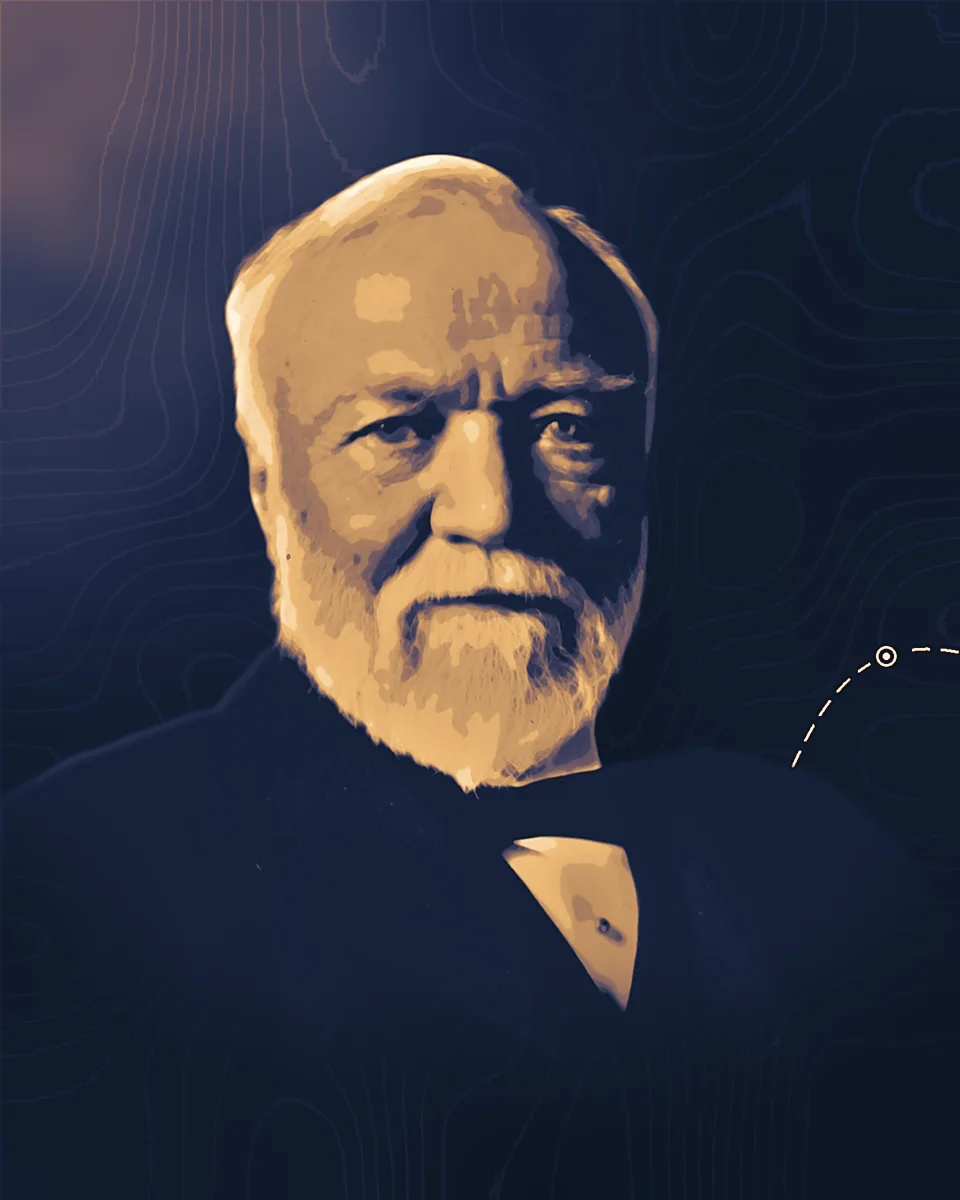
Andrew Carnegie
He argued that the rich should give their fortunes away while they lived, and set up the large trustee-run foundation that later grantmakers copied.
1835–1919
What they changed
1881
Libraries the town must keep
Carnegie gave his first library to his birthplace, Dunfermline in Scotland, in 1881. He and later his foundation gave some $56 million for 2,509 public library buildings, 1,681 of them in the United States, by his foundation's count. Each gift came on the condition that the town would pay to run the library, which made his money draw public money after it.
1889
The Gospel of Wealth
In two articles in the North American Review, Carnegie wrote that the rich were trustees of their wealth and should spend it on the "general good" while they lived: "The man who dies thus rich dies disgraced." He called most charity of his day wasteful and named universities, libraries, hospitals, parks and meeting halls as the best uses for a fortune.
1902
Boards free to change aims
After he sold his steel business to J. P. Morgan in 1901 for $480 million, Carnegie endowed one institution after another: the Carnegie Institution for research in 1902 and a $10 million pension fund for teachers in 1905, among them. By 1911 he had endowed five organizations in the United States and three in Britain. He gave each board the power to change its aims, writing to the trustees of his last that they "shall best conform to my wishes by using their own judgment."
1911
A trust for knowledge
He set up Carnegie Corporation of New York "to promote the advancement and diffusion of knowledge and understanding", and by 1912 had given it $125 million. The Philanthropy Roundtable's magazine writes that it, with the Russell Sage Foundation of 1907 and the Rockefeller Foundation of 1913, "marked the beginning of the modern era of foundation philanthropy", and that its approach "has served as a model for many other foundations".
Life
Andrew Carnegie was born on 25 November 1835 in Dunfermline, Scotland, the son of a hand-loom weaver. When steam looms reached the town in 1847 his father lost his work, and in 1848 the family emigrated to Pittsburgh. At 12 Andrew worked as a bobbin boy in a cotton mill for $1.20 a week, then as a telegraph messenger. In 1853 he became telegrapher and assistant to Thomas Scott, superintendent of the Pennsylvania Railroad's western division.
From the railroad he moved into iron bridges, telegraph lines and then steel. He opened the Edgar Thomson steel works in 1875, bought the rival Homestead Works in 1883 and joined his steel companies into Carnegie Steel in 1899. In 1901 J. P. Morgan bought him out for $480 million, which let Morgan form US Steel and, by PBS's account, made Carnegie the richest man in the world.
His steel business fought its unions. In 1892 his manager Henry Clay Frick set out to cut wages and break the steelworkers' union at Homestead, and Carnegie, in Scotland, backed him by cable: "We are with you to the end." Frick locked out 3,800 men and brought in 300 armed Pinkerton agents by river barge. In the fight on 6 July 1892 nearly a dozen people died, and the governor sent 8,500 troops. PBS records that after the union gave in, Carnegie cut wages, imposed 12-hour days and cut 500 jobs. In his autobiography he wrote: "No pangs remain of any wound received in my business career save that of Homestead."
His giving drew criticism in his own time. The British statesman William Gladstone defended the right of the rich to keep what they inherited, and the Methodist minister Hugh Price Hughes called the Gospel of Wealth "anti-Christian", arguing that the way such fortunes were made was the real problem. Carnegie had already decided to give most of his money away: his wife signed an agreement before their marriage in 1887 that acknowledged it.
He spent his last years on the cause of peace, and paid for the Peace Palace at The Hague, opened in 1913. The outbreak of war in 1914 depressed him, by the Philanthropy Roundtable's account, and he left Scotland for the last time. He died at his estate, Shadowbrook, in Lenox, Massachusetts, on 11 August 1919. His foundation took the name Andrew Carnegie Foundation in 2026.
Read more
6 accounts
The Gospel of Wealth, Andrew Carnegie, 1889.
The two essays, in an annotated edition from the foundation he set up.
carnegie.org
Autobiography of Andrew Carnegie, Andrew Carnegie, Houghton Mifflin, 1920.
His own account, published the year after his death, with his chapter on Homestead.
archive.org
Andrew Carnegie, Joseph Frazier Wall, University of Pittsburgh Press, 1989.
A reissue of the long scholarly life first published in 1970.
archive.org
Andrew Carnegie, David Nasaw, Penguin Press, 2006.
A full life by a historian, from Dunfermline to the foundations.
archive.org
The Strike at Homestead Mill, American Experience, PBS, 1997.
The companion to the film Andrew Carnegie: The Richest Man in the World, with Carnegie's cables to Frick.
pbs.org
The Carnegie Corporation Turns 100, Philanthropy magazine, Philanthropy Roundtable, 2011.
An essay on the Gospel of Wealth, its critics and what the foundation did with its founder's money.
philanthropyroundtable.org