Industries / Figureheads
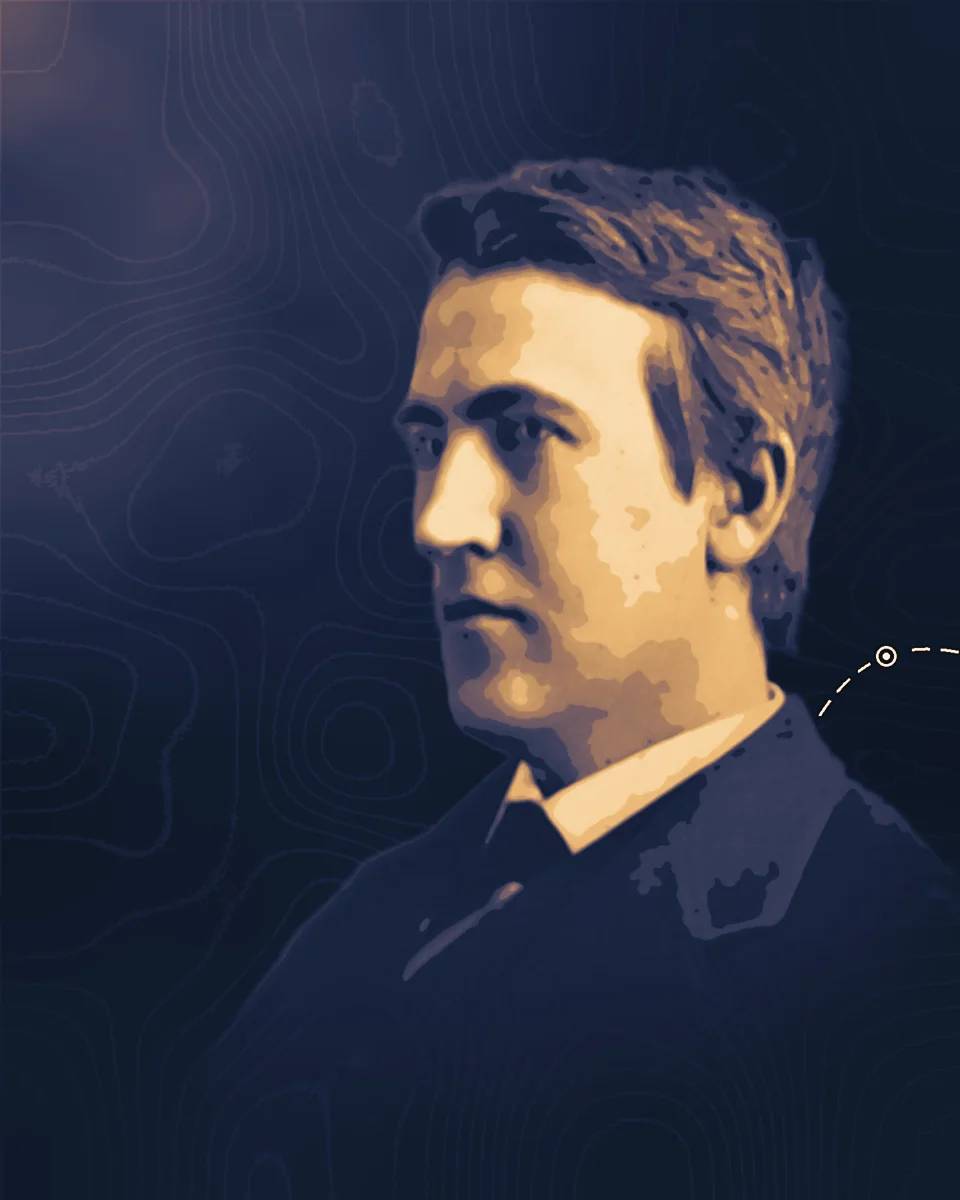
Thomas Edison
He built the first permanent central power station, which sold electric light to a whole district from one plant, and the lamps, dynamos and underground wiring to go with it.
1847–1931
What they changed
1879
A lamp that lasted
After about a year and a half of work at Menlo Park, New Jersey, a lamp with a filament of carbonized sewing thread burned for 13.5 hours. Edison showed the lamp and the system around it to the public in December 1879.
1882
A trial in London
An Edison station under Holborn Viaduct in London began running on 12 January 1882 and worked for about two years. IEEE's history says it proved that a central station could be made to work.
1882
Pearl Street sells power
On 4 September 1882 his station at 257 Pearl Street, New York, began supplying direct current to about 85 customers with about 400 lamps, in a district of a quarter of a square mile. Six "Jumbo" dynamos of about 100 kW each were driven by steam engines fed from four coal-fired boilers. IEEE calls it "the first permanent central power station for supplying incandescent lighting" and "the forerunner of all central electric generating stations."
1883
Three wires, less copper
The copper mains were the most expensive part of Pearl Street. Edison replaced the two-wire layout with a three-wire one at 220 volts, which needed far less copper, and attended the opening of the first three-wire central station at Sunbury, Pennsylvania, on 4 July 1883.
1888
A campaign against alternating current
Edison held that alternating current at high voltage did not belong in wires over public streets. From July to December 1888 he ran electrocution experiments on dogs and other animals at his West Orange laboratory, and he called his rival's system the "executioner's current." New utilities chose alternating current anyway in the 1890s, because it was cheaper to build and run.
Life
Thomas Alva Edison was born on 11 February 1847 in Milan, Ohio. He went to school for only a few months. His mother taught him to read, write and do arithmetic, and he taught himself the rest. At about 13 he sold newspapers and candy on the railroad between Port Huron and Detroit, where he learned to work a telegraph, and by 16 he was a full-time telegrapher.
His first patent, for an electric vote recorder in 1868, was a commercial failure. An improved stock ticker earned him $40,000 in New York, which paid for a laboratory in Newark, New Jersey, in 1871. In 1876 he moved his family and his assistants to the village of Menlo Park, where the phonograph followed in 1877 and the lamp in 1879.
The lamp was one part of a system. Edison set up companies to make lamps, dynamos and fittings, and began laying underground conductors in lower Manhattan in the spring of 1881. IEEE's history says he was his own chief engineer on every phase of Pearl Street. He did not work alone or from nothing: the Jumbo dynamo was adapted from an earlier design by Werner Siemens, J. Pierpont Morgan was a principal investor, and the chief electrician John W. Lieb closed the switch on the first day. Within a year the station served 513 customers and about 10,000 lamps.
His direct current could not be sent far, and he fought the alternating-current system that could. The Edison Papers project at Rutgers University calls the rivalry of the late 1880s a feud and says his motives were mixed, some of them self-serving. The animal experiments at his laboratory were among the things that led New York State to adopt the electric chair, and Edison testified in the court case of William Kemmler, the first man sentenced to die in it. He won a lawsuit over the lamp and lost the contest over current.
His companies merged into Edison General Electric in 1889. In 1892 that firm merged with Thomson-Houston to form General Electric, his name was dropped, and he left the lighting business. He worked on at the five-building laboratory he had opened at West Orange, New Jersey, in November 1887, and died on 18 October 1931.
Read more
4 accounts
The Thomas A. Edison Papers, Rutgers University, ongoing. The scholarly edition of his notebooks and letters, with a year-by-year chronology.
edison.rutgers.edu
The Current Wars, Thomas A. Edison Papers, Rutgers University, undated. A short essay on the contest with Westinghouse, with the documents behind it.
edison.rutgers.edu
Milestones: Pearl Street Station, 1882, IEEE History Center, 2011.
The engineering account of the station: dynamos, conductors, customers and the 1890 fire.
ethw.org
Edison: His Life and Inventions, Frank Lewis Dyer and Thomas Commerford Martin, 1910.
The two-volume authorized life, written with his help and friendly to him.
archive.org
Industries
Power generationGeneratorsElectric transmission and distribution