Industries / Figureheads
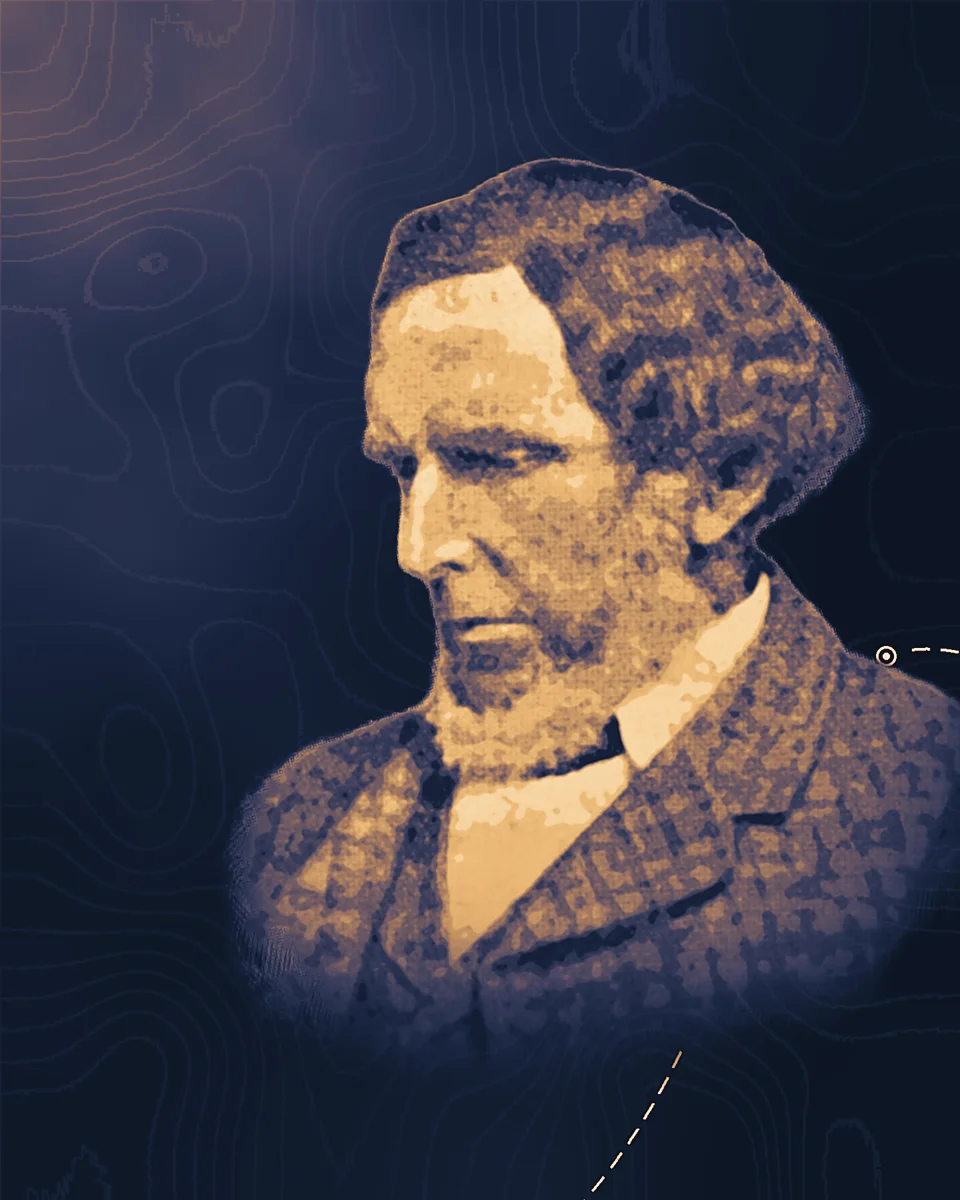
Robert Forester Mushet
He patented the dose of manganese that made converter steel sound, rolled an early steel rail, and made the first tool steel that hardens in air.
1811–1891
What they changed
1856
Manganese after the blow
Air blown through molten iron burns out the carbon and leaves oxygen combined with the metal. On 22 September 1856, about six weeks after Bessemer announced his process, Mushet patented adding "a triple compound" of iron, carbon and manganese to the blown metal. He used spiegeleisen, a manganese-rich iron he had first handled in 1848. The manganese takes up the oxygen and the compound puts back a measured amount of carbon, and a manganese addition after the blow became the standard way to finish converter steel.
1857
A steel rail at Derby
Mushet remelted failed converter metal from the Ebbw Vale works with spiegeleisen and had it rolled into a double-headed rail. It was laid early in 1857 at Derby station, at a spot where iron rails wore out in months, and in 1863 it "seemed as perfect as ever", by the account Grace's Guide reprints.
1868
Steel that hardens in air
Tool steel was hardened by heating it and plunging it in water. Mushet's steel, alloyed with tungsten, hardened as it cooled in air. The Science Museum Group, which holds a piece of the original ingot of 1868, calls "R Mushet's Special" the forerunner of many tool steels, high-speed steel among them, because it kept its hardness when cutting made it red hot.
1871
Tool steel moves to Sheffield
Mushet's Titanic Steel and Iron Company in the Forest of Dean was wound up in 1871, and the Sheffield firm of Samuel Osborn took over the special steel and made it there from 1872. Between 1880 and 1900 many other steelmakers brought out self-hardening steels of their own.
Life
Robert Forester Mushet was born on 8 April 1811 at Coleford in the Forest of Dean, Gloucestershire, the youngest son of David Mushet, a Scottish metallurgist and ironmaster. He learned the trade helping with his father's experiments and worked at Coleford. Forestry England, which looks after the ruins, says father and son "carried out secret experiments with iron and steel" at the Darkhill ironworks, and that Robert built his Titanic Steelworks on the same site.
In 1856 he was a consultant to the Ebbw Vale Iron Works in South Wales, which was trying to get round Bessemer's patents. He took out three patents on 16 September 1856 and two more on the 22nd. He was not free to deal with them as he liked, by his own admission, and in 1859 the stamp duty that would have kept the main patent alive was not paid. Mushet called it an accident. The Smithsonian historian Philip Bishop thought Ebbw Vale had let the patents go because it no longer expected to win a lawsuit. From then on anyone could use the method, and Bessemer did.
How much Bessemer owed him was argued for the rest of both their lives and is not settled. Mushet said in letter after letter to the trade papers that his process had made Bessemer's work. Bessemer answered that manganese in steelmaking was known before Mushet and that the patents had only "pointed out to me some rights which I already possessed". In December 1866 Mushet's daughter called on Bessemer to ask for help to save the family home. Bessemer paid the debt, and from about 1867 gave Mushet £300 a year until he died, saying he wanted "to make him my debtor rather than the reverse". In 1876 the Iron and Steel Institute awarded Mushet its Bessemer gold medal.
Later judgments are mixed. Bishop, in 1959, wrote that Mushet's "sometimes absurd claims to priority of invention" of nearly every new idea in iron and steel "progressively reduced the respect for his name". He allowed that the opinion of later metallurgists may be sound, and that Mushet and Bessemer had each worked successfully at the same problem. His own conclusion was that "Bessemer owed more to the development work of his Swedish licensees than to Mushet."
The royalties on the special steel and Bessemer's allowance kept him in reasonable comfort, by Bishop's account. In 1883 he published his own version of events, The Bessemer-Mushet Process; or, Manufacture of Cheap Steel. He died at Cheltenham in January 1891, aged 79.
Read more
5 accounts
The Beginnings of Cheap Steel, Philip W. Bishop, Smithsonian Institution, 1959.
The fullest outside test of Mushet's claims, from his own letters to the trade press. It is hard on him.
gutenberg.org
Mushet, Robert Forester, R. B. Prosser, Dictionary of National Biography, 1894.
The national biography's entry, by a historian of patents, with the patent numbers and dates.
en.wikisource.org
Sir Henry Bessemer, F.R.S.: An Autobiography, Henry Bessemer, 1905.
Chapter 18 is his opponent's account of manganese, the visit of Miss Mushet and the allowance.
archive.org
Robert Mushet, Grace's Guide to British Industrial History, undated. Reprints The Engineer's 1869 article on his new tool steel and the account of the Derby rail.
gracesguide.co.uk
Darkhill Ironworks, Forestry England, undated. The keeper's page for the ruins of the Mushets' works near Coleford, which can be visited.
forestryengland.uk