Industries / Figureheads
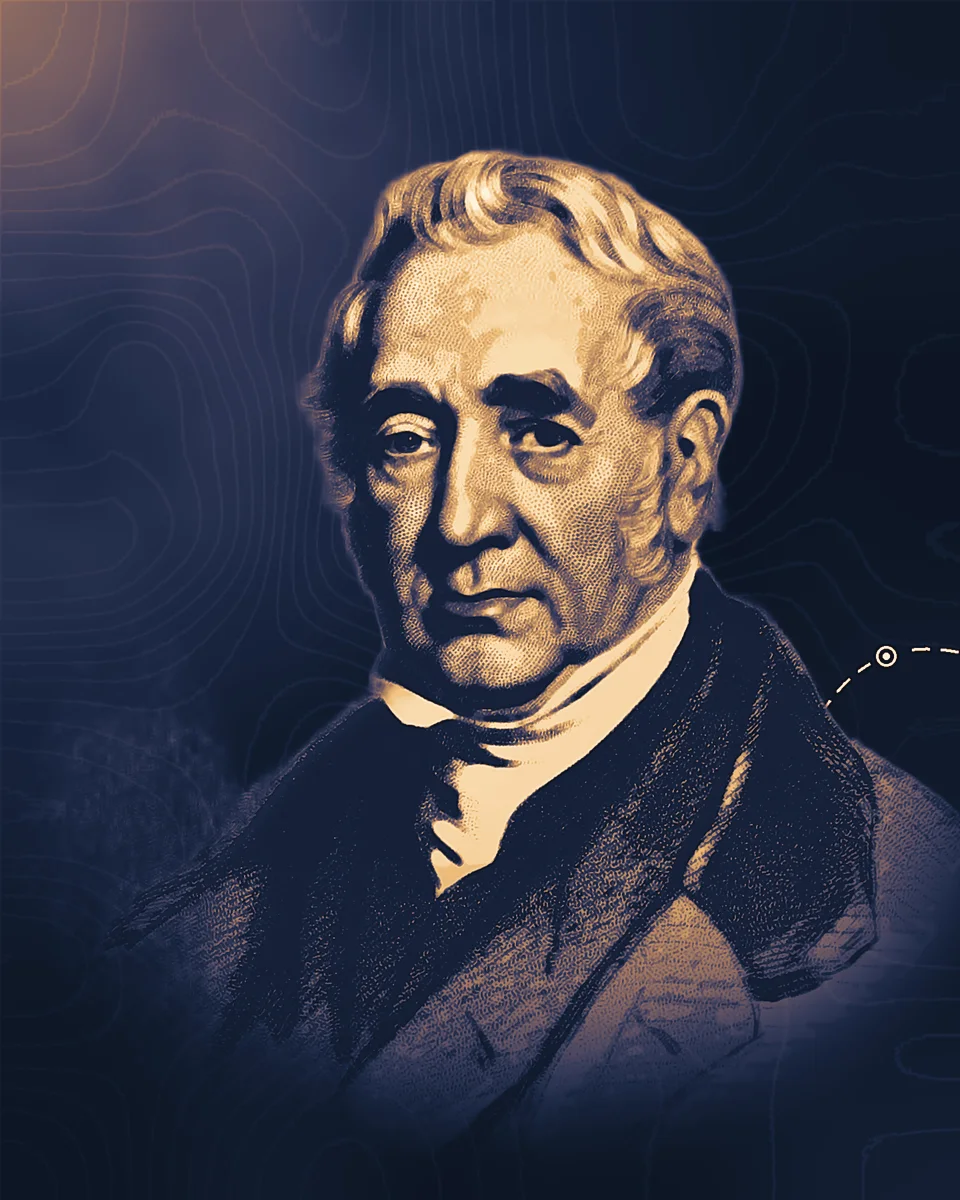
George Stephenson
A colliery engineman who taught himself to read, he built the Stockton and Darlington and the Liverpool and Manchester railways, and his 4 ft 8½ in gauge became the standard for railways.
1781–1848
What they changed
1815
A lamp for the pits
As engine-wright at Killingworth colliery, Stephenson made a miners' safety lamp, the "Geordie" lamp, whose flame would not set off the gas in a coal mine, and tested it in a gassy part of the mine in 1815. Humphry Davy made a lamp of his own, and the two men fell into a dispute over who came first. In 1817 Stephenson published a description of his lamp, with engravings and an account of Davy's.
archives.imeche.orgcollection.sciencemuseumgroup.org.ukwellcomecollection.org
1825
Steam on a public railway
The Stockton and Darlington Railway was approved by Parliament in 1821 as a horse-drawn line. Its backer Edward Pease discussed steam locomotives with Stephenson, who became its engineer that year, and the line was redesigned in 1823 to be steam-hauled for much of its 26 miles. On 27 September 1825 his engine Locomotion hauled the opening train, which Historic England says carried 600 passengers, and the line became, in its words, "the world's first standard-gauge, steam-hauled public railway".
1830
The first intercity line
The Liverpool and Manchester Railway named Stephenson its chief engineer. Its first bill failed in Parliament in 1825 and a second passed in 1826. His 31-mile line needed a 2,250-yard tunnel from the Liverpool docks to Edge Hill, the nine-arch Sankey Viaduct and a crossing of the "almost bottomless marsh of Chat Moss". It opened on 15 September 1830, and the University of Manchester Library calls it "the first exclusively steam-powered railway in the world", "the first inter-city railway" and "the first railway to be fully timetabled".
1846
One gauge for Britain
Stephenson laid his lines with rails 4 ft 8½ in apart, a measure that Network Rail's archive says "came from George's experience of the colliery railways of the early 1800s". Isambard Kingdom Brunel built the Great Western to a broad gauge of 7 ft ¼ in, and the two men fought over whose gauge should be the standard. The Railway Regulation (Gauge) Act 1846 restricted the broad gauge, and the last of it was taken up in May 1892.
Life
George Stephenson was born on 9 June 1781 at Wylam, Northumberland, in one room of a labourers' cottage, by the account of his first biographer, Samuel Smiles. His father, Robert, fired the pumping engine at the Wylam colliery. The Institution of Mechanical Engineers (IMechE), whose first president he became, says he followed his father into the mines and was "not educated" but "technically able and prepared to learn". The Science Museum Group dates his first lessons in reading and writing to 1799, when he was 18. He was a brakesman, working a pit's winding engine, at Black Callerton in 1801 and moved to West Moor colliery at Killingworth in 1804.
archive.orgarchives.imeche.orgcollection.sciencemuseumgroup.org.uk
He married Fanny Henderson, a farm servant, in 1802, and their son Robert was born in 1803. At Killingworth he rose to look after the colliery engines, and his first locomotive, the Blücher, was built there in 1814. The safety lamp made him enemies. Davy and his supporters rejected his claim, and Stephenson's friends raised about £1,000 for him, presented at a dinner in Newcastle in January 1818, by Smiles's account. A parliamentary report of 1835 that Smiles quotes counted 447 deaths in the mines of Durham and Northumberland in the 18 years before the lamps and 538 in the 18 years after, as dangerous mines were reopened.
archive.orgcollection.sciencemuseumgroup.org.ukarchives.imeche.org
His railways were not his work alone. Rocket, the engine that won the Liverpool and Manchester's Rainhill trials in 1829, was built by Robert Stephenson and Company of Newcastle, and the Science Museum Group names Robert as its designer. Timothy Hackworth was the Stockton and Darlington's principal engineer, and from 1833 built locomotives at his own Soho Works. Edward Pease, a Quaker investor and Darlington merchant, was the one who discussed steam with Stephenson before the line was redesigned.
The Liverpool and Manchester's opening day brought the first death of a railway passenger. William Huskisson, the member of Parliament for Liverpool, who had steered the railway's bill through Parliament, stepped down from his carriage to walk beside the trains, fell onto the other track and was run over by Rocket. He died that evening. Stephenson himself drove the Northumbrian, which hauled the Duke of Wellington's train.
Stephenson was engineer to many of the lines that followed. He retired in 1845, by the IMechE's account, and lived at Tapton House near Chesterfield, Derbyshire, where Smiles describes him growing pineapples, melons and grapes. In 1847 he became the first president of the IMechE, which counts his support for the young institution in his last year a lasting legacy. He died there on 12 August 1848, aged 67, after a fever and a sudden bleeding from the lungs.
Read more
5 accounts
The Life of George Stephenson, Railway Engineer, Samuel Smiles, 1857.
The first full biography, written within ten years of his death, and the source of most later accounts.
archive.org
George and Robert Stephenson: The Railway Revolution, L. T. C. Rolt, 1960.
A life of father and son by a historian of engineering, which weighs the credit between them.
archive.org
George Stephenson: A Biographical Study of the Father of the Railways, Hunter Davies, 1975.
A later full biography.
archive.org
A Description of the Safety Lamp Invented by George Stephenson, George Stephenson, 1817.
His own pamphlet on the Killingworth lamp, with engravings and an account of Davy's lamp.
wellcomecollection.org
The Liverpool and Manchester Railway, University of Manchester Library, 2022.
The library's account of the line's planning, building and opening day, with maps and plates from its collections.
rylandscollections.com