Industries / Figureheads
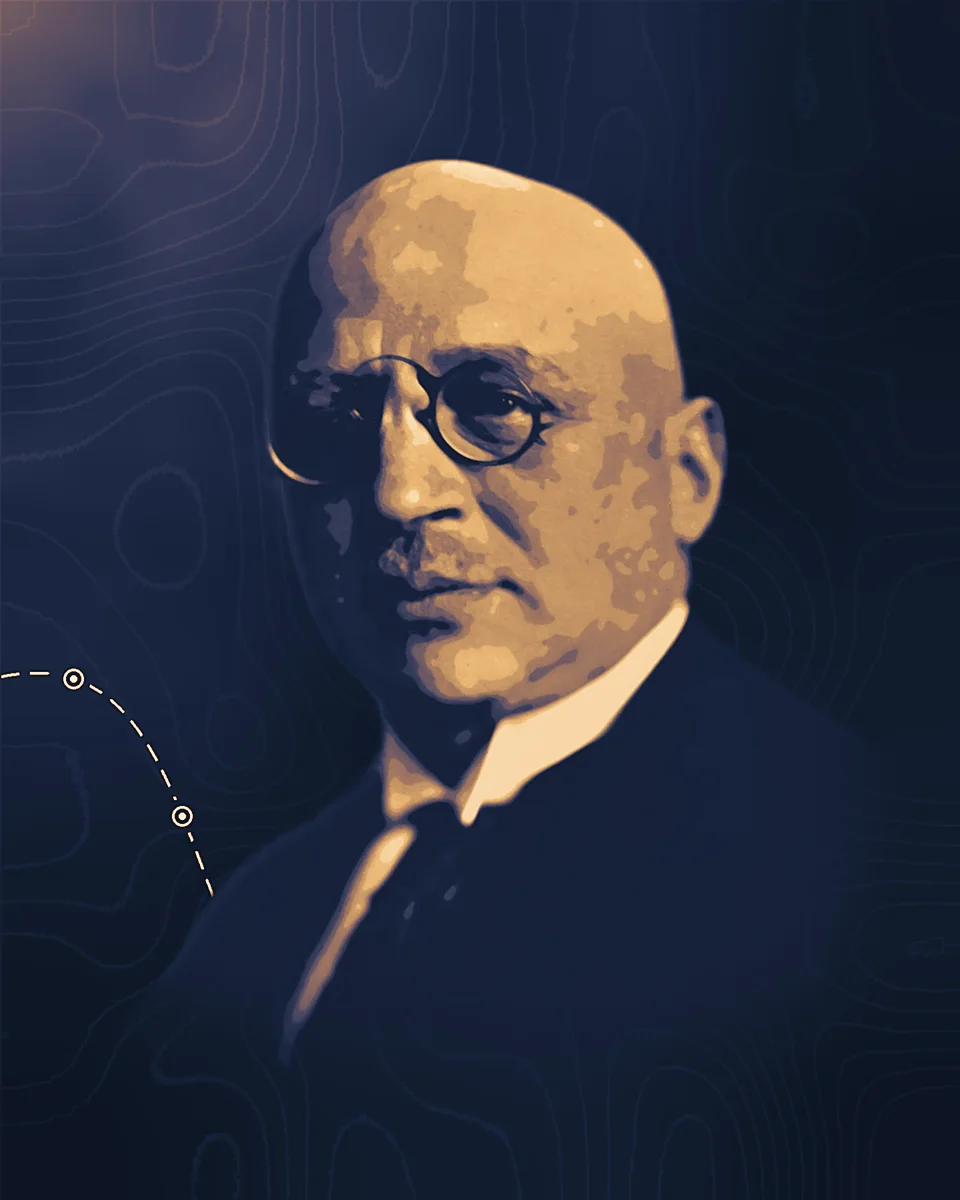
Fritz Haber
He found how to make ammonia from the nitrogen in air, the starting point for synthetic fertilizer.
1868–1934
What they changed
1909
Ammonia from air
At Karlsruhe, Haber and his co-worker Robert Le Rossignol passed nitrogen and hydrogen over a catalyst (a substance that speeds a reaction without being used up) at 150 to 200 atmospheres and about 500 °C, and built a small plant that fed the heat of the reaction back to the incoming gas. He filed the patent on 13 October 1908. A demonstration to BASF staff the next year persuaded the firm to build the process.
1913
A factory at Oppau
Carl Bosch, Alwin Mittasch and other BASF chemists turned the bench apparatus into a works at Oppau, Germany, that made 30 metric tons of ammonia a day from 9 September 1913. Erisman and colleagues (Nature Geoscience, 2008) estimate that nitrogen fertilizer made this way fed 48% of the world's people in 2008.
1915
Chlorine gas at Ypres
As an adviser to the German war ministry, Haber proposed poison gas as a weapon and supervised its first large release, of chlorine, at Ypres in Belgium on 22 April 1915. His institute became Germany's central laboratory for chemical weapons and gas masks. After the war the Allies named him a war criminal.
1919
A Nobel Prize, contested
He received the 1918 Nobel Prize in Chemistry, awarded a year late, "for the synthesis of ammonia from its elements." The Science History Institute records "great consternation" at the award because of his part in gas warfare.
Life
Fritz Haber was born on 9 December 1868 in Breslau, Prussia, now Wrocław in Poland, into a Jewish merchant family. He studied chemistry at Heidelberg, Berlin and Charlottenburg from 1886 to 1891 and converted to Protestantism in 1893. In 1894 he took an assistant's post at the technical college in Karlsruhe, where he stayed until 1911 and became professor of physical chemistry in 1906.
Plants need nitrogen in a form they can take up, and the air's nitrogen is not in that form. In 1905 Haber reported making small amounts of ammonia from nitrogen and hydrogen at 1,000 °C over iron. He dropped the problem, then took it up again in 1908 with Le Rossignol, working at high pressure with osmium and uranium as catalysts. BASF backed the work from 1908 and gave the scale-up to Bosch, whose team replaced the rare osmium with iron. In his Nobel lecture Haber thanked Le Rossignol by name.
In 1911 he became director of the new Kaiser Wilhelm Institute for Physical Chemistry and Electrochemistry in Berlin. When war came in 1914 he offered his services to the war ministry. The ammonia works kept Germany in nitrates for explosives after its imports failed, which the Nobel Foundation's biography says let it prolong the war. He then organized gas warfare. Erisman and colleagues link nitrogen from the process, as the base of the world's ammunition supply, to 100 to 150 million deaths in armed conflicts in the twentieth century.
During the war his gas teams also fumigated mills and granaries to kill insect pests, and after it he moved poison-gas research into pest control, in part to keep military work going out of sight. The historian Margit Szöllösi-Janze writes that chemists in the network he set up developed the cyanide fumigants Zyklon A and Zyklon B. About twenty years later Zyklon B was used to murder people in the extermination camps, a use she calls "absolutely beyond Haber's imagination."
From 1920 to 1926 he tried to extract gold from seawater to pay Germany's war reparations, and failed. In 1933 the Nazi government told him to dismiss his Jewish staff. His own dismissal was not demanded, but he resigned on 30 April 1933 and left for England that autumn. Germany's national history museum puts it that he came under pressure because of his Jewish descent. He died in Basel, Switzerland, on 29 January 1934.
Fertilizer from his reaction is also a pollution problem. In 2005 farms used about 100 million tonnes of nitrogen made this way, and people ate about 17 million tonnes of it in food, by Erisman and colleagues' figures. A large share of the rest was lost to the environment.
Read more
6 accounts
The Synthesis of Ammonia from Its Elements, Fritz Haber, Nobel lecture, 2 June 1920.
His own account of the work and of who helped.
nobelprize.org
The Scientist as Expert: Fritz Haber and German Chemical Warfare During the First World War and Beyond, Margit Szöllösi-Janze, Springer, 2017.
An open-access chapter by the author of the 1998 German biography.
link.springer.com
Making Ammonia: Fritz Haber, Walther Nernst, and the Nature of Scientific Discovery, Benjamin Johnson, Springer, 2022.
An open-access book on the discovery, 1903 to 1909.
link.springer.com
The Story of Fritz Haber, Morris Goran, University of Oklahoma Press, 1967.
A full biography in English.
archive.org
The Alchemy of Air, Thomas Hager, Harmony Books, 2008.
A history of Haber, Bosch and the process, written for general readers.
archive.org
How a Century of Ammonia Synthesis Changed the World, Jan Willem Erisman and colleagues, Nature Geoscience, 2008.
The count of people fed, people killed and nitrogen lost.
iai.int
Industries
Agriculture and farmingFertilizers and agrochemicalsChemicals and petrochemicals