Industries / Figureheads
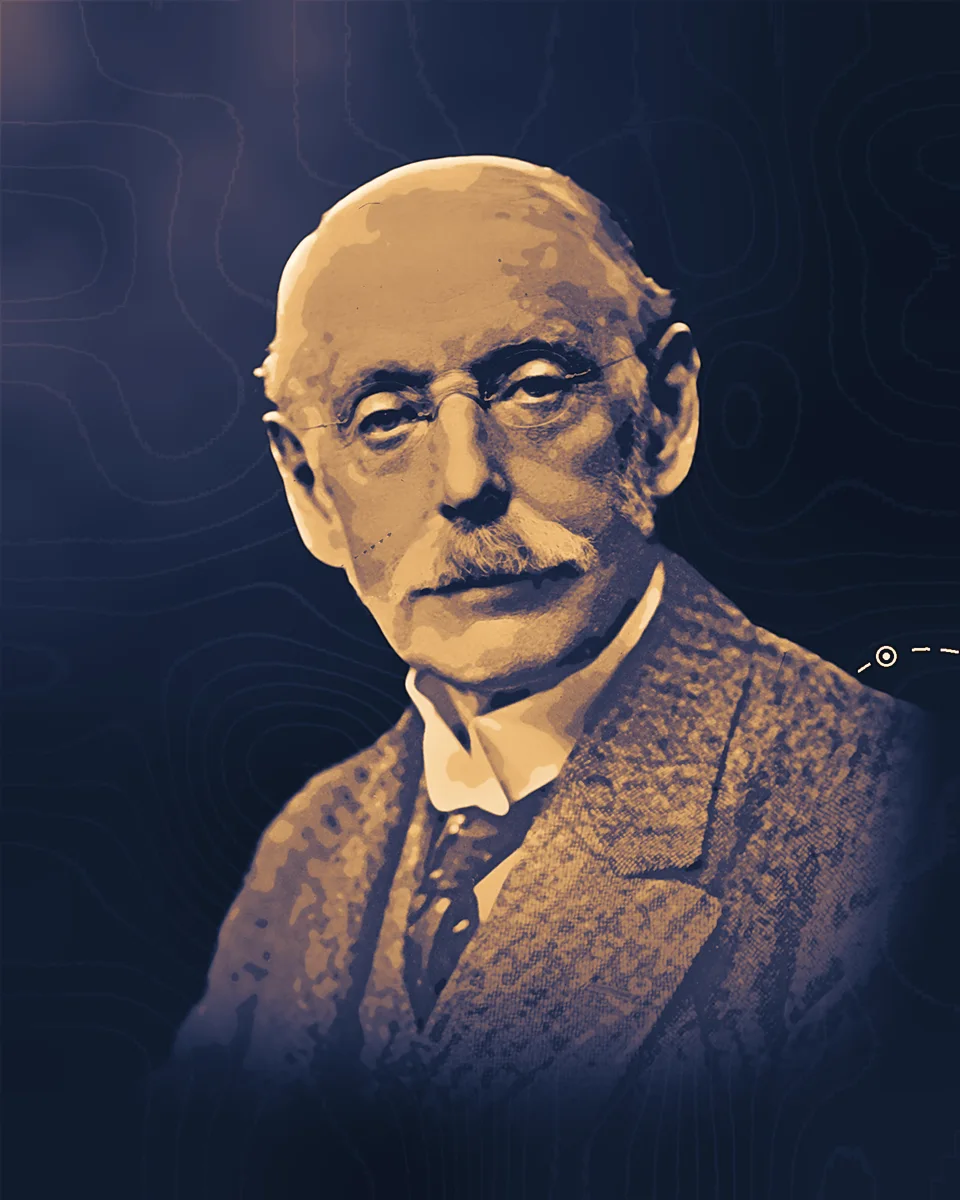
Charles Parsons
He built the steam turbine that drives a generator directly, the kind of machine that still makes most of the world's electricity.
1854–1931
What they changed
1884
A turbine drives a dynamo
Parsons patented his steam turbine on 23 April 1884 and built the first turbo-dynamo that year. A turbine is spun steadily by steam expanding through many rows of blades, where a piston engine is pushed back and forth. His ran at 18,000 revolutions per minute. The Science Museum, which holds it, calls it "the forerunner of the turbo-generators that today provide most of the world's electricity."
1890
Turbines in a public station
By 1888 about 200 of his small turbo-dynamos were at work, most of them lighting ships. Forth Banks in Newcastle, which started in 1890, was by Grace's Guide's account the first public generating station to use a turbo-generator.
1894
His patents bought back
When his partnership ended in 1889 he lost the rights to his own patents and had to build a different turbine, in which the steam flowed outward, to stay in business. In 1894 he recovered the patents for a small part of the price first asked.
1897
Turbinia at Spithead
He fitted the launch Turbinia with turbines between 1894 and 1897 and ran her at up to 34 knots through the naval review at Spithead. In 1905 an Admiralty committee advised turbines for every class of warship.
collection.sciencemuseumgroup.org.ukcollection.sciencemuseumgroup.org.uk
1928
Power-station scale
His land turbines reached 1,000 kW by 1900, by the account of his colleague Gerald Stoney. In 1928 the firm built a 25,000 kW turbo-alternator that generated at 36,000 volts, which the Science Museum says "set a new standard in power station practice."
Life
Charles Algernon Parsons was born on 13 June 1854 at 13 Connaught Place, Hyde Park, London. He studied for two years at Trinity College, Dublin, and then read mathematics at St John's College, Cambridge, where he was placed eleventh in the examination of 1877. He served a four-year apprenticeship at Sir William Armstrong's works at Elswick on the Tyne, then spent 1881 to 1883 at Kitson and Company in Leeds, working on a high-speed steam engine.
In 1884 he became a junior partner in Clarke, Chapman and Company at Gateshead. He promoted the turbine as a smaller and more efficient alternative to the piston engine. It combined high speed with little vibration, which suited a generator, and the first machines went to sea to light ships.
The partnership was dissolved in 1889. He set up C. A. Parsons and Company at Heaton, near Newcastle, without the right to use his own patents, and worked around them until he bought them back. In 1894 he formed a second company at Wallsend to build turbines for ships. By 1905 his turbo-alternators generated at 11,000 volts.
He took out more than 300 patents. Late in life he bought optical firms, among them the telescope makers Sir Howard Grubb and Sons in 1925. He was elected a Fellow of the Royal Society in 1898, knighted in 1911 and admitted to the Order of Merit in 1927. He died on 11 February 1931 aboard the liner Duchess of Richmond at Kingston, Jamaica.
Read more
4 accounts
The Steam Turbine, Charles Parsons, 1911.
His Rede Lecture at Cambridge: his own account of the turbine on land and at sea.
archive.org
Charles Algernon Parsons, Grace's Guide to British Industrial History, undated. Reprints the obituaries of 1931 from the engineering institutions and from Engineering, with Gerald Stoney's appreciation.
gracesguide.co.uk
Charles Parsons: His Life and Work, Rollo Appleyard, 1933.
The first full biography, written two years after his death.
archive.org
Parsons' steam turbine generator, 1884, Science Museum Group, undated.
The record of the first machine, which the museum has held since 1890.
collection.sciencemuseumgroup.org.uk