Industries / Finance and business services
Security guard services
Security guard firms supply trained staff who protect buildings, sites and events for a fee, by standing guard, walking or driving rounds, watching cameras and alarms, and writing down what they saw.
1850s
In Chicago, Allan Pinkerton's agency set up the Pinkerton Protective Patrol, a uniformed private night patrol that protected paying "banks, shops and department stores, jewelry houses, and hotels" at a time when the city's own police wore plain clothes. Sources differ on the year: PBS dates the agency to 1850, the Library of Congress to "the 1850s", and Pinkerton's own history to 1855, with the patrol "not long after".
29
Milestones achieved across 6 domains.
7
To watch for: announced, not yet confirmed outside.
12
Open deliverables. Nobody has shipped them.
In one minute
Where it started
Guarding for hire began in 1850s Chicago, where Allan Pinkerton's agency sold a uniformed night patrol to banks, shops and hotels. In 1858 Edwin Holmes of Boston installed an electric burglar alarm and later linked alarms by telephone line to offices staffed day and night, and from 1878 watchmen's clocks recorded when each checkpoint on a round was visited. After Pinkerton agents hired to break a strike at Homestead in 1892 fought armed workers, Congress barred the federal government from employing such firms.
Where it stands
The Small Arms Survey counted 19.5 million private security staff in 70 countries in 2011, against fewer than 11 million police, though 39 of those countries had more police than guards. In the US, 1.3 million security guards earned a median $38,020 in May 2025, and large firms lead the trade: Allied Universal, which bought G4S in 2021, gives a workforce of about 770,000, and Securitas about 322,000, with technology and solutions making up 35% of its sales in the third quarter of 2026. Official inquiries into Y-12 (2012), London 2012 and Manchester Arena (2017) found the same weak points: broken cameras and alarms nobody acted on, guards a contractor could not supply, and staff not trained to pass on a warning.
What is open
Much of what the industry relies on has never been tested in public. There has been no shared test set for camera alarm filters since the UK government stopped handing out its i-LIDS video in 2014, no published accuracy test of AI tools that write guards' reports or answer their questions from site instructions, no worldwide count of guards since 2011, and no sourced table of licensing rules. AI models that read video, speech and long documents, web agents, and patrol robots that cost about $1,000 put these datasets and tests within reach of a small team, and none of them needs to watch or identify a real person.
Domains
AchievedWatch forOpen
Domain
Progress
Last achieved
Watch for
Open
Guarding sites
This is the work of standing guard at one place, such as a gate, a front desk, a control room or a power plant, often around the clock, under written site instructions that the trade calls post orders.
6 · 1 · 2
Last achievedAllied Universal buys G4S2021
Watch forRobots, software and guards together
2
openPatrols
This is the work of walking or driving rounds of one site, or of many sites in a night, to check doors, fences and alarms, and of going to see when an alarm goes off.
4 · 2 · 2
Last achievedDrone rounds, nobody on site2024
Watch forA $999.99 patrol robot
2
openWatching cameras and alarms
This is the work of watching alarm signals and camera pictures, on site or from a monitoring centre far away, deciding which are real, and sending a guard or calling the police.
5 · 1 · 2
Last achievedA score for every alarm2023
Watch forAI that drops empty clips
2
openReports
This is the work of recording a shift: proof that rounds were walked, logs of visitors and events, incident reports for clients, insurers and police, and the handover to the next shift.
4 · 1 · 2
Last achievedGuard software consolidates2022
Watch forAI rewrites guards' notes
2
openTraining and licensing
This is the work of teaching guards the job and the law and testing them, and the state checks and licences that decide who may work as a guard.
4 · 1 · 2
Last achievedTop-up training after Manchester2021
Watch forCalifornia adds training hours
2
openEvents
This is the work of staffing concerts, matches, festivals and other gatherings with stewards and licensed guards who check tickets, search people and bags at the gates, manage crowds and deal with trouble.
6 · 1 · 2
Last achievedParis staffs its Games2024
Watch forMartyn's Law comes into force
2
open
Narrower industries
Advances to build with
5 research notes

NVIDIA GR00T 2
Five demonstrations per task
By NVIDIA's own test, its robot model GR00T 2 averages 95% success after five demonstrations of a task, on 50 tasks picked from those it learns that way.

Mistral Large 4
A trillion open parameters
Mistral published its Large 4 AI model, a trillion numbers by its count, free to download and sell, though firms that rent out models need a separate license.

Muse Ember
The jobs agents repeat
Meta's Muse Ember matched Claude Haiku 5.5 on an outside firm's tests at a third of the cost per task, though both list the same prices for text in and out.

Cursor Agent SDK
Findings that cite notes
Cursor released a kit for building AI agents, and its example, a code reviewer that cites the note behind each finding, is known only from Cursor's account.
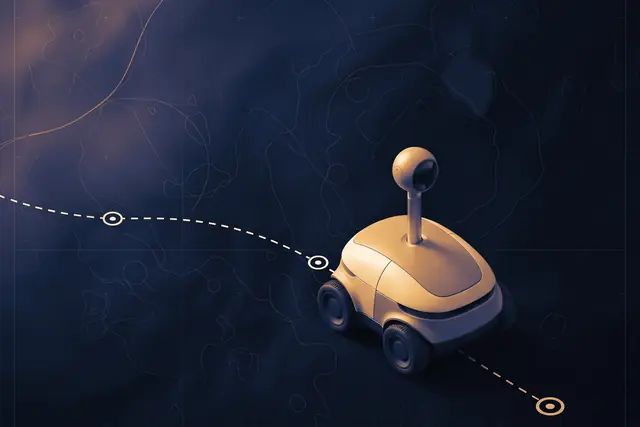
Ring Rover Cam
A camera on patrol
Amazon says Ring's $999.99 Rover Cam, a camera on wheels, maps an indoor space and drives itself to saved spots, and launch coverage reports no outside test.
Open in security guard services
3 of 12 open deliverables
Open · Guarding sites
Test answers from post orders
A public test of AI assistants that answer a guard's questions from a site's post orders, such as "The fire panel shows a fault at 03:00. Whom do I call, and do I clear the building?" It would hold invented post orders for 20 sites, 600 questions with answers agreed by two experienced supervisors, and a scoring script that counts wrong answers and flags the ones that could hurt someone, such as a wrong evacuation route.
Built with what exists
AI models that read long documents, such as Claude Opus 5.5, and, for firms that keep client instructions on their own servers, the open-weight Mistral Large 4 (see the Note "A trillion open parameters"); the idea behind Ai2's XYBench of checking whether an answer meets the need behind a question (see the Note "Answering the question behind the question"); Python for scoring.
Open · Patrols
A tally of door checks
A filmed, public tally of how well patrol robots check a building at night: whether each door is shut, each window closed, each light off and each floor dry. Before every round a helper sets each item open or shut at random from a sheet, in a building with nobody else inside, and the robot's report is compared with the sheet.
Built with what exists
Ring Rover Cam or a low-cost four-legged robot such as the Unitree Go2; an AI model that reads images, to judge each door and window from the robot's video; for pulling handles, a small arm on a wheeled base taught from a few recorded demonstrations with LeRobot (see the Note "No download") or NVIDIA's GR00T 2 (see the Note "Five demonstrations per task").
Open · Watching cameras and alarms
Nuisance alarms, labelled and public
A free, public set of short camera clips that set off motion alarms with no person in them (foxes, cats, rain, snow, spiders on the lens, swaying branches, car headlights), with staged intrusions acted out by mannequins or by figures drawn in a game engine, each clip labelled, and a scoring script for alarm filters.
Built with what exists
Outdoor cameras on property the team controls; Blender or Unreal Engine for drawn figures; Meta's SAM 2 to speed up labelling; open detectors such as Ultralytics YOLO11 as a first filter to score.