Ring Rover Cam
A camera on patrol
Amazon says Ring's $999.99 Rover Cam, a camera on wheels, maps an indoor space and drives itself to saved spots, and launch coverage reports no outside test.
Robots · Checked 13 Nov 2026 · 12 sources · 10 min
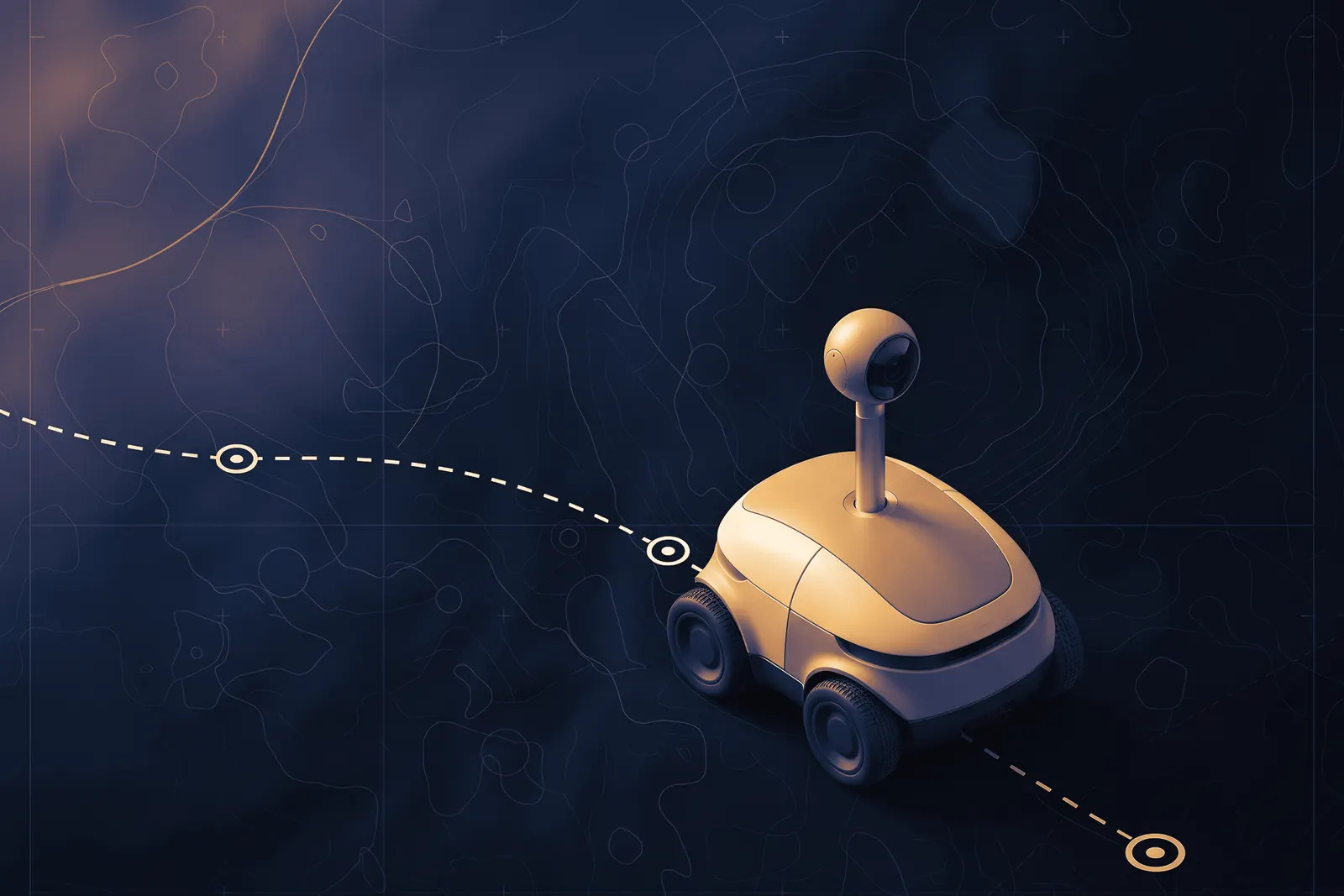
A security camera screwed to a wall has one view. It was aimed on the day it went up, and whatever happens outside that view happens unseen. Suppose a shop on one floor, with rows of shelving out front, a stockroom behind, a back door with a sensor that reports when the door opens, and a single camera above the till. At 2 a.m. the sensor reports that the back door has opened, and the camera goes on showing the till.
Somebody has to go and look. The usual somebody is a person: the owner in a car, or a guard paid to walk the building at night. On 10 November 2026 Amazon announced Ring Robotics, a product line under Ring, its security-camera brand, and one of the two devices the line launches with is built to do the going. Ring Rover Cam is a camera on wheels, a security robot for businesses. Amazon states that it will begin shipping in the U.S. on 16 December 2026 for $999.99.
Everything known about what the robot does comes from Amazon and Ring. A company describing its own product chooses which abilities to describe and under which conditions, and has every reason to choose the flattering ones. The description may be accurate in every line, and still nobody outside can vouch for it until a stranger has run the machine in a building of their own. The announcement contains no test score or accuracy figure. Launch coverage reports no independent test, and TechCrunch's launch report does not verify the mapping or AI claims.
The sensor notices and the robot goes
In the shop, the thing that noticed the back door was the sensor, and Amazon tells its own story the same way. In Amazon's example a sensor trips at 2 a.m., and when a connected Ring device is triggered like that, the robot checks its programmed patrol points, the spots it has been set to visit. In Ring's description, another Ring device or person detection decides that something is a disturbance, and the robot's part is to visit pre-programmed points. Person detection is software judging that a human is in the picture. A guard on rounds does two jobs, noticing and walking, and by that description Rover Cam is given the walk. Ring publishes no detection rate and no false-alarm rate, the figures that would say how often real trouble sets the system off and how often nothing does.
A trigger is one way to set the robot moving. A user can also send it to a room or a saved point with one tap, and a business can schedule routes ahead of time, which an Amazon footnote says needs a compatible Ring Protect plan, a subscription paid by the month.
However it is sent, the robot then has to get itself from its dock, where it waits, to each point on its list, the back door among them. A person crossing a dark shop they know well relies on a picture of the layout, a sense of where in that picture they are standing, and a path from here to there. A machine starts with none of these.
A floor plan made from pictures
By Amazon's account Rover Cam makes the picture of the layout for itself. During setup it explores the space on its own, and a system Amazon calls AI Pilot turns camera views into a floor plan. The trouble is that a picture is flat. It shows that a shelf stands to the left of a door, and it does not say how far away either one is. One way to get distance out of flat pictures is to move. Step sideways, and things close to you slide a long way across your view while things far off barely shift. From the size of each slide the distance to each thing can be worked out, but only by someone who knows how far they stepped.
A wheeled robot does not know that for certain. It can count the turns of its wheels, but wheels slip. A better way to tell where it has got to is to look for things whose positions it already knows, and those positions are on the map it has not finished drawing. To put a wall on the map it has to know where it was standing, and to know where it is standing it needs the map. Robotics treats the two as one problem and works on both together: guess at both, look again, correct both, repeat. Small errors still pile up, so that a long straight aisle can come out slightly bent. The standard cure is to return to a spot already visited, recognise it, and pull the whole map straight until the two visits agree.
That is the general method, and none of that account comes from Amazon. What Amazon gives for AI Pilot is a list of ingredients, a mix of vision models, on-device sensors and cloud processing. A vision model is software trained on a great many pictures to recognise what is in a new one. On-device sensors are the instruments the robot carries, and Ring names none besides cameras. Cloud processing is computing done on distant computers, reached over the internet. Ring does not say which processing runs on the device, though its product page says Wi-Fi is needed to map and navigate. Nor does it say what the robot does when Wi-Fi drops.
A floor plan is only walls, and a patrol also needs places worth looking from. Amazon says AI Pilot identifies rooms and suggests patrol points. Ring's product page, which does not use the name AI Pilot, describes viewpoints that users can label and edit. In the shop the owner might keep three and call them Back door, Stockroom and Till. Each stop also has a saved height for the mast, a pole that lifts the camera, listed by Amazon as an adjustable mast for seeing over counters and shelving. Ring publishes no mast height, so whether the camera clears this shop's shelves cannot be read off any page.
What remains is the route. By Amazon's account AI Pilot plans the most efficient route to a preset point and steers around furniture and shelving as it goes, which in the shop means the rows between the dock and the back door. The floor has to cooperate. Ring's support page says the robot is for dry indoor spaces with smooth, flat floors on one level. CE Pro reported further floor limits that it attributed to Ring, among them black glossy floors and transitions over 1.375 inches, which Ring's own product and support pages do not list. A transition is the join where one floor surface meets another, such as a strip across a doorway.
At each stop the robot, in Amazon's telling, raises its mast to the saved height and performs a 360° scan, a look all the way round. Ring's product page gives the camera a 152° diagonal field of view, the angle it takes in at once, measured between opposite corners of the picture. A full circle is 360°, so a single look takes in less than half of what is around the robot.
What the robot sends back is described as video in up to 4K, which is a ceiling. Ring's support page specifies up to 4K for day video and 2K for night video, so the headline figure is the daytime one. Both are trade labels for how many dots make up each picture, and 4K is the finer. The same page says quality varies with the capacity of the internet connection, the device's temperature and the light in the room. Ring's FAQ adds that the robot does not record 24/7, only when it detects people while docked, while moving and in Live View, Ring's name for a live feed.
Who can see that video, and where it is kept, is only partly answered. TechCrunch noted that critics say Ring cameras have formed surveillance networks that police can access, and that it is unclear whether the Ring Robotics devices will offer local storage. Amazon says their video is protected by TAKE, Ring's default encryption. Its article on TAKE describes a phased rollout from September 2026 with no end date or device list, so whether every Rover Cam ships with TAKE active is not established.
A charge time with no run time
For a business that wants rounds on a schedule, how much of a night the robot can spend moving depends on two numbers: how long it runs on a charge, and how long a charge takes. Ring's support page gives the second, a charge time of approximately 45 minutes. Neither company gives the first. Suppose a robot runs for 90 minutes and then charges for 45. A full cycle is then 135 minutes, of which the robot moves for 90, two-thirds of the time. Suppose instead it runs for only 15. The cycle shrinks to 60 minutes and the robot moves for a quarter of it. Both run times are invented. They describe different machines, and the published figures fit either.
The other number that bounds a patrol is floor area. Ring's product page states coverage of up to 5,000 sq ft, a figure absent from Amazon's announcement and given without a method of measurement. A square room 70 feet on a side has 70 times 70, or 4,900, square feet of floor, so the figure describes about that much.
The price has a gap of the same kind. The robot is $999.99, and Ring's product page ties scheduled patrols, video history and professional monitoring to a compatible subscription. Ring's plans page lists monthly plans from $4.99 to $99.00 without naming one as compatible with Rover Cam or offering a business plan, so what the shop would pay each month for scheduled rounds cannot be worked out from Ring's pages.
The nearest price comparison is Amazon's earlier business robot. Astro for Business was announced on 15 November 2023 at a starting price of $2,349.99, and TechCrunch recounts that Amazon repositioned Astro for businesses and discontinued it about seven months later. The Gadgeteer read Rover Cam as aimed at work businesses pay people to do, such as overnight patrols, at less than half the price of Astro's business version.
Prices as announced
Two Amazon robots for businesses
If the robot does what Amazon describes, the owner of the shop gets a look at the back door at 2 a.m. without sending a person to it, so long as the shop sits inside Ring's stated limits. If the single-floor limit applies as stated, a site with several floors would need a unit for each floor, each covering at most the 5,000 square feet Ring states.
MarketScale's Building Management desk wrote that the announcement alone does not establish performance in any given facility, and advised buyers to test the camera view and route under real operating conditions. On 13 November 2026 Ring's product page showed no reviews.
Check it yourself
- Open Ring's Rover Cam product page and read the price block, the specifications and the FAQ to confirm $999.99, the 16 December 2026 release date, the 152° field of view, coverage of up to 5,000 sq ft and that the robot does not record 24/7.
- Search the plain-text rendering of Amazon's announcement for the word shipping to confirm the ship date and the price.
- Read the Rover Cam section and the footnotes of Amazon's announcement to confirm the date, the description of AI Pilot and the footnote tying scheduled routes to a Ring Protect plan.
- Read the specifications on Ring's Rover Cam support page to confirm 4K day and 2K night video and the 45-minute charge time, and to see that no run time is given.
- Compare Ring's plans page with the subscription footnotes on the product page to see that no plan is named as compatible with Rover Cam.
- Read Amazon's TAKE article against the encryption paragraph of the announcement to confirm the phased rollout from September 2026 and that no end date or device list is given.
- Find the floor limits in CE Pro's report, then look for them on Ring's product and support pages to see that Ring's own pages do not list them.
Sources
- Ring announces Ring Robotics, ushering in a new era of security. Amazon, 10 November 2026.
- Ring announces Ring Robotics, ushering in a new era of security. Amazon, plain-text rendering, 10 November 2026.
- Report on Ring Robotics, by Lucas Ropek. TechCrunch, 10 November 2026.
- Rover Cam, product page. Ring.
- Ring Rover Cam, support page. Ring.
- Report on the Ring Robotics launch, by Zachary Comeau. CE Pro, 10 November 2026.
- Ring introduces TAKE, setting a new industry standard for default encryption and control. Amazon, 26 August 2026.
- Ring Protect Plans. Ring.
- Amazon brings its home robot to businesses. TechCrunch, 15 November 2023.
- Report on Ring Robotics, by Vincent Nguyen. The Gadgeteer, 10 November 2026.
- Ring Robotics, landing page. Ring.
- Report on Ring Rover Cam and Ring Drone Cam for building management. MarketScale, 10 November 2026.