Industries / Figureheads
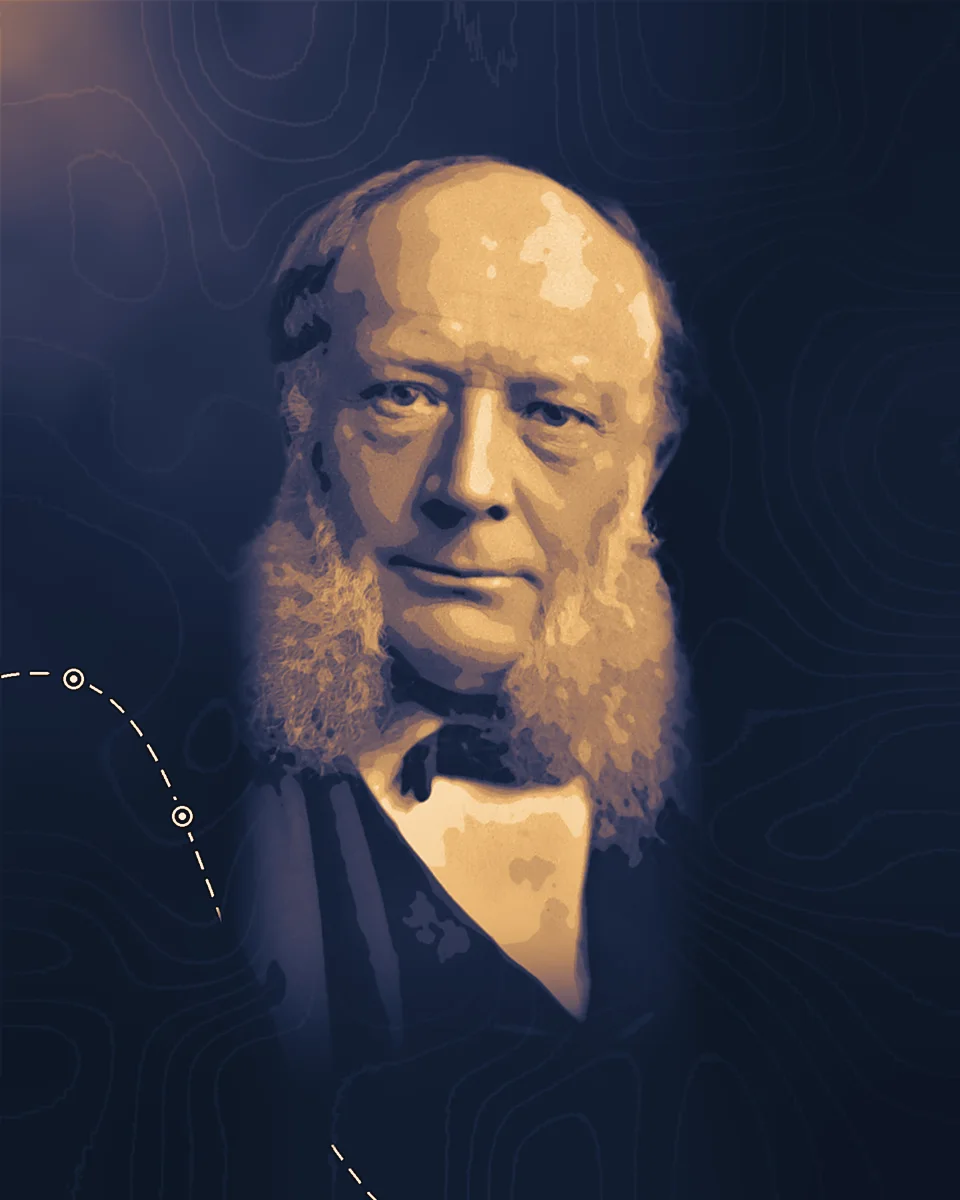
William Siemens
He and his brother Friedrich built the furnace that reuses its own waste heat, and he turned it to melting steel on an open hearth, the method that made most of the world's steel by 1913.
1823–1883
What they changed
1856
A furnace that reuses heat
The regenerative furnace sends its hot waste gases through chambers stacked with firebrick, then turns the incoming air back through the same hot brick, so heat that used to go up the chimney comes back to the fire. The patent of 2 December 1856 was in the name of his younger brother Friedrich, whose idea it was. The Institution of Civil Engineers said William "was the chief agent in maturing it and directing its various applications."
1861
Gas and the open hearth
The brothers patented a gas producer, a separate chamber that turns coal into fuel gas, and four regenerators to preheat both the gas and the air. The patent said steel could be melted this way on an open hearth, a shallow bath under the flame, instead of in small clay pots.
1863
A licence to the Martins
On 26 March 1863 he licensed Émile Martin to use his heating system at the Sireuil works in France, for furnaces that included one "à fondre l'acier sur un sol ouvert", to melt steel on an open hearth. His engineers built the furnace to his drawings, and on 8 April 1864 Pierre Martin made the first open-hearth steel in it.
1867
Steel from pig and ore
At his own Sample Steel Works in Birmingham he worked out a second way to run the furnace, refining molten pig iron with iron ore, and took his first steel patent on 21 August 1867. The Landore works near Swansea followed and started in 1869. The Iron and Steel Institute counted 77,500 tons of open-hearth steel made in the United Kingdom in 1873 and 436,000 tons in 1882.
1879
Steel melted by an arc
He patented a crucible with an electric arc struck inside it on 27 May 1879 and showed it to the Society of Telegraph Engineers on 3 June 1880, saying the arc could be made "useful in the arts for fusing platinum, iridium, steel, or iron". Paul Héroult built the first industrial arc furnace for steel twenty years later.
Life
Carl Wilhelm Siemens was born on 4 April 1823 at Lenthe, near Hanover, the fourth son in a family of fourteen children. He went to school in Lübeck and Magdeburg, studied for a year at the University of Göttingen and trained at an engine works in Magdeburg. He first came to England in 1843 to sell an electro-gilding process that he and his elder brother Werner had worked out, and came back in 1844 to stay. He became a British subject in 1859 and used the name Charles William.
His early work was on saving heat in steam engines, without much success. The furnace came from the same idea. His biographer William Pole, who wrote at the request of Siemens's executors, records that the 1856 patent was granted to Friedrich because the invention was his, and that William "was always pleased to explain that the original merit of the invention belonged to his brother." William then spent years making it work. Its first clear success was in glass, at Chance Brothers near Birmingham in 1862.
Steel took longer. Trials from 1862, at Tow Law near Durham and then in Glasgow and at Barrow, made good steel but did not pay, by the Institution of Civil Engineers' account. A French trial at Montluçon was given up when the hearth was destroyed. The Martins at Sireuil got good steel first, by melting pig iron together with scrap, and patented their method. Otto Johannsen's history for the German ironmasters' association says Siemens learned of the Martins' patents only in the autumn of 1865, and was too taken up with his own plans to see what melting scrap would be worth. The two families reached an agreement in 1868. Johannsen judged that the process rightly carries both names, because Martin could not have done it without the Siemens furnace.
Not everything worked. From 1869 he tried to make iron and steel straight from ore in a rotating furnace, at Landore and then at Towcester. The Iron and Steel Institute's obituary says the process "was not commercially satisfactory", and he gave up the Towcester works in 1878. He was also an electrical engineer. For laying Atlantic telegraph cables he designed a ship of his own, the Faraday, which laid the Direct United States cable of 1874 and 1875. He was elected a Fellow of the Royal Society in 1862 and was the first president of the Society of Telegraph Engineers in 1872.
He was knighted in 1883, fell in a London street on 5 November and died on 19 November 1883. After a service at Westminster Abbey he was buried at Kensal Green. The open hearth outgrew the Bessemer converter after his death: of 74 million tons of steel made in the world in 1913, 44 million came from open hearths, by the Iron and Steel Institute's figures. It has since given way to oxygen converters and electric furnaces. The World Steel Association's table for 2025 gives those two 69.4% and 30.3% of crude steel, and all other processes 0.3%.
Read more
4 accounts
The Life of Sir William Siemens, William Pole, John Murray, 1888.
The full biography, written from his papers at his executors' request, with the 1856 patent claim and the 1863 licence letter to the Martins printed in full.
archive.org
Charles William Siemens, Grace's Guide to British Industrial History, undated. Reprints the obituaries of 1883 and 1884 from the Institution of Civil Engineers, the Institution of Mechanical Engineers and the Iron and Steel Institute.
gracesguide.co.uk
Geschichte des Eisens, Otto Johannsen for the Verein Deutscher Eisenhüttenleute, 1924.
A history of iron, in German, whose pages 165 and 166 set out what each Siemens brother and each Martin did.
archive.org
Death of Pierre-Emile Martin, Scientific American Supplement, 26 June 1915.
Prints the Iron and Steel Institute's 1915 statement on the open-hearth process, with the world output figures for 1913.
archive.org