Industries / Figureheads
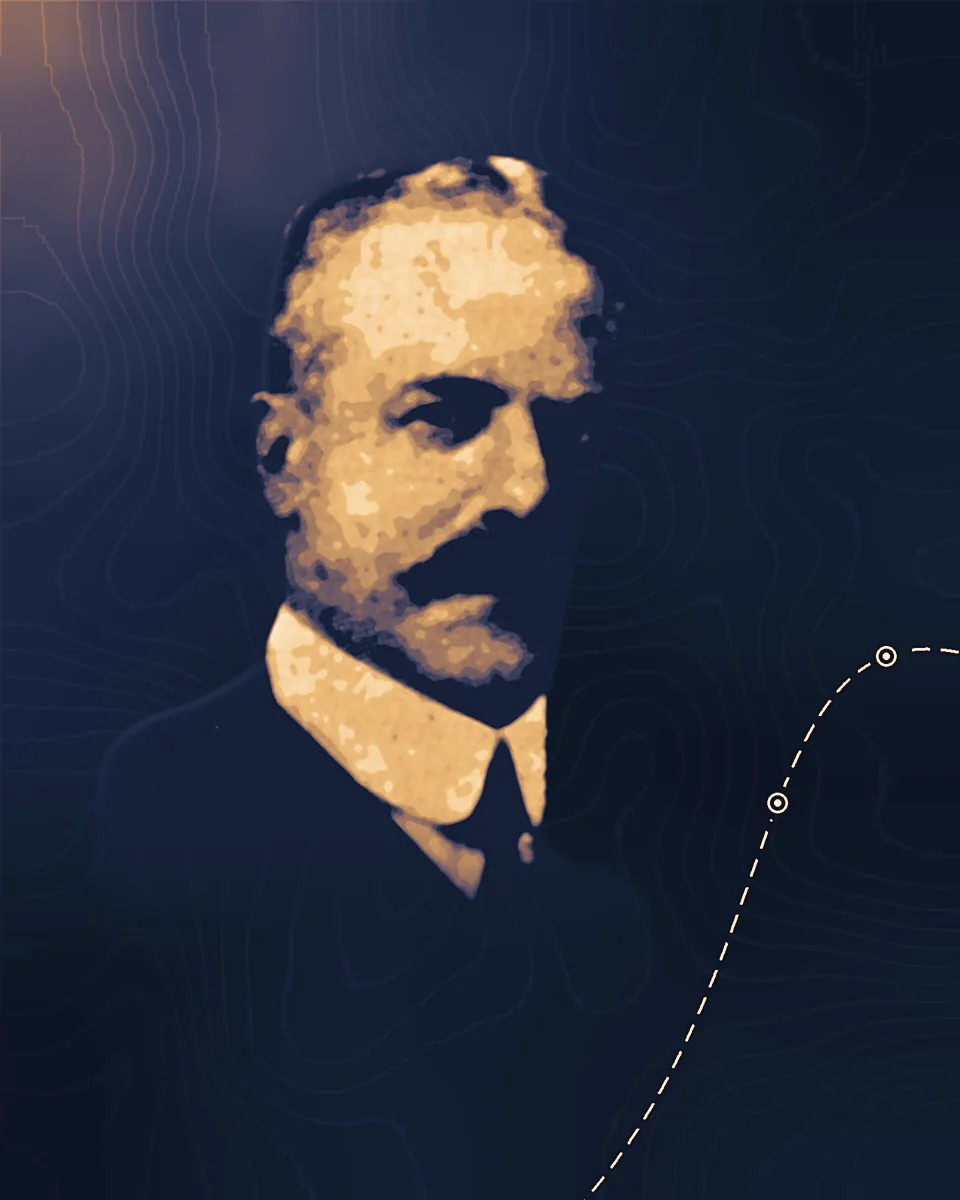
William M. Burton
He made cracking heavy oil into gasoline work at refinery scale, in pressure stills at Standard Oil of Indiana's Whiting refinery from 1913.
1865–1954
What they changed
1909
Cracking under pressure
Before about 1910, Burton said, US refineries got only about 11% of each barrel of crude as gasoline, the part that boils off at ordinary pressure, and sold about 40% as fuel and gas oil. He and his staff at Whiting tried cracking the oil vapor and then catalysts such as aluminum chloride, and gave both up. Distilling heavy distillates in the liquid at about five atmospheres broke them into gasoline of the same paraffin type, with little gas or coke.
1913
The pressure still patent
His patent, filed on 3 July 1912 and granted on 7 January 1913 as US 1,049,667, claims distilling oils boiling above 500 °F at about 650 to 850 °F under about 4 to 5 atmospheres of pressure. It was assigned to the Standard Oil Company of Whiting, Indiana.
1913
Stills in a row
Standard Oil of Indiana started the first battery of twelve pressure stills at Whiting in January 1913, by the historian John Heitmann's account. Burton recalled asking the directors for US$1,000,000 to build sixty stills, each 8 feet across and 30 feet long and charged with 8,000 gallons, and said it took "considerable argument" to win the vote.
1920s
Licensed across the industry
By January 1922 the company ran more than 800 pressure stills and licensees ran about as many again, Burton said, making 2,000,000 gallons of gasoline a day of the 12,500,000 produced daily in the US and Canada. The process was licensed as far away as Indonesia and Romania. Penn State's refining course says thermal cracking made about 20% of US gasoline in 1924 and over 50% by 1940.
1984
Hall of Fame
The National Inventors Hall of Fame inducted him in 1984 for what it calls the first commercially successful process for cracking crude oil into gasoline, which it says more than doubled the potential yield of gasoline. Cracking by heat alone survives in refineries in coking, which Penn State's course calls the most severe thermal process in the refinery and the preferred route at many plants that run heavy crude.
Life
William Meriam Burton was born in Cleveland, Ohio, on 17 November 1865. He graduated from Western Reserve University in 1886 and took a doctorate in chemistry at Johns Hopkins University in 1889 under Ira Remsen. That year Standard Oil hired him in Cleveland to help refine the sulfur-laden crude of Lima, Ohio. The process that cleaned it up was Herman Frasch's copper oxide treatment, by the account of Charles F. Chandler, who presented Burton's Perkin Medal.
In 1890 he moved to Standard Oil of Indiana and its new refinery at Whiting, near Chicago. He became assistant superintendent in 1892 and general superintendent in 1895. Chandler recalled that Burton went with him to Berlin that year to persuade the German government that Ohio oil was as good as Pennsylvania oil. Burton was general manager of manufacturing by 1909, when the cracking work began.
The work was shared. Robert E. Humphreys was his closest collaborator, and William F. Rodgers worked with them from 1909, by Heitmann's account. Burton thanked Humphreys, E. M. Clark and T. S. Cooke by name in his Perkin Medal address, and a later distillation patent was granted to Humphreys and Burton together. He also said the idea was not new: Sir Boverton Redwood and James Dewar had patented distilling under pressure about thirty years before, for Russian residues, but it was never used in industry. The Standard Oil trust's leaders were not interested at first, and the Indiana company went ahead after the trust was broken up in 1911, according to a 2005 history in Invention and Technology.
The stills were dangerous. Burton said the oil had to be held at 370 to 400 °C, close to the 450 °C at which steel begins to lose its strength, and that they ran more than eight years before a fatal accident. On 4 July 1921 pressure still number 95 exploded at Whiting and set four stills burning. Eight men died and 24 were badly hurt. No defect was found, and the company called it an act of God, by the Whiting-Robertsdale Historical Society's account. The batch stills were later replaced by continuous cracking.
He became a director of Standard Oil of Indiana in 1911, vice-president in 1915 and president in 1918, and retired in 1927. He received the American Chemical Society's Willard Gibbs Medal on 17 May 1918 and the Perkin Medal of the Society of Chemical Industry on 13 January 1922. He died on 29 December 1954.
Read more
5 accounts
Address of Acceptance, William M. Burton, Chemical and Metallurgical Engineering, 18 January 1922.
His own account of the experiments, the first stills and the scale of the process, printed with Chandler's presentation and his list of patents.
archive.org
Burton Refines Petroleum with Thermal Cracking, John A. Heitmann, EBSCO Research Starters, 2021.
A historian's account of the work from 1909, with a bibliography.
ebsco.com
Standard Oil Company (Indiana): Oil Pioneer of the Middle West, Paul H. Giddens, Appleton-Century-Crofts, 1955.
The company history, including the patent litigation that followed the process.
archive.org
Petroleum Progress and Profits: A History of Process Innovation, John L. Enos, MIT Press, 1962.
An economic history of the main cracking processes, from Burton's onward.
archive.org
Whiting's 4th of July Disaster, Whiting-Robertsdale Historical Society, undated. The local record of the 1921 pressure still explosion.
wrhistoricalsociety.com