Industries / Figureheads
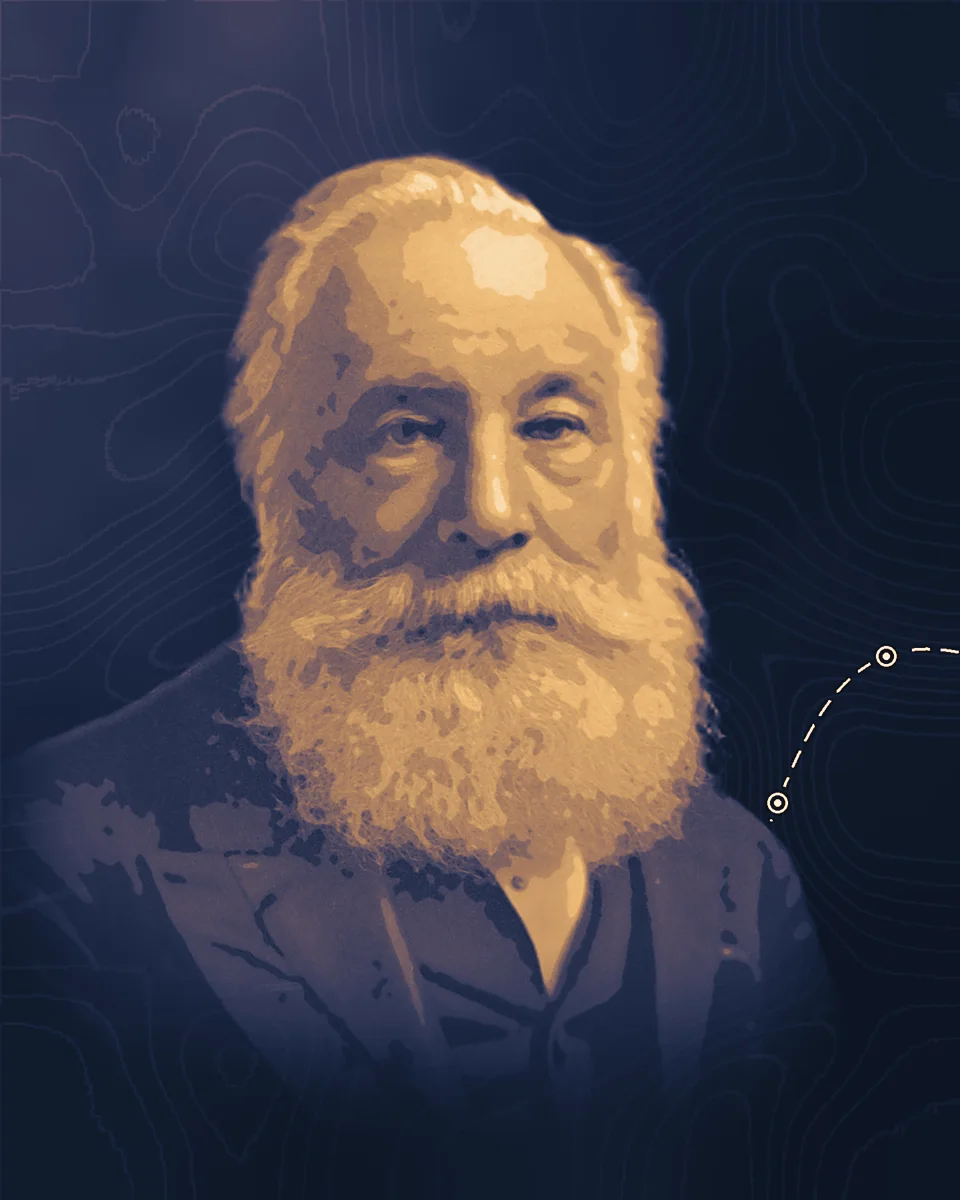
William Henry Perkin
He made the first synthetic dye to be sold, from coal tar, and built the factory that showed chemistry could be an industry of its own.
1838–1907
What they changed
1856
A purple from coal tar
In the Easter holiday of 1856 Perkin, aged 18, tried in his home laboratory in east London to make the malaria drug quinine. The attempt failed. When he repeated it with aniline, a chemical made from coal tar, he got a dark mass that gave a purple solution in alcohol and dyed silk. He filed a patent that August.
1857
A factory for one molecule
With money from his father, a building contractor, he opened a works at Greenford Green, near London. To make the dye he had to make its ingredients in bulk: benzene turned into nitrobenzene, that into aniline, and aniline into a mixture holding a few per cent of dye. He also worked out how to fix the dye on cotton as well as silk.
1858
Mauve in fashion
Dyers held back until the color was taken up in France late in 1858, where it was named mauve. Other makers followed with new aniline dyes within a few years. The historian Tony Travis writes that the fashion for mauve "started the modern organic chemical industry".
1869
Madder red from the factory
Perkin found a workable way to make alizarin, the red dye of the madder root, in 1869 and 1870. The German chemists Carl Graebe, Carl Liebermann and Heinrich Caro found their own routes at the same time. Large-scale growing of madder ended soon after.
1874
Back to the bench
He sold the business at 36 and went back to research. There he found the reaction that carries his name and made coumarin, a scented compound, in the laboratory, which opened the way to synthetic perfumes.
Life
William Henry Perkin was born in London on 12 March 1838. He went to the City of London School, and from 1853 he studied at the Royal College of Chemistry under the German chemist August Wilhelm Hofmann, who made him his assistant. A year later, at sixteen, he fitted up a laboratory at his home in Cable Street.
It was Hofmann who had pointed to quinine as a prize worth making, and Hofmann was himself looking for useful products in coal tar, without success. Perkin's purple came out of that setting, and out of a failed experiment. The Science History Institute calls it "the first commercialized synthetic dye". What was his own was the decision, at 18, to patent it and manufacture it himself.
The dye was first sold as Tyrian purple and was renamed mauve in France. The Science Museum records that demand grew after Queen Victoria and the Empress Eugénie of France were seen wearing the color, and that Perkin showed mauve shawls at the International Exhibition of 1862. Travis argues that the dye "succeeded commercially only because the colour purple was all the rage" in Paris and then London.
Britain did not keep the industry he started. Travis writes that after 1870 the dye industry "passed to Germany", whose firms had the stronger chemistry, research laboratories and sales forces, and that by 1897 they were making synthetic indigo, which broke a British monopoly in the natural dye. He counts drugs, polymers, explosives and the first industrial research laboratories among the things that grew from Perkin's discovery.
Perkin lived to see the fiftieth anniversary of the discovery kept in London in 1906. He was knighted that year, and the Society of Chemical Industry gave him the first Perkin Medal at a dinner in his honor. Travis describes him as a modest man of strong religious convictions who gave freely to Christian charities. He died on 14 July 1907.
Read more
5 accounts
Mauve: How One Man Invented a Colour That Changed the World, Simon Garfield, 2000.
The full-length life, written for general readers.
archive.org
Jubilee of the Discovery of Mauve and of the Foundation of the Coal-Tar Colour Industry by Sir W. H. Perkin, edited by Raphael Meldola and others, 1906.
The record of the fiftieth-anniversary celebrations, with the speeches.
archive.org
The British Coal-Tar Industry: Its Origin, Development, and Decline, edited by Walter M. Gardner, 1915.
A collection made when Britain was asking how it had lost the industry to Germany.
archive.org
A forgotten anniversary?, Tony Travis, Education in Chemistry, Royal Society of Chemistry, 2006.
A historian of the dye industry on what Perkin started and why Britain lost it.
edu.rsc.org
Mauve mania, Sophie Waring, Science Museum, 2018.
The museum's curator of chemistry on the discovery, with the surviving dye samples and dyed cloth.
blog.sciencemuseum.org.uk