Industries / Figureheads
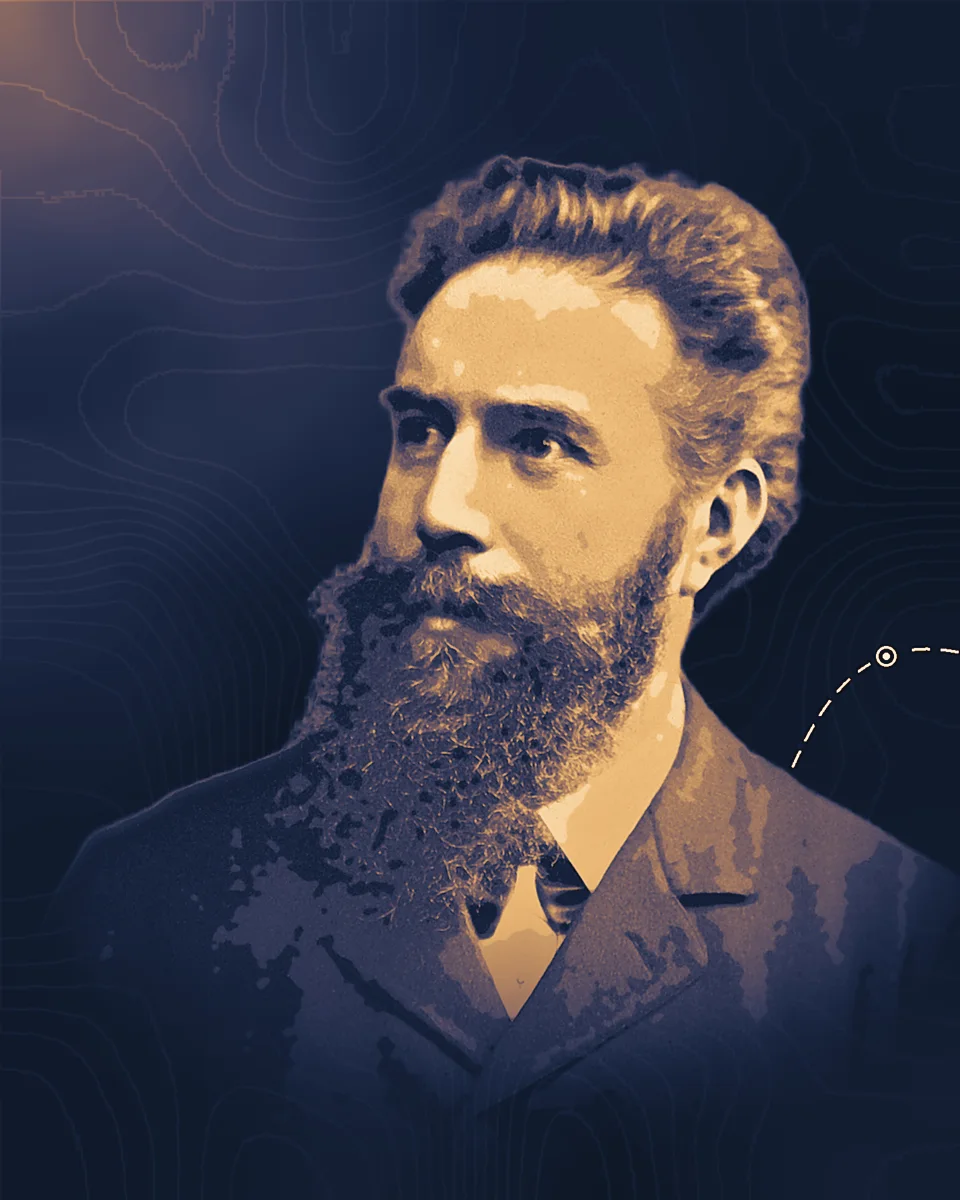
Wilhelm Conrad Röntgen
He discovered X-rays in 1895 and left them unpatented, so within months doctors everywhere could see bones and bullets inside living patients.
1845–1923
What they changed
1895
Rays that pass through flesh
At the University of Würzburg, Röntgen was passing current through a cathode-ray tube sealed in black card when a screen coated with barium platinocyanide, a fluorescent salt, glowed up to two metres away. He found that the new rays went through card, wood and metal to different degrees and could be recorded on photographic plates. One plate showed the bones of his wife Bertha's hand and her ring. He called them X-rays, X for unknown, and the Würzburg Physical-Medical Society accepted his paper "On a new kind of rays" on 28 December 1895.
1896
News within a week
On 1 January 1896 he posted 90 reprints of the paper to physicists across Europe, twelve of them with photographs. One set reached the editor of the Vienna daily Die Presse, whose story was cabled abroad. Leading German papers carried it on 6 January, and British papers followed within days. By the end of 1896 more than 1,000 books and papers on X-rays had been published, by the Nobel Foundation's count.
1896
Bullets and needles found
Doctors took up the rays at once to find foreign objects and broken bones without cutting. In Manchester the physicist Arthur Schuster was "inundated by medical men bringing patients" with needles in their bodies. At McGill University in Montreal John Cox found a bullet lodged between a patient's shin bones, and the British Army took two X-ray machines on its Nile expedition that spring.
1896
No patent on the rays
Röntgen deliberately did not patent the discovery, holding that it belonged to the world, so anyone with a cathode-ray tube could make X-rays. Instrument makers were building tubes for medical use in 1896. Reiniger, Gebbert & Schall of Erlangen, a forerunner of Siemens Healthineers, sent him two, and he wrote back, "Your tubes are really very good."
1901
The first physics Nobel
He received the first Nobel Prize in Physics "in recognition of the extraordinary services he has rendered by the discovery of the remarkable rays subsequently named after him".
Life
Wilhelm Conrad Röntgen was born on 27 March 1845 in Lennep, in the Prussian Rhineland, now part of Remscheid, the only child of a cloth merchant and manufacturer. When he was three the family moved to Apeldoorn in the Netherlands. In 1862 he was expelled from a technical school in Utrecht, accused of drawing a caricature of a teacher that someone else had drawn. Without the certificate for regular university study, he passed the entrance examination of the Polytechnic in Zurich, studied mechanical engineering there and took his doctorate at the University of Zurich in 1869.
He followed the physicist August Kundt to Würzburg and Strasbourg, then held chairs at Hohenheim, Strasbourg and Giessen, and in 1888 took the chair of physics at Würzburg. His earlier work was on the specific heats of gases, heat conduction in crystals and the properties of quartz. He preferred to work alone and built much of his own apparatus.
Others had worked with the same tubes before him, among them Hittorf, Crookes, Hertz and Philipp Lenard. The physicist George Barker, who translated Röntgen's papers in 1899, wrote that the rays "had been previously detected and some of their properties noted by other observers, notably Professor Lenard", but that Röntgen made the first systematic study of them. The date usually given for the discovery, 8 November 1895, is disputed: J.-F. Monville and R. F. Dondelinger trace it to a single interview by the American journalist H. J. W. Dam, published in April 1896, and say no other source confirms it.
The fame did not suit him. He published only two more papers on X-rays, gave one public lecture on them in Würzburg and turned down all other invitations, and he gave no lecture when he received the Nobel Prize. He always called them X-rays, though others named them Röntgen rays. In 1900, at the request of the Bavarian government, he moved to the chair of physics at Munich, where he stayed for the rest of his life.
He married Anna Bertha Ludwig of Zurich in 1872. They had no children and in 1887 adopted her brother's daughter, Josephine Bertha, then six. Bertha Röntgen died in 1919. He died in Munich on 10 February 1923, of cancer of the intestine.
Read more
5 accounts
Eine neue Art von Strahlen, W. C. Röntgen, Würzburg, 1896.
The paper in its original German, as printed in Würzburg, scanned from Harvard's Countway Library of Medicine.
archive.org
Röntgen Rays: Memoirs by Röntgen, Stokes and J. J. Thomson, translated and edited by George F. Barker, Harper, 1899.
His three papers on X-rays in English, with a biographical sketch.
archive.org
Wilhelm Conrad Röntgen and the Early History of the Roentgen Rays, Otto Glasser, Charles C. Thomas, 1934.
The standard early biography, by a medical physicist.
archive.org
Perspectives: A helping hand from the media, Nobel Foundation, undated. How the discovery reached the press and the hospitals in the first weeks of 1896.
nobelprize.org
Professor Röntgen and "Jack the Ripper": Were X-rays Discovered on November 8?, J.-F. Monville and R. F. Dondelinger, RöFo, 2026.
The case against the usual date of the discovery.
europepmc.org