Industries / Figureheads
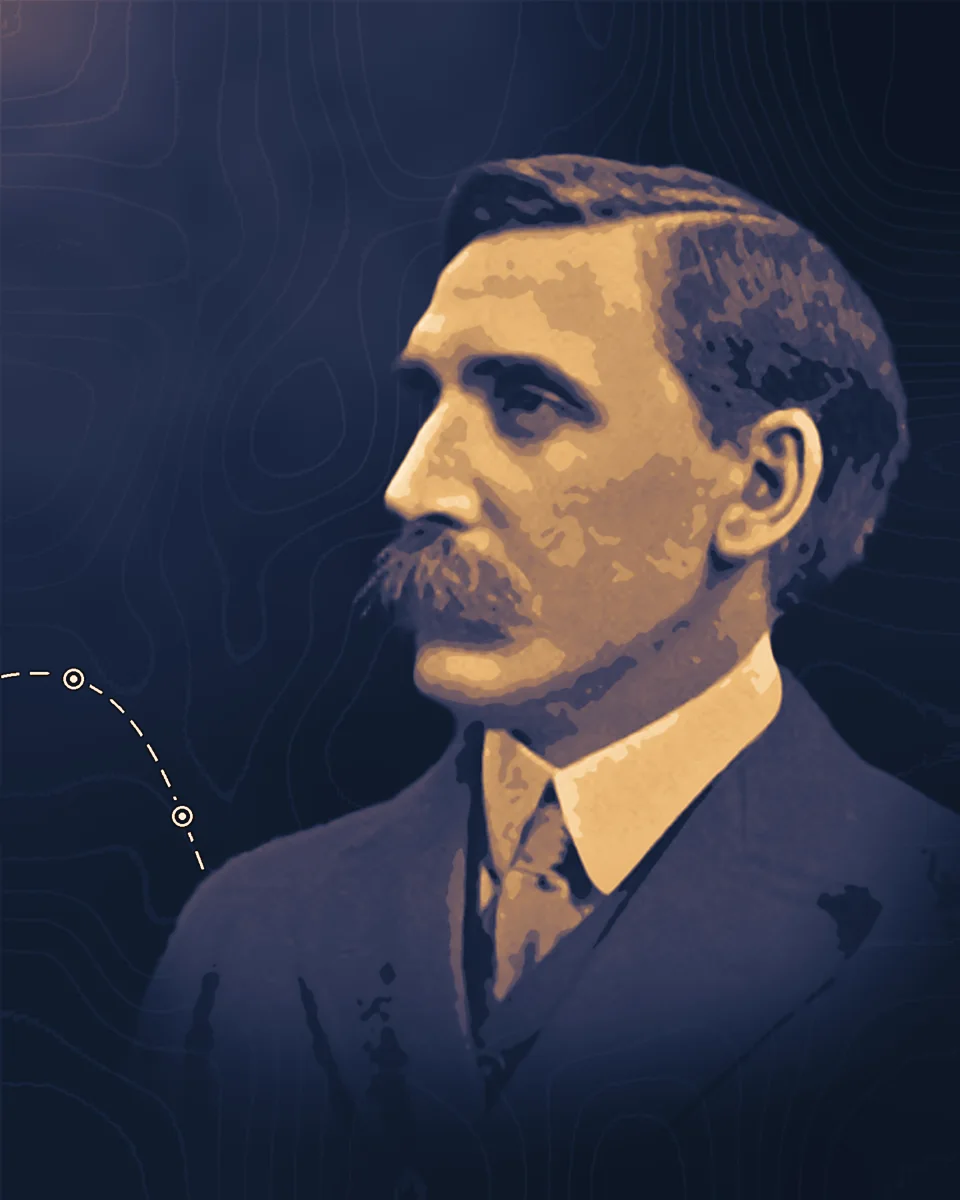
Sebastian Ziani de Ferranti
He built the Deptford power station on the Thames and sent its current into central London at 10,000 volts through cables of his own design.
1864–1930
What they changed
1886
Grosvenor Gallery goes parallel
Sir Coutts Lindsay's company supplied lamps around the Grosvenor Gallery in Bond Street, London, at first through Gaulard and Gibbs transformers wired in series, and the lamps' voltage was hard to hold steady. Ferranti, made its engineer at 22, installed two 750-horsepower alternators working at 2,500 volts and connected the transformers in parallel, the arrangement that keeps each customer's voltage steady whatever the others draw. Overhead lines then carried the supply from Lincoln's Inn Fields to Albert Gate and from Regent's Park to Charing Cross, by the obituary in Engineering.
1888
A power station outside town
Ferranti judged that a station in a crowded district was wrong in principle, and placed the next one where coal and water were easy to bring, on the Thames at Deptford, to supply a wide area through high-voltage mains. Work began in April 1888 on a station designed for 13,000 horsepower at first and 65,000 in the end, with 10,000-horsepower machines planned. The Electric Lighting Act of 1888 and the Board of Trade cut down the area it could serve, and smaller sets were installed. The Institution of Electrical Engineers' obituary says the plan went against "all the existing ideas of other engineers", who put stations as near the centre of their areas as they could.
1890
Paper-insulated mains
Cables made by the best practice of the day kept breaking down at 10,000 volts, until Ferranti made mains of two concentric copper tubes separated by paper soaked in ozokerite wax, laid in 20-foot lengths. The Science Museum Group holds a sample of what it calls "the first paper-insulated 10,000-volt electricity supply cable", made by his firm for the Deptford scheme and in use from 1890 to 1933.
1891
10,000 volts into London
Supply from Deptford reached the West End in February 1891 through a substation at the Grosvenor Gallery, which lowered the voltage, by The Times as recorded in Grace's Guide, a British industrial-history archive. Mains at 10,000 volts fed substations that lowered it to 2,500 volts, and transformers in the streets lowered it again to 50 or 100 volts for customers. The American Institute of Electrical Engineers' biography of him dates the start of regular transmission at 10,000 volts into the city to 1891.
1910
Electricity from a few stations
In his inaugural address as president of the Institution of Electrical Engineers on 10 November 1910, Ferranti argued that all the coal Britain burned for heat and power should be turned into electricity "at a comparatively small number of great electricity producing stations" and the current distributed all over the country. For his estimate he took 100 stations of 250,000 kilowatts, each with ten 25,000-kilowatt generators, built near coal and cooling water. Engineering's obituary in 1930 called the national scheme then being worked out "nothing more than an embodiment of what Ferranti suggested".
Life
Sebastian Ziani de Ferranti was born in Liverpool on 9 April 1864, the son of César de Ferranti and Juliana Scott, a daughter of the painter William Scott. He was educated at St Augustine's College, Ramsgate, and for a short time at University College London; the IEE's obituary says his science was mostly self-taught. He joined Siemens Brothers in London as a youth, at 16 by one obituary and 17 by another, and in 1882 took out his first patent, for the machine later known as the Ferranti alternator. Engineering's obituary notes that its zigzag winding had already occurred to Sir William Thomson, later Lord Kelvin, with whom he made a manufacturing agreement.
Credit at the Grosvenor Gallery was contested. Ferranti took over a supply built on Gaulard and Gibbs's series transformers, and the IEE's obituary says he had also seen the Hungarian Zipernowsky transformers worked in parallel, the arrangement the Ganz engineers had patented in 1885. In March 1887 Gaulard, Gibbs and their company gave notice of an action against Sir Coutts Lindsay and Co. and Ferranti for infringing their patents. Grace's Guide records that their 1882 patent was revoked in 1888, and that Ferranti had challenged it in court, saying it was being used to interfere with his business.
gracesguide.co.ukpp.bme.hugracesguide.co.ukgracesguide.co.uk
Deptford cost failures as well as ideas. Engineering's obituary says that at one point only one cable between Deptford and London still worked, and only at half its pressure; that a trial of the earth as the return conductor upset Post Office and railway telegraph lines and was given up; and that the 10,000-volt switchgear was a danger to the people who worked it. A short circuit on the switchboard at the Grosvenor Gallery shut the whole system down for about three months, and the company lost many customers after a fire at that substation. In 1889 a steam pipe failed at Deptford and killed one person, during a visit by a Board of Trade inspector. The company dispensed with Ferranti's services in 1891, by Grace's Guide's account; Engineering says he resigned in 1892.
After Deptford he worked mainly as a manufacturer. His firm opened a factory at Hollinwood, near Oldham, in 1896, and made transformers, meters, rectifiers for arc lighting, oil switches and fuses; Engineering counted his mercury meter among its most successful products. After a financial crisis in 1903 he was kept out of the Hollinwood works for much of the next eleven years, and Engineering judged his long work on steam turbines to have given "meagre" results. The Institution of Mechanical Engineers counted 176 patents in his name between 1882 and 1927, only five of them shared.
He was president of the Institution of Electrical Engineers for 1910 and 1911, received an honorary doctorate from the University of Manchester in 1911 and the IEE's Faraday Medal in 1924, and was elected a Fellow of the Royal Society in 1927. The American Institute of Electrical Engineers made him an honorary member on 12 January 1912. In his last years he fitted his own homes to do every household task by electricity and spoke widely for its use. He married Gertrude Ruth Ince in 1888, and they had three sons and four daughters. He died in Zurich on 13 January 1930.
Read more
6 accounts
Inaugural Address, S. Z. de Ferranti, Journal of the Institution of Electrical Engineers, vol. 46, 1911.
His address of 10 November 1910 on coal, food and labour, with his plan for a hundred great power stations.
archive.org
Sebastian Ziani de Ferranti, Grace's Guide to British Industrial History, undated. A dated outline of his life, with the full obituaries from Engineering, the Institution of Mechanical Engineers and the Institution of Electrical Engineers, all of 1930.
gracesguide.co.uk
Sebastian Ziani de Ferranti, Engineering and Technology History Wiki, IEEE History Center, undated. The American Institute of Electrical Engineers' biography of him.
ethw.org
Papers of Sebastian Ziani de Ferranti, IEEE Archives, undated. Scans of his file at the American Institute of Electrical Engineers, from his application of 1903 to the obituaries and memorial resolution of 1930.
ethw.org
The Life and Letters of Sebastian Ziani de Ferranti, Gertrude Ziani de Ferranti and Richard Ince, Williams & Norgate, 1934.
The life by his widow and his brother-in-law, with facsimiles of his letters; a lending copy is on the Internet Archive.
archive.org
London Electric Supply Corporation, Grace's Guide to British Industrial History, undated. The history of the company that built Deptford, from the Grosvenor Gallery to nationalisation, with its newspaper sources.
gracesguide.co.uk