Industries / Figureheads
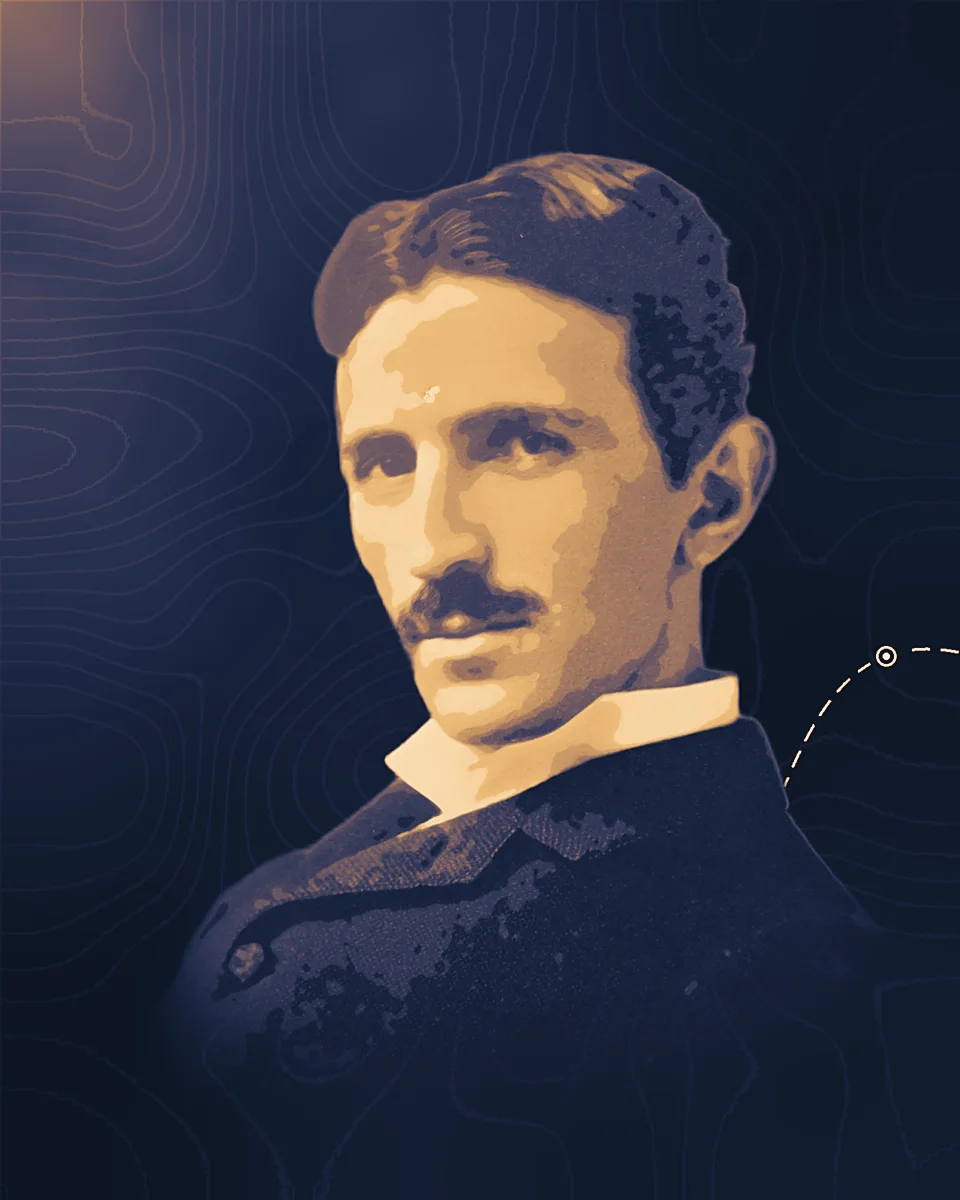
Nikola Tesla
He designed a system of alternating-current generators, transformers and motors working on several currents out of step with one another, the kind of system power plants have used since Niagara.
1856–1943
What they changed
1883
A motor with no brushes
As a student at Graz, Tesla saw a Gramme dynamo run as a motor and began looking for a way to use alternating current. In Budapest he pictured a magnetic field that rotates, made by two or more alternating currents out of step, which can drag a rotor round without any sliding contacts. He built his first such induction motor in Strasbourg in 1883.
1888
A whole system patented
The two basic patents for his polyphase motor were granted in 1888, and he filed some three dozen more by 1891. The energy historian Vaclav Smil writes that he "designed not only the AC induction motors but also the requisite AC transformers and distribution system." Polyphase means several alternating currents carried together, each rising and falling a little after the last.
1888
Westinghouse buys the patents
George Westinghouse bought the rights to the system in 1888 and hired Tesla to fit the motor to his company's alternating-current network.
1893
Chicago lit by alternating current
Westinghouse lit the World's Columbian Exposition in Chicago with Tesla's system. The success helped win the contract for the first generators at Niagara Falls.
1895
Niagara
The Adams plant at Niagara Falls began supplying power on 26 August 1895, and its machinery carried Tesla's name and patent numbers. IEEE calls it "the first large-scale multiphase power station" in commercial operation and "a key victory for alternating-current systems over direct-current." Power reached Buffalo by 1896.
Life
Nikola Tesla was born on the night of 9 to 10 July 1856 at Smiljan, then in the Austrian Empire and now in Croatia, to a Serbian family. His father was an Orthodox priest. He studied engineering at the technical university in Graz and at the University of Prague, and in 1881 went to Budapest to help install a telephone exchange.
In 1882 he went to work in Paris for the Continental Edison Company. He sailed for New York in 1884 and worked for Thomas Edison, but the two soon parted. Britannica says they were far apart in background and methods. Within four years he held the patents that Westinghouse bought.
He was not the only man with the idea, and not the first into print. Galileo Ferraris lectured on alternating-current motors to the Royal Academy of Science in Turin in March 1888 and published a month later, before Tesla lectured to the American Institute of Electrical Engineers. The three-phase form that the world settled on owes much to others: Mikhail Dolivo-Dobrovolsky of the German firm AEG built the first three-phase induction motor in 1889.
When Westinghouse's company ran short of money, Tesla by IEEE's account "supposedly tore up his contract and refused further royalties." He became a United States citizen in 1891, the year he invented the Tesla coil, an induction coil later widely used in radio. A fire in 1895 destroyed his laboratory with his notes and equipment.
After 1899 his work moved away from power plants. He spent 1899 and 1900 at Colorado Springs on experiments in sending power without wires, then began a tower on Long Island for worldwide wireless communication with $150,000 from the financier J. Pierpont Morgan. The project was abandoned when the money ran out. His later claims, among them a "death ray" and signals from another planet, drew sharp criticism from scientists.
The American Institute of Electrical Engineers gave him its Edison Medal for "meritorious achievement in his early original work in polyphase and high-frequency electrical currents." He died in New York on 7 January 1943, living alone in a hotel room. His papers went to the Nikola Tesla Museum in Belgrade, and in 1960 the unit of magnetic flux density was named the tesla.
Read more
4 accounts
My Inventions, Nikola Tesla, 1919.
His own account of his early life and the rotating field, first printed in the magazine Electrical Experimenter.
archive.org
May 1888: Tesla Files His Patents for the Electric Motor, Vaclav Smil, IEEE Spectrum, 2018.
A short assessment that sets Tesla beside Ferraris and Dolivo-Dobrovolsky.
spectrum.ieee.org
Milestones: Adams Hydroelectric Generating Plant, 1895, IEEE History Center, 1990.
The engineering record of the Niagara plant.
ethw.org
Nikola Tesla, IEEE History Center, Engineering and Technology History Wiki, undated. The engineers' society's short life, with the Edison Medal citation.
ethw.org