Industries / Figureheads
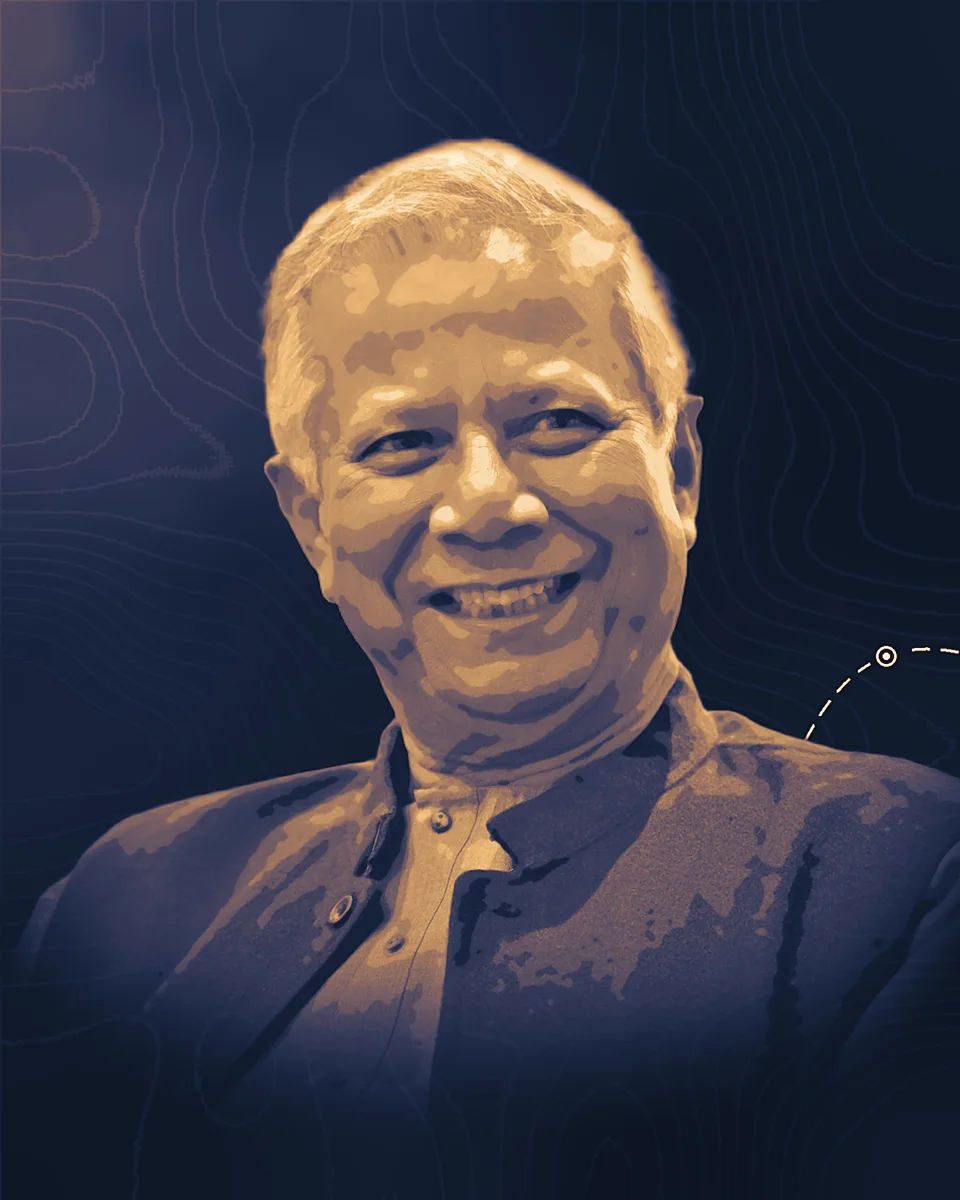
Muhammad Yunus
A Bangladeshi economist, he built the Grameen Bank's way of lending small sums to poor village women in groups without collateral, which was copied around the world as microcredit.
born 1940
What they changed
1974
Lending his own money
Teaching economics at Chittagong University after the famine of 1974, Yunus found villagers in debt to moneylenders on harsh terms. In his Nobel lecture he says his first list had 42 borrowers who owed US$27 in all, and he paid it from his own pocket. When the bank on the campus would not lend to the poor, he stood guarantor for their loans himself, and he says they paid back on time.
1970s
Groups in place of collateral
Many of his first borrowers did not repay, so he tried other ways to lend, by David Hulme's account. The model that worked lent to poor rural women, organized in groups of five that took responsibility for each other's loans, in place of collateral, the property a borrower pledges. Six groups met at a set time each week to apply for loans and repay them, members saved a little each week, and loans were small and standard with small regular repayments. The state-run Bangladesh Krishi Bank financed and housed the experiment.
1983
A bank by ordinance
Yunus negotiated a Grameen Bank Ordinance in 1983, under the military government of General Ershad. It made the bank a state-chartered body overseen by a board of Yunus, a few state officials and a larger group of the bank's clients, which Hulme says gave Yunus firm personal control. By 1991 it had more than a million clients.
2001
Grameen II
By the late 1990s many borrowers had taken on more debt than they could repay, and branch managers were hiding defaults by issuing new loans to pay old ones. Between March 2001 and August 2002 all 1,200 branches moved to a new model, Grameen II, which dropped joint liability, offered flexible loans and turned to savings from members and the public. From 2002 to 2005 deposits tripled to US$478 million, by Hulme's figures.
2006
A Nobel for microcredit
The Norwegian Nobel Committee divided the 2006 Peace Prize equally between Yunus and the Grameen Bank "for their efforts to create economic and social development from below". It wrote that loans to poor people without any financial security "had appeared to be an impossible idea".
Life
Muhammad Yunus was born on 28 June 1940 in Chittagong, then in British India. He studied at Dhaka University, went to Vanderbilt University in the United States on a Fulbright scholarship, and took his doctorate in economics there in 1969. He taught at Middle Tennessee State University, then went home to head the economics department at Chittagong University.
The model spread fast. Hulme, of the University of Manchester, says it was copied in more than 40 countries, and the Nobel Foundation's biography says more than 100. Hulme credits the bank with proving that "the poor are bankable", and counts 7.4 million clients and US$545 million in loans outstanding at the end of February 2008. He also writes that Yunus promoted microenterprise credit as a cure for poverty, which Hulme thought "so wrong", and that independent fieldwork found borrowers using loans for food, health, schooling and even dowry as well as business.
The effects of microcredit itself turned out to be smaller than its champions claimed. In 2015 Abhijit Banerjee, Dean Karlan and Jonathan Zinman summed up six randomized evaluations in six countries on four continents and found "a consistent pattern of modestly positive, but not transformative, effects".
His public life in Bangladesh has been contested. In 2011 he was removed as the Grameen Bank's managing director on the ground that he had stayed past the legal retirement age of 60, and on 5 April 2011 the Supreme Court rejected his final appeal. He called the removal illegal and said the government was trying to take control of the bank. Al Jazeera reported that the prime minister, Sheikh Hasina, had accused him of "sucking blood from the poor" after a Norwegian television documentary of December 2010, and that the Norwegian government found no evidence of misuse of funds or corruption.
On 1 January 2024 a Dhaka labour court sentenced him and three officials of Grameen Telecom to six months in prison for breaking labour law, and on 7 August 2024 an appeals tribunal annulled the sentences. That August, after a student-led uprising brought down Hasina's government, he returned from self-imposed exile to serve as chief adviser of an interim government. He stepped down on 16 February 2026, after an election that the Bangladesh Nationalist Party won.
Read more
5 accounts
Grameen Bank and I, Muhammad Yunus, 2006.
His Nobel lecture, with his own account of the first loans in Jobra and the bank's figures that year.
nobelprize.org
Banker to the Poor: The Autobiography of Muhammad Yunus, Founder of Grameen Bank, Muhammad Yunus, 1998.
His own book-length account.
archive.org
The Story of the Grameen Bank: From Subsidised Microcredit to Market-based Microfinance, David Hulme, University of Manchester, 2008.
A critical history by a researcher who followed the bank from 1987, through its crisis and Grameen II.
hummedia.manchester.ac.uk
Six Randomized Evaluations of Microcredit: Introduction and Further Steps, Abhijit Banerjee, Dean Karlan and Jonathan Zinman, American Economic Journal: Applied Economics, 2015.
What the controlled trials found microcredit did and did not do.
aeaweb.org
The Nobel Peace Prize 2006, press release, Norwegian Nobel Committee, 2006.
Why the committee gave the prize to him and the bank together.
nobelprize.org