Industries / Figureheads
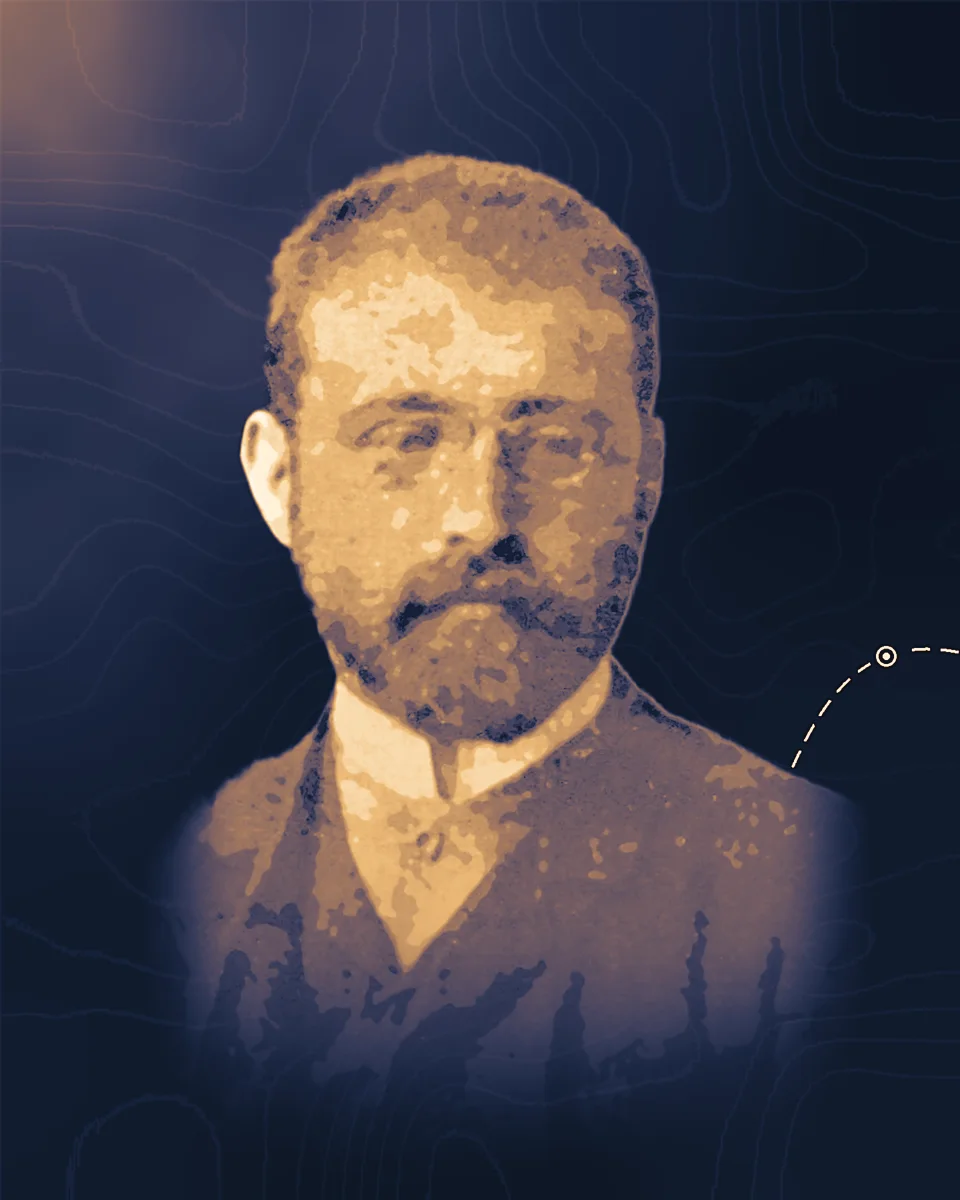
Miksa Déri
At the Ganz Works he did most of the experiments behind the 1885 transformer system and built its first central stations, and he later designed the repulsion motor that carries his name.
1854–1938
What they changed
1882
A self-excited alternator
With Károly Zipernowsky he designed an alternator of 1,350 V and 70 Hz that fed its own field magnets, so it needed no separate exciting machine, and Ganz began making it in 1883, by the Hungarian patent office's account. The Electrical World listed a self-exciting alternating-current dynamo of 1882 first among his patents. A Ganz alternator of the same voltage and frequency fed the transformers at the Budapest exhibition of 1885.
1885
Testing the transformer
Déri had worked in Vienna as Ganz's Austrian representative since 1883, and in 1884, under Zipernowsky's direction, he began experiments on distributing power through transformers connected in parallel. The patent office's biography says he did the greater part of the experimental work on the closed-core transformer. Early in 1885 he showed the Ganz system at the Technologisches Gewerbemuseum in Vienna, and his name is on all three patents of February and March 1885 that Uppenborn lists, one of them his alone.
1886
Building the first stations
The Electrical World wrote in 1892 that Déri personally superintended the construction of the first central stations with transformers of the Zipernowsky-Déri-Bláthy system, in Lucerne, Milan, Rome and other places, until 1889. The Cerchi station in Rome, built in 1886, sent single-phase current at 2,000 V through underground cables to transformer stations in the city, where it was lowered to 150 V.
1889
A power company in Vienna
In 1889 he became managing director of the new Internationale Elektricitäts-Gesellschaft in Vienna and built several central stations for it, one of them in Vienna itself. The Hungarian patent office calls it the first company in Europe set up only to finance the building of power stations.
1903
The Déri repulsion motor
In 1903 and 1904 he designed a single-phase AC motor with two sets of brushes, known as the Déri motor. The patent office says it filled a gap in lifts, which no motor then in use could run safely, that Brown, Boveri & Cie of Switzerland bought the right to make it, and that AEG used it on single-phase railways.
Life
Miksa Déri was born on 27 October 1854 in Bács, in the south of the former Bács-Bodrog county of Hungary, into a wealthy merchant family. He began his engineering studies at the technical university in Budapest and took a diploma in hydraulic engineering at the polytechnic in Vienna in 1877. From 1878 to 1882 he worked for the Hungarian government on the regulation of the Danube and the Tisza. He studied electricity on the side, and in 1881 the Minister of Public Works sent him to the electrical exhibition in Paris. In 1882 he joined Ganz in Budapest as an electrical engineer.
The transformer system had a forerunner. Lucien Gaulard and John Dixon Gibbs applied for a British patent in 1882 on "secondary generators", induction coils with open iron cores and equal windings wired in series, and showed them in London in 1883 and at Turin in 1884. Ottó Bláthy saw them at Turin, and his report gave new impetus to the work Zipernowsky and Déri already had in hand. Péter Asztalos, writing from the Ganz Electric Works in 1986, credits the parallel connection to Zipernowsky working with Déri and the closed core to Bláthy, and records that the three agreed in September 1885 to share the income 40% each to Zipernowsky and Déri and 20% to Bláthy, changed in 1889 to 35, 35 and 30. MTESZ, the Hungarian federation of technical societies, puts it in three parts: the parallel idea Zipernowsky's, the experiments Déri's, the closed core Bláthy's. Their United States patent, filed on 7 May 1885, names Déri as "residing at Vienna".
In the United States the credit goes to William Stanley, whose transformers lit Main Street in Great Barrington, Massachusetts, in March 1886; IEEE's milestone there calls him the first to understand that transformers had to be wired in parallel and needed a closed iron core. Asztalos replies that the Ganz system was described in New York's Electrical Review on 3 October 1885, before Stanley's patent applications of 23 October and 23 November. Stanley himself wrote in 1912 that the three Ganz engineers "disclosed the alternating-current system as we now use it." Friedrich Uppenborn, whose History of the Transformer appeared in German in 1888, gave the fame for the closed-core transformer and its self-regulating parallel system to Zipernowsky, Déri and Bláthy together.
Déri's later work was based in Vienna. In 1889 Ganz built the first large alternating-current station in Vienna, by Elektrotechnische Zeitschrift's account, and the patent office says Déri organized and equipped the city's power station that year. After the transformer he turned to new machines: a combined electromagnetic and eddy-current brake for railway cars, for which he applied for a patent in 1897; a compensated direct-current machine, built between 1898 and 1902, with its compensating winding laid in slots in the stator, which was used to drive large reversing rolling mills; and the repulsion motor.
In 1930 the Elektrotechnischer Verein in Berlin, at its fiftieth jubilee, made "Hofrat Dr.-Ing. Max Déri in Meran" a corresponding member. He had retired to Merano, and he died there on 5 March 1938.
Read more
5 accounts
Déri Miksa, Hungarian Intellectual Property Office, archived 2024.
The patent office's Hungarian-language life, with a list of his Hungarian patents after 1895.
web.archive.org
Electrical World Portraits No. XXXIII, The Electrical World, 1892.
A profile of all three Ganz engineers written in their lifetimes, with the dates of Déri's patents and the stations he built.
archive.org
History of the Transformer, F. Uppenborn, 1889.
The English edition of a history first published in German in 1888, with the Ganz patents of 1885 and what set them apart.
archive.org
Centenary of the Transformer, Péter Asztalos, Periodica Polytechnica Electrical Engineering, 1986.
The Ganz Electric Works' history of the invention from its own records, including the Vienna demonstration of 1885.
pp.bme.hu
Induction apparatus for transforming electric currents, Karl Zipernowsky, Maximilian Déri and Otto Titus Bláthy, US patent 352,105, 1886.
The three engineers' own description of the closed-core transformer.
patents.google.com
Industries
Electric transmission and distributionTransformers and switchgear