Industries / Figureheads
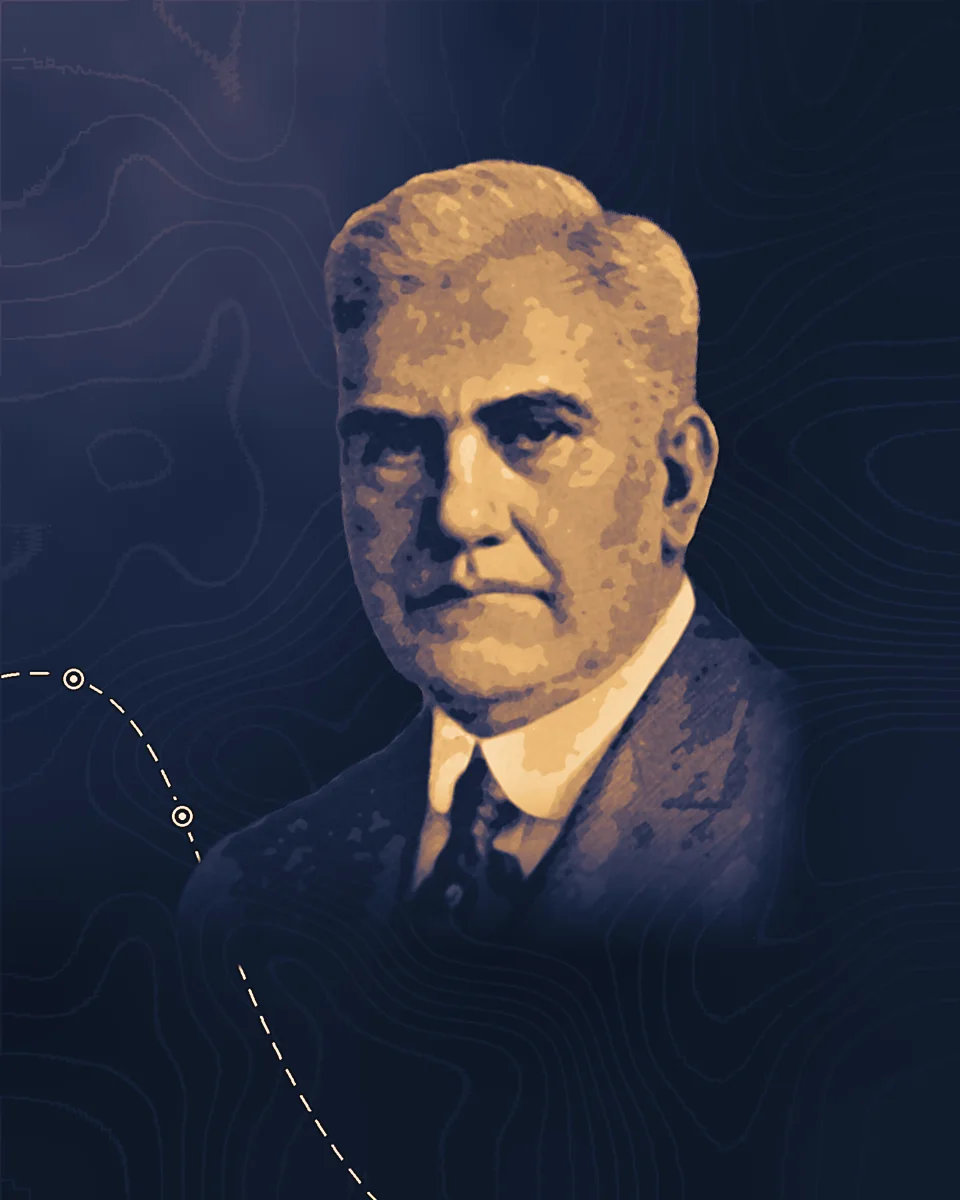
Michael J. Owens
He built the machine that made glass bottles without a glassblower, which made them cheap, uniform and plentiful.
1859–1923
What they changed
1895
Tumblers and chimneys by machine
Owens and his employer Edward D. Libbey formed the Toledo Glass Company in 1895 to develop his patents. His machines for blowing tumblers and lamp chimneys ran commercially, and the rights were sold to makers in Rochester, Pennsylvania, and Pittsburgh.
1903
Bottles without a blower
Owens devised what the American Society of Mechanical Engineers (ASME) calls "the first commercially successful, fully automatic bottle-making machine". A writer quoted in a Toledo history of 1923 said the machine feeds itself with molten glass, "sucks it up methodically, clutches it with iron hands, blows its breath into it" and drops a finished bottle. Until then, the same history says, glass containers had always been blown by human lung power. The Owens Bottle Machine Company was formed that year to build, run and license it.
1912
Bottles in every size
The AR model of 1912 averaged 50,400 bottles a day and made sizes from small medicine bottles to gallon jars. ASME says the Owens machines made glass containers cheap and plentiful. Food and drink packers could now buy identical bottles by the million, which filling and capping machines need.
1913
Boys out of the glasshouse
Glass plants had put boys to work, as Owens himself had been at ten. ASME says the Owens machines ended child labor in glass-container plants. In 1913 the National Child Labor Committee said the automatic machine had done more to end child labor in the trade than it had managed through legislation.
1916
Window glass drawn flat
From about 1911 Owens and his partners bought and developed Irving Colburn's failed patents for drawing window glass as a continuous flat sheet. In 1916 he opened a factory at Charleston, West Virginia, that became the world's largest maker of window glass.
Life
Michael Joseph Owens was born on 1 January 1859 in Mason County, in what is now West Virginia, to poor Irish immigrants from County Wexford. The West Virginia Encyclopedia says he worked with his father in a coal mine before he was ten and was hurt in a slate fall. The family moved to Wheeling, and at ten he was tending a furnace at the Hobbs, Brockunier glassworks. By fifteen he was a glassblower.
He rose in the union and became an officer of the American Flint Glass Workers. In August 1888 he went to Toledo, Ohio, as a blower in Edward Libbey's new factory, and three months later he was its superintendent. He ran the Libbey exhibit at the Chicago World's Fair of 1893, where glass was made and cut in front of visitors.
Owens had the ideas and Libbey the money. ASME names the engineers who turned the bottle machine into metal: William Boch, C. William Schwenzfeier and Richard LaFrance. A Toledo history printed in 1923 describes the machine of that year as weighing over 100,000 pounds, with about 10,000 parts and fifteen arms, and making 150 bottles a minute.
The machine did to skilled blowers what Owens had once been. A man who began as a child laborer and a union officer built the machine that removed both the boys and the craft from bottle making. The sources opened here record the end of child labor and do not count the blowers who lost their trade.
The company set up a European arm in 1905 with a factory at Manchester, England, and by 1923 the Toledo history called it the largest maker of bottles in the world. Owens died suddenly on 27 December 1923, while working on safer glass for automobiles. The last Owens machines ran at Gas City, Indiana, until 17 December 1982.
Read more
3 accounts
Owens AR Bottle Machine, American Society of Mechanical Engineers, 1983.
The engineering landmark record, with the machine's output and the child labor finding.
asme.org
Michael J. Owens, Fred A. Barkey, e-WV: The West Virginia Encyclopedia, revised 2024.
A short life by a labor historian, from the coal mine to the window glass works.
wvencyclopedia.org
Michael Joseph Owens, in Toledo and Lucas County, Ohio, 1623–1923, volume 2, 1923.
A biographical sketch printed in the year he died, with the company's history as his associates told it.
archive.org