Industries / Figureheads
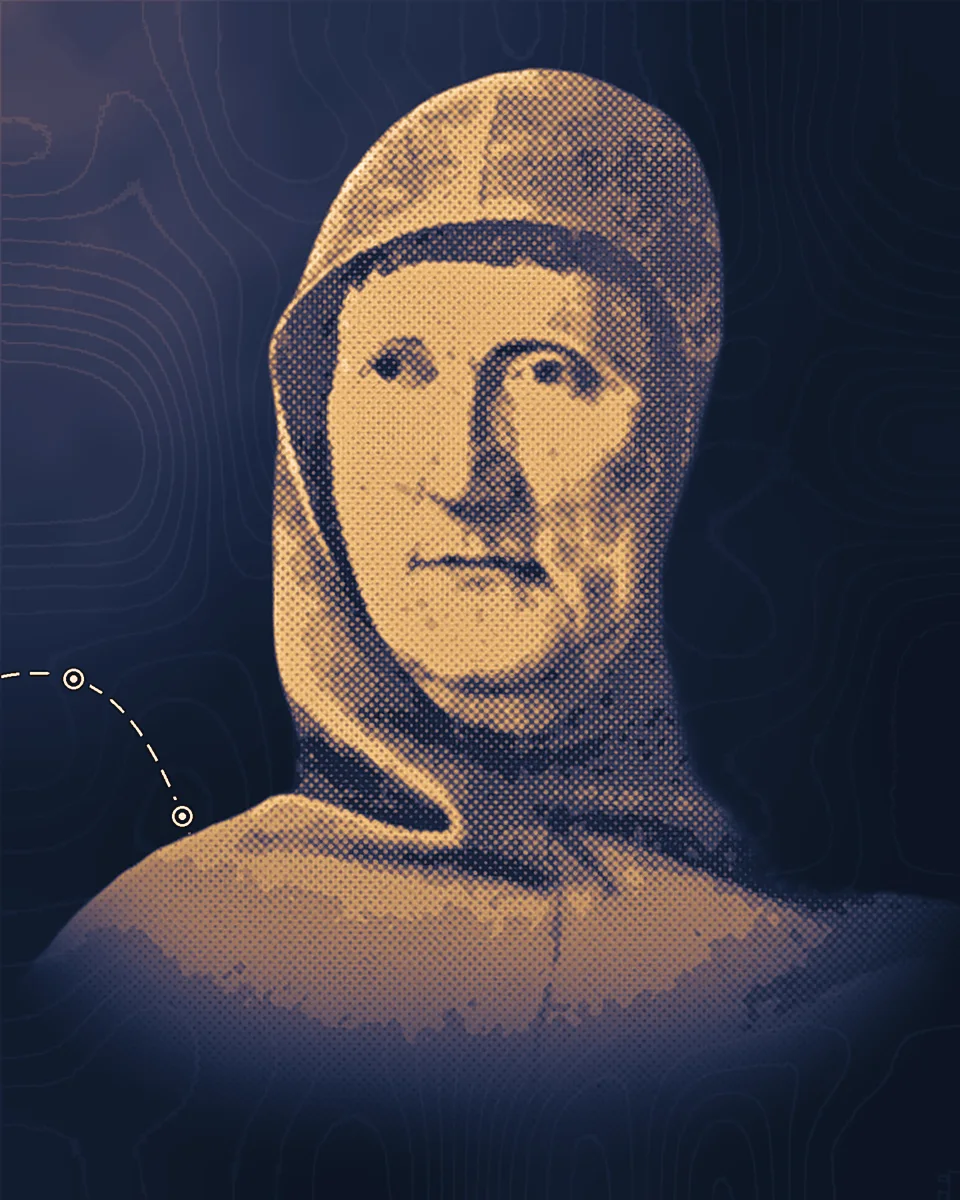
Luca Pacioli
An Italian friar and mathematician, he put the Venetian merchants' double-entry bookkeeping into print in 1494, and his account became the model for bookkeeping manuals across Europe.
c. 1445–1517
What they changed
1494
Double entry in print
Pacioli went to Venice in 1494 to publish his Summa de arithmetica, geometria, proportioni et proportionalita, a 600-page work in Italian covering arithmetic, algebra, geometry, a table of the moneys, weights and measures of the Italian states, and "a treatise on double-entry bookkeeping", by the account of the MacTutor history. In double-entry bookkeeping every transaction is written twice, as a debit in one account and a credit in another, so the books can be checked by seeing that they balance. John Geijsbeek's 1914 translation calls him "the earliest known writer on bookkeeping".
1494
Inventory, then three books
The treatise tells a merchant to start with an inventory of all he owns, all that is owed to him and all he owes, made in a single day, and then to keep three books: a memorandum book for every transaction as it happens, a journal that puts them in order, and a ledger of accounts. It notes that many small traders used only the journal and the ledger.
1494
The method of Venice
Pacioli did not claim to have invented double entry. He called what he described "the method of Venice", as distinct from the methods of other cities. Historians date double-entry ledgers in Italy well before him: Mikhail Kuter and Marina Gurskaya call the Farolfi company's ledger of 1299–1300 the earliest kept by its rules, and Genoa's city museums date its first use in public accounts to the city treasurers' register of 1340.
1500s
Copied across Europe
Geijsbeek, an American accountant, wrote that Pacioli's work was "the real foundation of all books published in Germany, Holland, France, and England" on bookkeeping in the first hundred years after it. Domenico Manzoni's Venetian manual of 1534, which ran to six or seven editions in forty years, followed it without giving Pacioli any credit, and the line ran on through Dutch and English writers to Richard Dafforne's The Merchants' Mirrour of 1636.
Life
Luca Pacioli was born in Sansepolcro, in central Italy, about 1445; Pietro Crivelli's 1924 account puts his birth between 1445 and 1450. His father was Bartolomeo Pacioli, but he grew up in the house of the Befolci family. The painter Piero della Francesca had a workshop in the town, and MacTutor's authors think it likely that Pacioli learned some of his mathematics there.
As a young man he went to Venice to tutor the three sons of a rich merchant, Antonio Rompiasi, and helped with his business while he studied mathematics under Domenico Bragadino. He wrote his first arithmetic book there in 1470. He then spent some months in Rome in the house of Leone Battista Alberti, studied theology and became a Franciscan friar. From 1477 he taught mathematics at Perugia, Zara, Naples and Rome.
He wrote the Summa in his home town and dedicated it to Guidobaldo da Montefeltro, Duke of Urbino, whom he had tutored. MacTutor says it showed "little in the way of original ideas" and that he admitted borrowing freely from Euclid, Boethius, Sacrobosco, Fibonacci and others; its value was as a summary that later mathematicians built on. A portrait of 1495 attributed to Jacopo de' Barbari shows him with the Summa open before him, beside a young man whom Crivelli identifies as Guidobaldo.
About 1496 Ludovico Sforza invited him to teach mathematics at his court in Milan, where Pacioli and Leonardo da Vinci became close friends, and Leonardo drew the figures for Pacioli's Divina proportione, a study of the golden ratio published in 1509. When French armies took Milan the two fled together in December 1499 and later shared a house in Florence, where Pacioli taught geometry until 1506. He died in Sansepolcro in 1517.
His credit has been disputed. In 1550 Giorgio Vasari, in his life of Piero della Francesca, accused Pacioli of stealing Piero's work on perspective, arithmetic and geometry. MacTutor calls this unfair: Pacioli leaned heavily on others, and on Piero above all, but acknowledged the sources he used.
Read more
4 accounts
Ancient Double-Entry Bookkeeping: Lucas Pacioli's Treatise, John B. Geijsbeek, 1914.
A facsimile and English translation of the bookkeeping treatise, with its influence on the writers who followed.
archive.org
An Original Translation of the Treatise on Double-Entry Book-keeping, Pietro Crivelli, Institute of Book-keepers, 1924.
A second translation, with a life of Pacioli and a note on the portrait.
archive.org
Luca Pacioli, J. J. O'Connor and E. F. Robertson, MacTutor History of Mathematics, University of St Andrews, 1999.
A sourced life of the mathematician, with the plagiarism charge.
mathshistory.st-andrews.ac.uk
The Virtual Reconstruction of the Earliest Double-Entry Accounting Ledger, Mikhail Kuter, Marina Gurskaya and colleagues, Springer, 2018.
A study of the Farolfi ledger of 1299–1300, which shows how far double entry predates Pacioli.
link.springer.com
Industries
Finance and bankingAccountingLegal and professional services