Industries / Figureheads
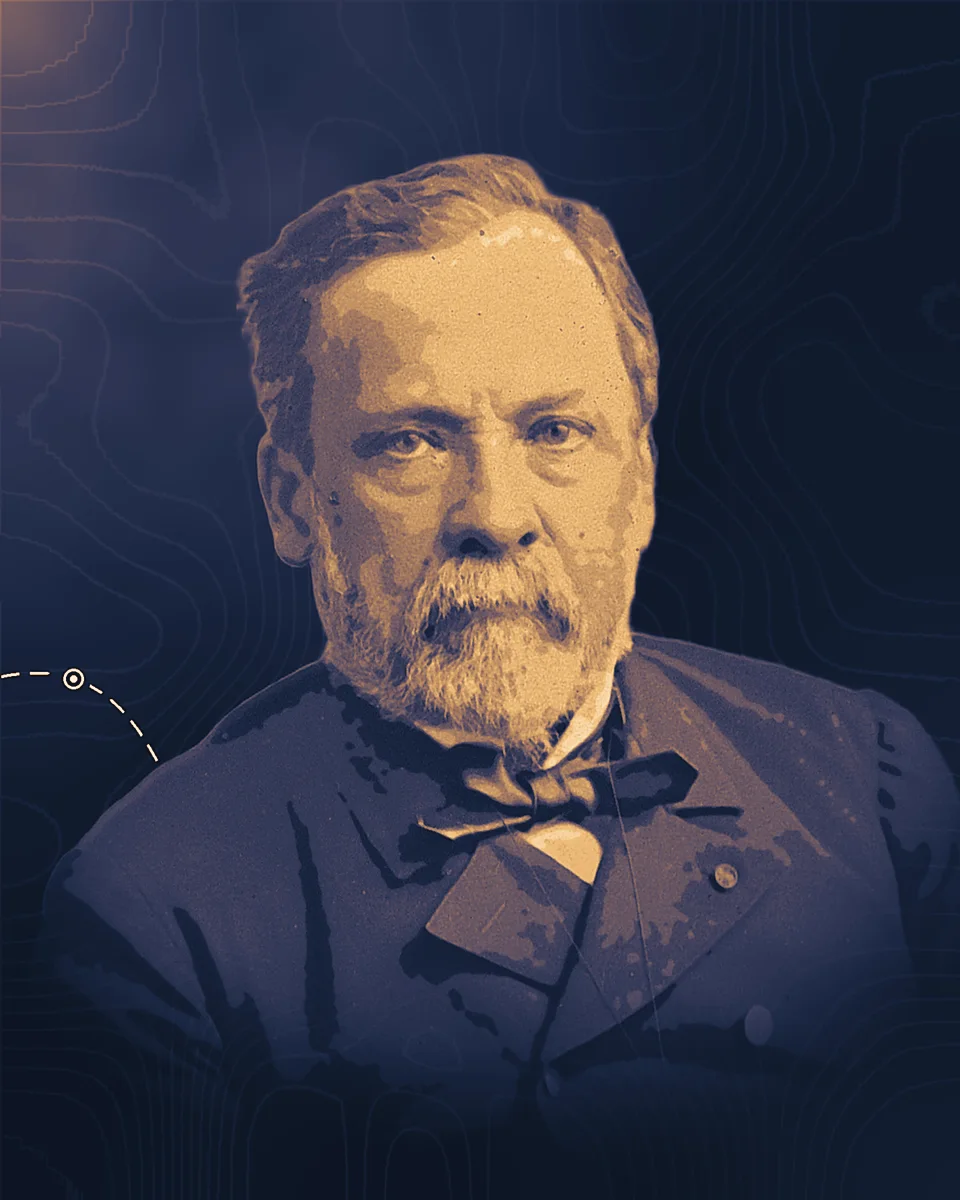
Louis Pasteur
He showed that microbes cause fermentation and spoilage, and that gentle heating stops them without ruining the drink.
1822–1895
What they changed
1857
Fermentation is living work
In August 1857, at Lille, Pasteur presented a memoir on lactic fermentation, the souring of milk. He had been visiting a local factory that made alcohol from beetroot to find out why its batches were going wrong. His conclusion, in the words of the Institut Pasteur, was that each fermentation is caused by a specific microbe. Brewers, winemakers and dairies now had a living cause to control.
1865
Heat that keeps wine
Napoleon III asked Pasteur in 1863 to study the diseases that were spoiling French wine. On 11 April 1865 he filed a patent for preserving wine by heating it to between 60 and 100 °C in closed vessels, and later lowered the range to 50 to 60 °C. The word "pasteurisation" was in use within a few years.
1876
Spoiled beer has a cause
In Études sur la bière Pasteur traced the diseases of beer to bacteria, fungi and stray yeasts. He showed that holding beer at 55 to 60 °C for a short time held back the spoilage organisms, and he urged brewers to watch their fermentations under a microscope.
1885
Vaccines made in a laboratory
After weakened cultures protected sheep from anthrax in a public trial at Pouilly-le-Fort in 1881, Pasteur treated a nine-year-old boy bitten by a rabid dog on 6 July 1885. In 1886 the rabies treatment was given to 2,500 patients in Paris, and the Institut Pasteur opened in November 1888.
1886
Others take it to milk
Pasteur worked on wine and beer, not milk. The German agricultural chemist Franz von Soxhlet first suggested pasteurizing bottled milk in 1886, and in 1909 Chicago became the first American city to enforce it by law.
Life
Louis Pasteur was born on 27 December 1822 at Dole in the Jura, France, the son of a tanner. He entered the École Normale Supérieure in Paris, took his doctorate in 1847, and made his name in chemistry with work on crystals. He became professor of chemistry at Strasbourg in 1849 and, in December 1854, professor and dean of the new Faculty of Sciences at Lille.
Lille was a factory town, and in 1856 he began visiting a distillery owned by a Monsieur Bigo that made alcohol from beetroot. From there he argued that fermentation was the work of living microbes and that the germs came from outside, not from the liquid itself. In 1858 he set up a laboratory in the attic of the École Normale in Paris and spent years on experiments against spontaneous generation, the belief that life arises on its own in decaying matter.
The heating method was not new. Nicolas Appert had kept food and wine by heat half a century earlier. Pasteur defended his priority in letters and notes from 1865 to 1872. The Dictionary of Scientific Biography entry carried by Encyclopedia.com says he at last admitted that Appert had anticipated him, and claimed for himself that he had rescued the technique from oblivion and set it on experiment. What he added was the reason it worked, and with it a way to choose the temperature.
A stroke on 19 October 1868 left his left side paralysed. He kept working. After France lost the war of 1870 to Prussia he turned to beer, hoping to help French brewers match the Germans, and called the result the "Beer of National Revenge". From 1877 he studied infectious disease in animals and then in people.
His laboratory notebooks, which he asked his family to keep private, show that his published accounts did not always match what he did. The Science History Institute's biography says he "altered or exaggerated results in landmark publications". He reported that he had weakened the anthrax germ with air, when the vaccine used at Pouilly-le-Fort had been treated with an antiseptic, a method close to one his competitor Henri Toussaint had already used. He said he had tested the rabies vaccine on about 50 dogs with complete success, and later accounts questioned both the number and the success. The historian Gerald Geison set this out from the notebooks in 1995. Reviewers disagreed over how harshly to read it: Alice Stewart, in Times Higher Education, called the book "a true portrait, warts and all", and the Nobel laureate Max Perutz, in the New York Review of Books, wrote that Geison's evidence "does not survive scientific examination" and that Pasteur owed Toussaint no debt, since Toussaint's vaccine could not be grown in culture.
Pasteur died on 28 September 1895 at Villeneuve-l'Étang, near Paris.
Read more
6 accounts
Studies on Fermentation: The Diseases of Beer, Their Causes, and the Means of Preventing Them, Louis Pasteur, translated by Frank Faulkner and D. Constable Robb, 1879.
His own book on beer in English.
archive.org
The Life of Pasteur, René Vallery-Radot, translated by Mrs. R. L. Devonshire, 1902.
The family's biography, written by his son-in-law, admiring and detailed.
archive.org
The legend of Pasteur turns sour, Alice Stewart, Times Higher Education, 1995.
A review of Gerald Geison's The Private Science of Louis Pasteur (Princeton University Press, 1995), the study of his laboratory notebooks, with its main findings.
timeshighereducation.com
The Pioneer Defended, M. F. Perutz, New York Review of Books, 1995.
A scientist's reply to Geison, arguing that the charges against Pasteur do not hold.
nybooks.com
Louis Pasteur, Science History Institute, undated. A short life that sets the discoveries beside what the notebooks show.
sciencehistory.org
The Lingering Heat over Pasteurized Milk, Bryn Nelson, Distillations, 2009.
How heating moved from wine and beer to milk after Pasteur, and the arguments it met.
sciencehistory.org
Industries
Food and beverage processingBrewing and distillingHealthcarePoultry