Industries / Figureheads
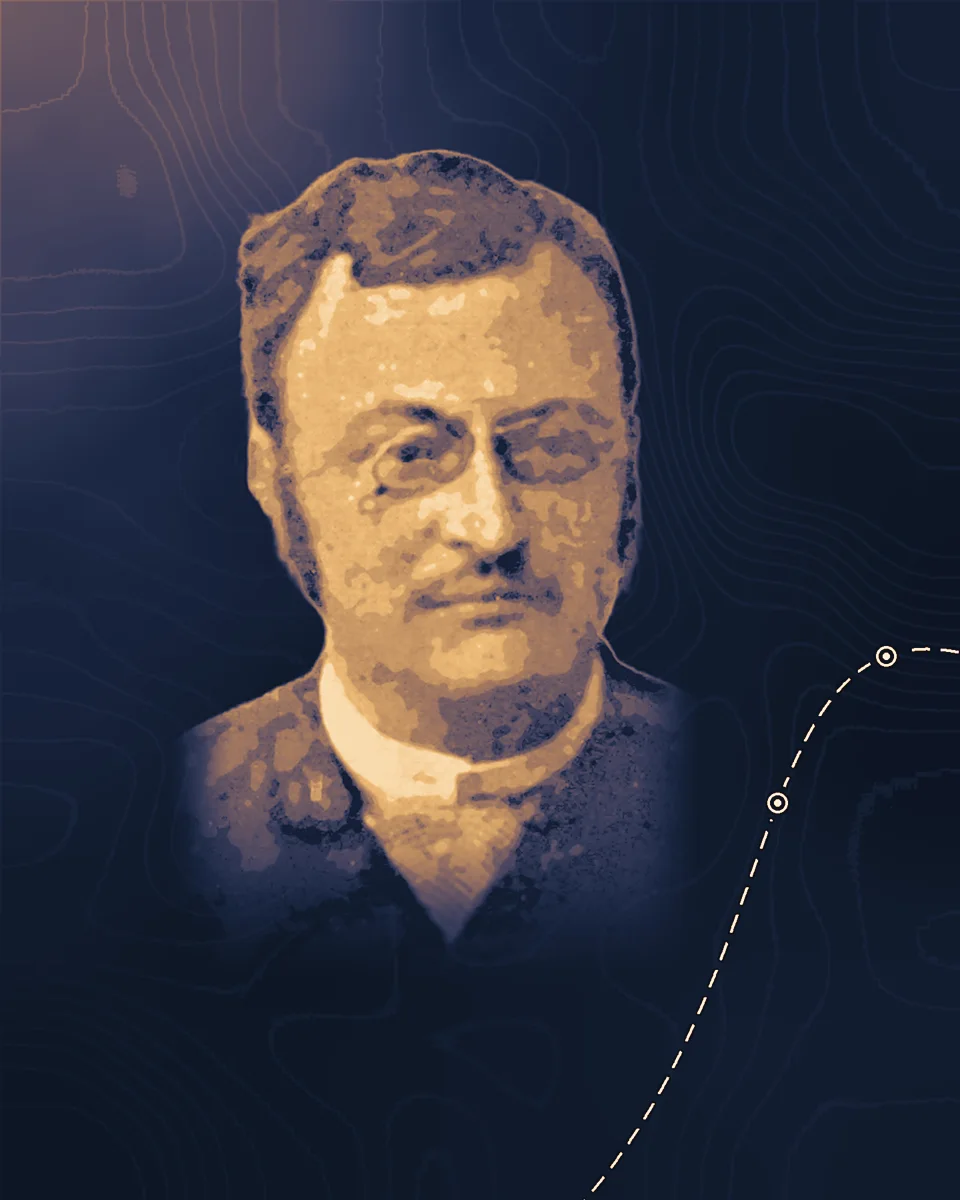
Károly Zipernowsky
He built up the electrical department of the Ganz Works in Budapest and, with Miksa Déri, worked out the parallel connection of transformers that lets one high-voltage AC line feed many customers who each switch on and off without upsetting the rest.
1853–1942
What they changed
1878
Ganz's electrical department
András Mechwart, who ran the Ganz Works in Budapest, invited Zipernowsky to organize an electrical department, and it grew from a small workshop into the firm's electrical works. The Electrical World wrote in 1892 that in his first year there he built the first direct-current dynamo made in Hungary and the firm's first alternating-current dynamo, a type Ganz was still building.
1885
Transformers in parallel
In the earlier transformer systems each coil sat in series on one loop of wire, so a change of load at one customer shifted the voltage at all the others. The first Ganz patent application, filed in Austria-Hungary on 2 January 1885, covered distributing high-voltage AC through transformers connected in parallel, each across the same two main wires, as lamps are in a house. Péter Asztalos's 1986 history says the parallel connection was in all probability Zipernowsky's idea, worked out with Déri.
1885
Lighting the Budapest exhibition
At Hungary's National Exhibition, opened on 1 May 1885, a Ganz alternator at 1,350 V and 70 Hz fed more than 1,000 lamps through transformers, and the installation ran until the exhibition closed in November, by Asztalos's account. Friedrich Uppenborn's History of the Transformer reported that lamps in any circuit could be lit or put out with no perceptible change in the others, and dated to that year the first practical solution of distributing current through transformers.
1886
Central stations abroad
The department he headed moved from exhibits to whole power stations. Asztalos counts close to 60 complete stations delivered by Ganz between 1885 and 1890. One was the Cerchi steam station in Rome of 1886, which sent single-phase current at 2,000 V through underground cables to transformer stations in the city, where it was lowered to 150 V.
1893
A chair of electrical engineering
The Budapest technical university set up a new department of heavy-current electrical engineering and made Zipernowsky its professor without a competition. He taught there until 1924, and the portraits of the department's professors on its wall begin with his.
Life
Károly Zipernowsky was born in Vienna on 4 April 1853 and went to school in Budapest. The Electrical World's profile of 1892 says he was a merchant's son and worked as an apothecary for five years before he entered the Budapest polytechnic in 1872 to study mechanical engineering. MTESZ, the Hungarian federation of technical and scientific societies, gives three years as a pharmacist, in Kecskemét. As a student he lectured on electricity to the society of Hungarian engineers. He took his degree in 1877 by the 1892 profile, or 1878 by the Magyar Életrajzi Lexikon, the Hungarian biographical dictionary, and went to Ganz in 1878.
His first years went into dynamos and arc lamps. Lamps made at Ganz lit a savings bank on Kálvin Square in Budapest and, during the Szeged flood of 1879, night work on the flood defences. In 1882 his installation lit Budapest's National Theatre with 1,000 incandescent lamps of 20 candlepower each, fed by steam-driven generators. In 1883 he and Déri built a self-excited alternator, one that fed its own field magnets instead of needing a separate machine to do it.
The transformer system had a forerunner. Lucien Gaulard and John Dixon Gibbs applied for a British patent in 1882 on "secondary generators", induction coils with open iron cores and equal windings, their primaries wired in series, and showed them in London in 1883 and at Turin in 1884. Ottó Bláthy saw them at Turin and reported their weak points to Zipernowsky, which gave new impetus to the work he and Déri already had in hand. Asztalos, writing from the Ganz Electric Works, splits the credit: the parallel connection Zipernowsky's with Déri, the closed core Bláthy's. He adds that the system was first sold as "System Zipernowsky-Déri" and only later carried all three names, and that in September 1885 the three agreed to share its income 40% each to Zipernowsky and Déri and 20% to Bláthy, changed in November 1889 to 35, 35 and 30. Uppenborn gave the fame for the closed-core transformer and its self-regulating parallel system to all three, and W. Petersen, lecturing at the German Elektrotechnischer Verein's jubilee in 1930, also named all three for the parallel system of high- and low-voltage lines joined by transformers.
In the United States the same steps are credited to William Stanley, who lit Main Street in Great Barrington, Massachusetts, with transformers in March 1886. IEEE's milestone there calls Stanley the first to understand that transformers had to be connected in parallel and needed a closed magnetic circuit, and the IEEE History Center's biography of him dates a notebook entry on parallel connection to 18 September 1883. Asztalos answers that the Ganz system was reported in New York's Electrical Review on 3 October 1885, before Stanley's patent applications of 23 October and 23 November 1885. Stanley himself wrote in 1912 that Zipernowsky, Déri and Bláthy "disclosed the alternating-current system as we now use it," and that without Great Barrington "we would still have had the system from Budapest without essential modification." Asztalos also records that the Edison Electric Light Company took an option on the Ganz patents for the United States in 1886 for $20,000 and never used it, and that infringement suits over the patents, whose wording was not unequivocal, went against the inventors in Britain and Germany.
In 1889 he and Déri patented a polyphase distribution system. In 1891 he proposed electric trains for the Vienna to Budapest line at 200 to 250 km/h, with 800 hp motor cars fed from a 10,000 V line, and in 1900 he published descriptions of 40 of his inventions. He left the directorship at Ganz for the university. He was elected a corresponding member of the Hungarian Academy of Sciences in 1893, and from 1905 he was president of the Hungarian Electrotechnical Association for 33 years; it founded a medal in his name in 1911. He died in Budapest on 29 November 1942.
Read more
6 accounts
History of the Transformer, F. Uppenborn, 1889.
The English edition of a history first published in German in 1888, which sets the Ganz system beside every induction coil before it and judges between them.
archive.org
Centenary of the Transformer, Péter Asztalos, Periodica Polytechnica Electrical Engineering, 1986.
The Ganz Electric Works' history of the invention from its own records, with the patent dates, the transformer register and the inventors' shares.
pp.bme.hu
Electrical World Portraits No. XXXIII, The Electrical World, 1892.
A profile of all three Ganz engineers written in their lifetimes, with a list of Zipernowsky's inventions to that date.
archive.org
Induction apparatus for transforming electric currents, Karl Zipernowsky, Maximilian Déri and Otto Titus Bláthy, US patent 352,105, 1886.
The three engineers' own description of the closed-core transformer, filed in the United States on 7 May 1885.
patents.google.com
Alternating-current development in America, William Stanley, Journal of the Franklin Institute, 1912.
The American rival's own account, with his judgment of the Ganz work.
archive.org
Károly Zipernowsky, MTESZ, about 1995.
A longer life in English from the Hungarian technical societies' series on landmarks of Hungarian science and technology, kept by the Internet Archive.
web.archive.org
Industries
Electric transmission and distributionTransformers and switchgear