Industries / Figureheads
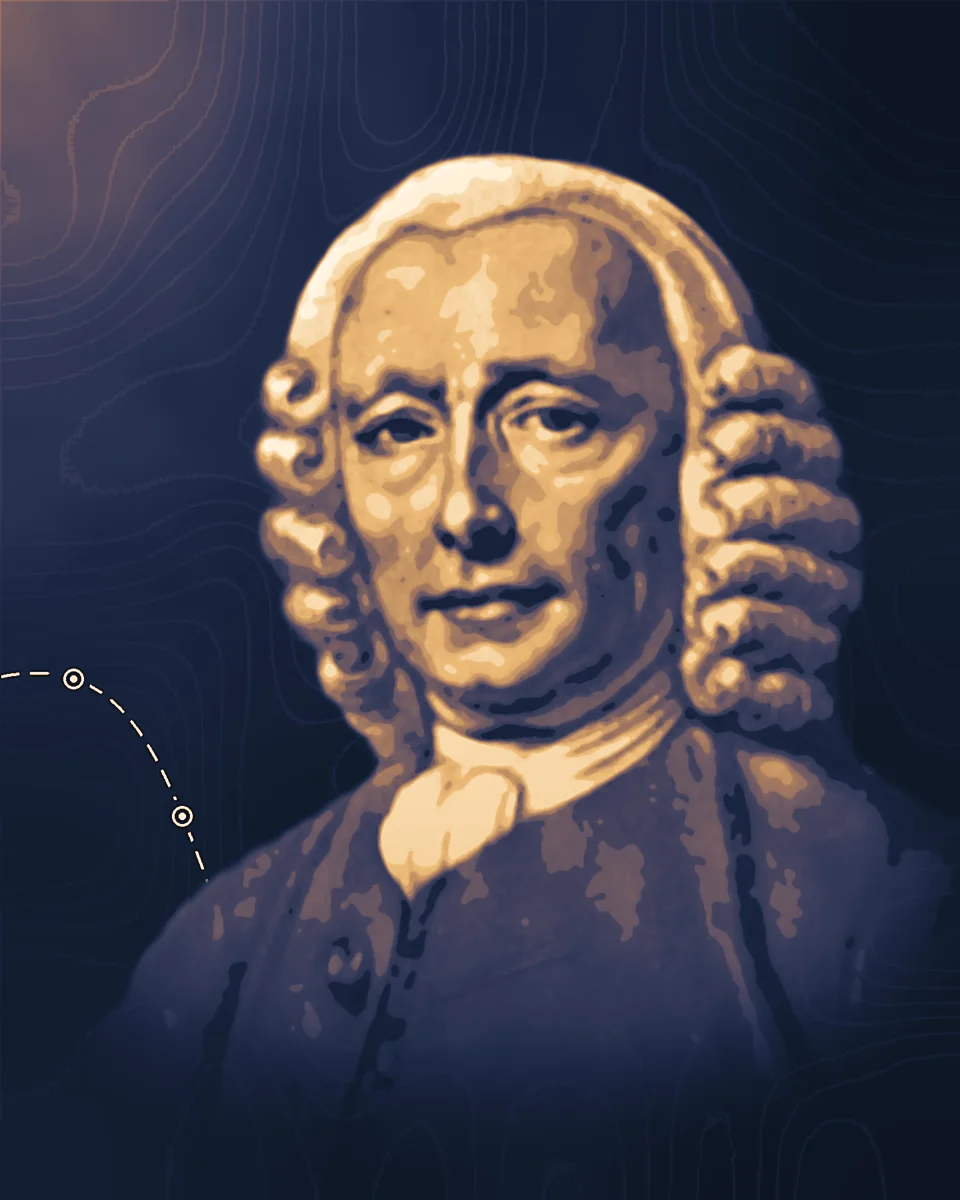
John Harrison
A Yorkshire carpenter turned clockmaker who built the first timekeepers accurate enough at sea for a ship to find its longitude by the clock.
1693–1776
What they changed
1736
A sea clock tried
Harrison's first marine clock, H1, went to Lisbon in HM ship Centurion in May 1736. On the way home in the Orford he identified the Lizard correctly, and in 1737 the Commissioners of Longitude agreed to pay him £500 to build a better one. The Dictionary of National Biography says the clock corrected an error of a degree and a half in the ship's reckoning.
1759
A clock made watch-sized
After 19 years on a third large clock, Harrison finished H4 in 1759: a timekeeper 165 mm across and 1.45 kg in weight, begun in 1755. Royal Museums Greenwich, which holds it, says its "very stable, high frequency balance" (it ticks five times a second) "proved the successful design."
1764
Trials across the Atlantic
His son William took H4 to Jamaica in 1761 and to Barbados, where Harrison arrived in May 1764. In February 1765 the Board of Longitude found it had kept time within the strictest limits of the Longitude Act of 1714. The national biography gives its error on the Jamaica run as 1 minute 54.5 seconds of time, and its Barbados result as within ten miles.
1765
A design others must copy
The Board would pay £10,000 once Harrison explained how H4 worked, and the rest only when other makers could build timekeepers like it; Parliament wrote this into law on 10 May 1765. In 1767 the Board published The principles of Mr. Harrison's time-keeper, with plates.
1772
Cook's trusty friend
The Board had Larcum Kendall make a copy of H4, K1, from 1766 to 1769, and issued it to James Cook for his second and third voyages to the South Seas. Cook came to call it his "trusty friend the watch" and his "never failing guide."
Life
John Harrison was baptised on 31 March 1693 at Foulby, in the parish of Wragby, Yorkshire. His father Henry was a carpenter and joiner who also mended clocks, and John joined his workshop and did some land surveying. He taught himself clockmaking, and by the mid-1720s he was building wooden longcase clocks that Royal Museums Greenwich says kept time to about a second a month.
Longitude is a ship's position east or west. A ship can find it by comparing its local time, from the sun, with the time at its home port, but only if it carries a clock that keeps home time through months of rolling, damp and heat. The British Longitude Act of 1714 offered money for a practical method. Harrison came to London in 1728 with his drawings; the clockmaker George Graham told him to build the machine first, and Graham and the astronomer Edmond Halley later certified his first timekeeper. He received the Royal Society's Copley Medal in 1749.
The work was not his alone. William Harrison sailed with H4 on its trials. The idea of a small, fast-beating balance came to Harrison through a pocket watch that the watchmaker John Jefferys made to his design in 1753.
His quarrel with the Board was long and bitter. The astronomer Nevil Maskelyne, who championed the rival lunar-distance method, tested H4 at the Royal Observatory for ten months from May 1766, and it "did not perform well." Royal Museums Greenwich says the popular picture of Harrison as "the plucky underdog" has "tarnished the reputation" of Maskelyne, whose Nautical Almanac, with tables for 1767, gave navigators a working method of their own. After the King took his side, Parliament granted Harrison a further award in 1773, though not all he felt he was owed.
He died at his house in Red Lion Square, London, on 24 March 1776, and was buried at Hampstead. Marine timekeepers stayed rare and costly for decades after his death. Later makers simplified the design, and Royal Museums Greenwich dates their wider use at sea to the early 1800s. His H2, H3 and H4 are at the Royal Observatory, Greenwich.
Read more
5 accounts
The Marine Chronometer: Its History and Development, Rupert T. Gould, J. D. Potter, 1923.
The first full technical history, with chapters on each of Harrison's machines.
archive.org
The principles of Mr. Harrison's time-keeper, with plates of the same, Commissioners of Longitude, 1767.
The description of H4 that the Board required before it would pay.
wellcomecollection.org
A description concerning such mechanism as will afford a nice, or true mensuration of time, John Harrison, 1775.
His own last account of his work and his case against his critics.
wellcomecollection.org
John Harrison and the longitude problem, Royal Museums Greenwich, undated. The account by the museum that holds H2, H3 and H4, clock by clock.
rmg.co.uk
Harrison, John (1693-1776), Gordon Goodwin, Dictionary of National Biography, 1891.
The national biography's entry, with the sums paid and the trial results.
en.wikisource.org