Industries / Figureheads
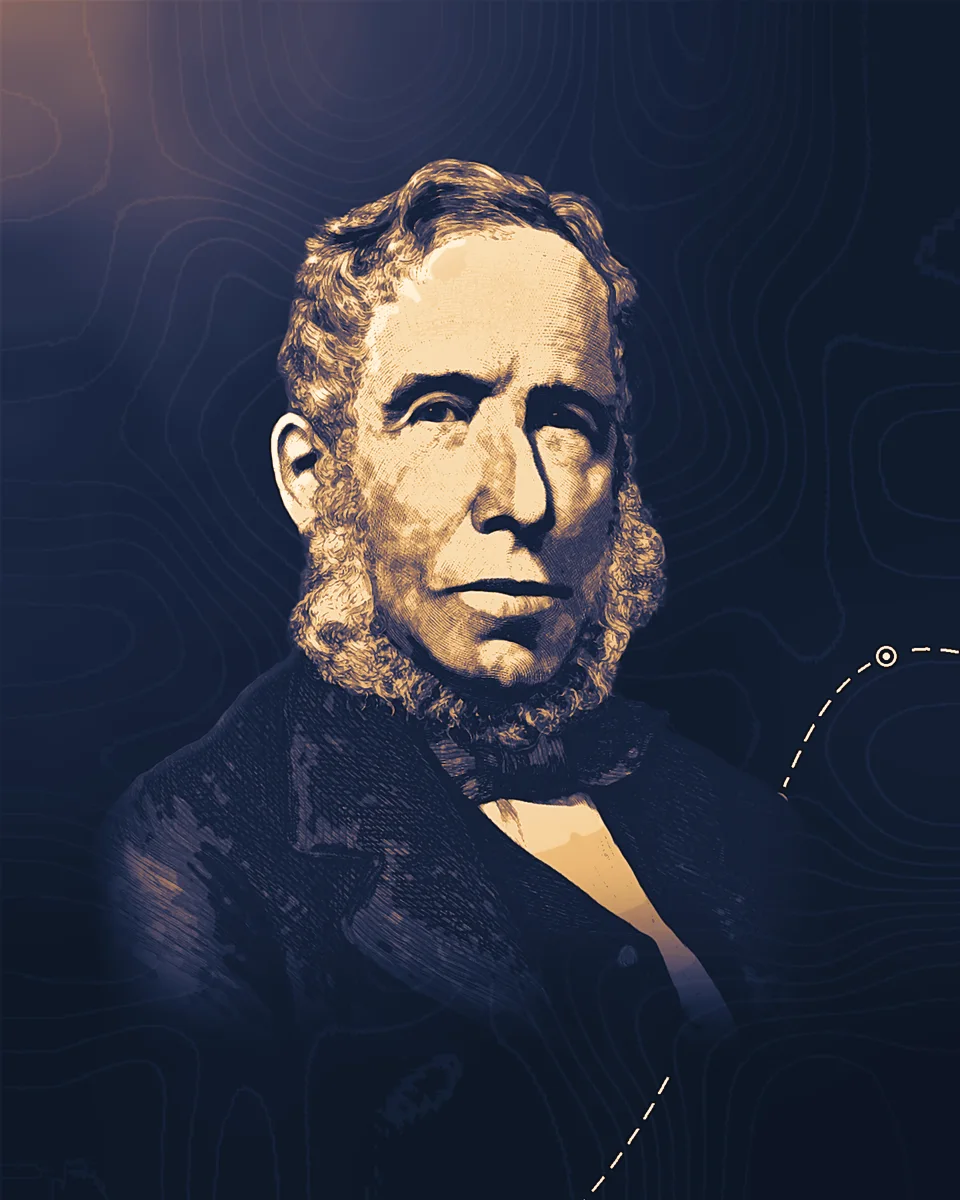
John Bennet Lawes
He patented superphosphate fertilizer and began the field trials at Rothamsted that still run.
1814–1900
What they changed
1842
Phosphate made soluble
Lawes patented a way to treat bones and mineral phosphates with sulfuric acid, which turns phosphate that plants take up slowly into a form they take up fast. The product was named superphosphate. A 2024 history from the American agronomy and soil science societies says it "marked the beginning of the modern fertilizer industry".
1843
A fertilizer factory
He opened a works at Deptford Creek in London to make "J. B. Lawes's Patent Manures", and in 1857 built a larger one at Barking Creek that made its own sulfuric acid. He sold the business in 1872.
1843
Trials that never stopped
In autumn 1843 Lawes and the chemist Joseph Henry Gilbert sowed winter wheat on Broadbalk field at Rothamsted, each strip with a different fertilizer or manure and one strip with none. Wheat has been grown there every year since. Rothamsted calls it the longest-running scientific experiment in the world.
1889
An endowment for the work
He put the laboratory and the experimental fields in trust, with £100,000, so that the experiments would go on after his death. The Lawes Agricultural Trust ran the station until 1990.
Life
Lawes was born at Rothamsted, in Hertfordshire, on 28 December 1814, the only son of the lord of the manor. He went to Eton and to Brasenose College, Oxford, and left without a degree. By his own account neither place did much for a taste that ran to science. At twenty he had one of the best bedrooms in the house fitted out as a chemistry laboratory, and in 1834 he took over the estate.
A neighbor, Lord Dacre, set him a puzzle: ground bones fed the turnip crop on one farm and did nothing on another. Lawes ran experiments in pots from 1837 and in the field from 1840, and found that bones treated with sulfuric acid worked on his own soil. He patented the process in 1842 and opened his factory the next year. A former assistant wrote that he made a fortune in London and spent a fortune at home on research.
The idea was not his alone, and the credit is disputed. The German chemist Justus von Liebig had already suggested that bones would feed plants faster if they were treated with sulfuric acid. In Ireland the physician James Murray was treating bones with sulfuric acid in the same years and wrote about it in 1841, and his son took out patents on the process. A December 2021 column in the Irish Times argues that Murray deserved the credit that went to the buyer of his patent.
The Rothamsted work was shared from the start. Gilbert, who had studied under Liebig, took charge of the laboratory on 1 June 1843, and the two men worked together for 57 years. Most of the 132 Rothamsted papers published in Lawes's lifetime carry both names, and the Royal Society gave them its Royal Medal jointly in 1867. Their field results showed that crops need nitrogen supplied in the soil, which set them against Liebig in a long and, in Rothamsted's words, "sometimes acrimonious" dispute.
Lawes was made a baronet in 1882. In Harpenden, the village beside Rothamsted, he laid out allotment gardens for laborers from 1852 and ran a savings bank for them himself. He died on 31 August 1900. The station he founded is still at work.
Read more
4 accounts
Lawes, Sir John Bennet, Ernest Clarke, Dictionary of National Biography, 1901 supplement.
A life written the year after he died, drawing on his own autobiographical note.
en.wikisource.org
Sketch of Sir John Bennet Lawes, Popular Science Monthly, March 1886.
A profile from his lifetime, printed with the engraving this portrait is based on.
en.wikisource.org
A visual history of Rothamsted, Rothamsted Research. A dated timeline of the station, with photographs and documents from its archive.
rothamsted.ac.uk
Broadbalk Wheat Experiment, the electronic Rothamsted Archive. The experiment's own record: its plan, its treatments and its data since 1843.
era.rothamsted.ac.uk