Industries / Figureheads
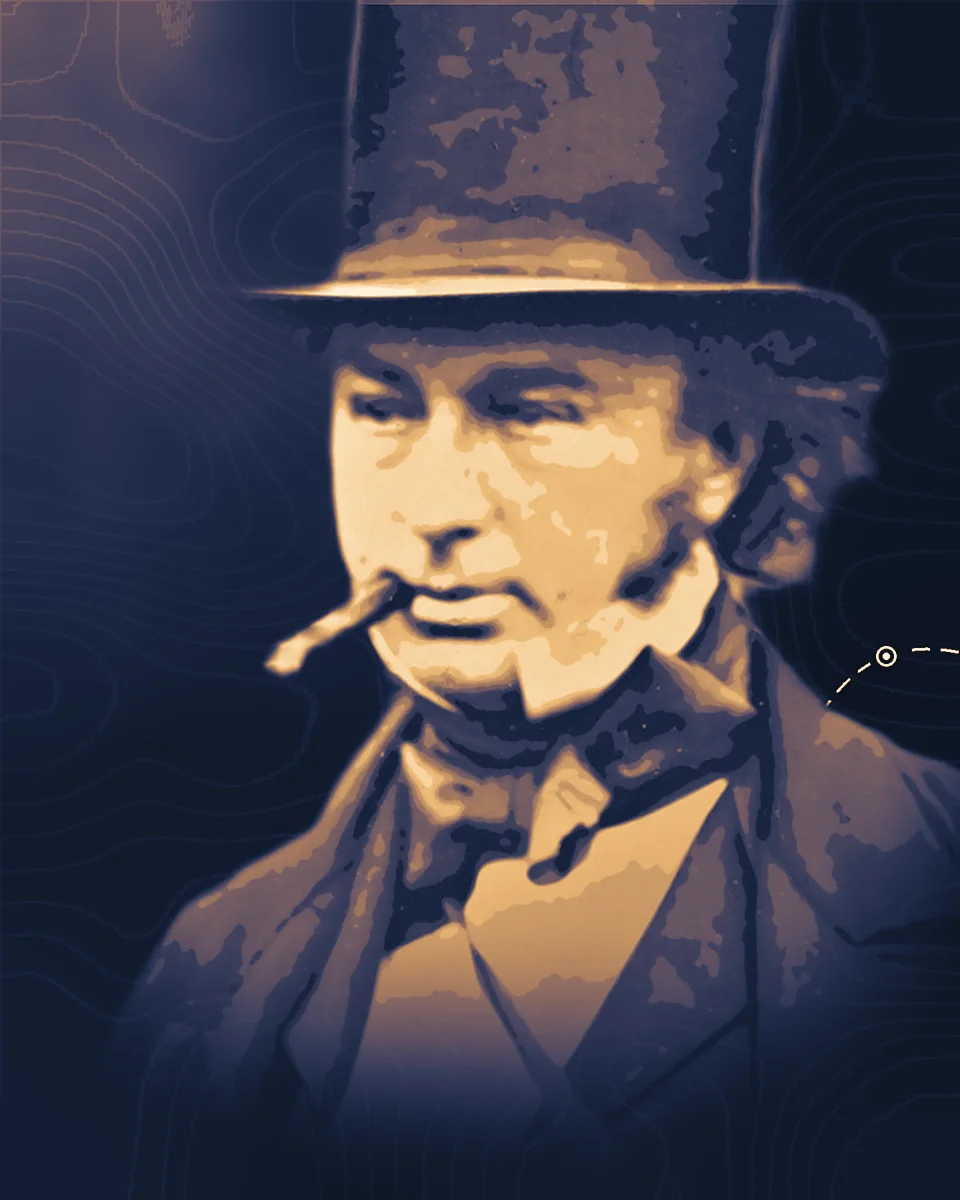
Isambard Kingdom Brunel
An engineer who argued that bigger steamships would cross oceans more cheaply, then built a steamer for a regular run to New York and the iron, propeller-driven Great Britain.
1806–1859
What they changed
1835
A railway to New York
At a meeting of Great Western Railway directors in October 1835, Brunel asked why the line from London to Bristol should not be made longer, with "a steamboat to go from Bristol to New York." The idea was taken up, and the Great Western Steam-Ship Company was formed in Bristol to build her.
1836
Bigger ships burn less
Into a report on ship design dated 1 January 1836, written by the director Thomas Guppy and Captain Christopher Claxton, Brunel inserted a passage saying that a ship's carrying capacity grows with the cube of its dimensions while the water's resistance grows only about with the square, so a larger ship needs proportionally less engine power and fuel. His son's biography says the principle set the size of all three of his ships.
1838
Steam across the Atlantic
The Great Western left Bristol on 8 April 1838 and reached New York 15 days and 12 hours later with 200 metric tons of coal to spare, by Vaclav Smil's account. The smaller Sirius, which left four days earlier, arrived first but only just. The Great Western then ran regularly between Bristol and New York until the end of 1846.
1843
Iron hull and propeller
The SS Great Britain, launched at Bristol in 1843, was the largest ship in the world, built of iron and driven by a propeller, with an engine of about 1,000 horsepower. The SS Great Britain Trust calls her "the first ocean-going ship in history to be built from metal, and the first to be moved by a propeller" and "the blueprint for every ocean liner that followed."
1858
The Great Eastern launched
His last ship, 692 feet long and 18,915 tons, was the largest in the world. She was built at John Scott Russell's yard at Millwall and launched on 31 January 1858 after many technical difficulties. Royal Museums Greenwich calls her "a commercial failure as a passenger ship"; from 1865 she laid four telegraph cables across the Atlantic.
Life
Isambard Kingdom Brunel was born at Portsea, Portsmouth, on 9 April 1806, the third child and first son of the engineer Marc Isambard Brunel. He learned engineering as his father's apprentice and worked on his father's tunnel under the Thames from Rotherhithe to Wapping, where by Grace's Guide's account he was chief assistant engineer from 1826.
In 1833 he became engineer of the Great Western Railway from London to Bristol, which he built to a broad gauge of 7 feet; a government Gauge Commission rejected the broad gauge in 1845. He designed the Clifton bridge at Bristol, advised on the city's docks, and was engineer to the Great Western Steamship Company.
The ships were the work of many. Thomas Guppy, a railway director, and Captain Christopher Claxton of the Royal Navy studied the shipyards and wrote the 1836 report; Maudslay, Sons and Field built the Great Western's engines; William Patterson built the Great Britain, and John Scott Russell built the Great Eastern. Many doubted that a steamer could cross the ocean without refuelling: the lecturer Dionysius Lardner argued that a direct voyage to New York was inexpedient, and Brunel's reply in the debate is recorded as failing to sway most of those present.
His ships did not make their owners rich. On 22 September 1846 the Great Britain, carrying 180 passengers, ran ashore in Dundrum Bay on the coast of Ireland. She was refloated the next year, but the stranding ruined the Great Western Steam-Ship Company and she was sold to Liverpool owners, who ran her to Australia from 1851. The Great Eastern was laid up in 1864 and sold to a cable-laying company.
In September 1859 Brunel collapsed with a stroke at the trial of the Great Eastern's engines, the day before she left the Thames, and he died ten days later, on 15 September 1859, aged 53. He was buried at Kensal Green. The Great Britain, abandoned in the Falkland Islands for decades, was brought back to Bristol in 1970 and is shown in the dry dock where she was built.
gracesguide.co.ukcollection.sciencemuseumgroup.org.ukbristoldockyards.org
Read more
5 accounts
The Life of Isambard Kingdom Brunel, Civil Engineer, Isambard Brunel, 1870.
The life by his son, with the ship reports and voyage records quoted at length.
archive.org
Isambard Kingdom Brunel: A Biography, L. T. C. Rolt, 1959 printing.
The standard modern biography.
archive.org
Brunel: The Life and Times of Isambard Kingdom Brunel, R. Angus Buchanan, 2006 edition.
A historian of technology's study of the engineer and his partners.
archive.org
Crossing the Atlantic, Vaclav Smil, IEEE Spectrum, 2018.
A short history of the first steam crossings, with times and fuel.
spectrum.ieee.org
I. K. Brunel, Grace's Guide to British Industrial History, undated. Reprints the Institution of Civil Engineers' obituary of 1860 with a list of his works.
gracesguide.co.uk