Industries / Figureheads
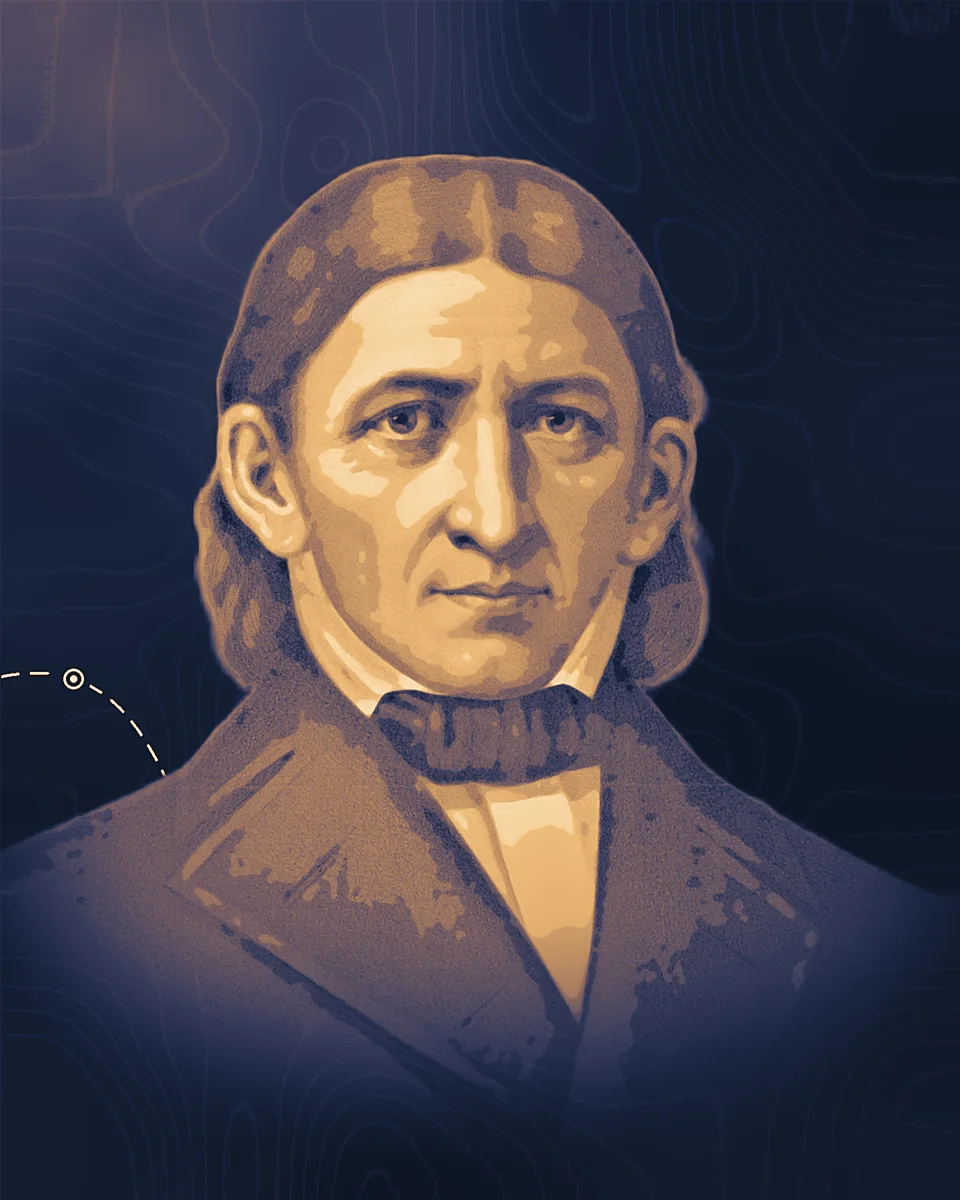
Friedrich Froebel
He founded the kindergarten, a school where children under school age learn through guided play with set materials.
1782–1852
What they changed
1816
A school of his own
On 13 November 1816 Froebel opened the "General German Educational Institute" at Griesheim in Thuringia, and moved it the next year to Keilhau near Rudolstadt, which he led until 1831. In 1826 he published his main work, The Education of Man.
1837
Play gifts for small children
At Blankenburg from 1837 he began making what he called gifts: soft coloured balls, then a wooden sphere, cylinder and cube, then boxed sets of blocks made by dividing a cube, used from simple to complex. The Froebel Trust calls them "one of the first sets of wooden blocks developed specifically for young children". They are still made, now by SINA in Germany.
1840
The kindergarten
On 28 June 1840 Froebel founded the "General German Kindergarten" in Blankenburg's town hall, a school where young children learned through play under a teacher's guidance. It closed for lack of money in 1844, and from 1849 at Bad Liebenstein he trained kindergarten teachers. The University of Edinburgh's account says other kindergartens were soon modelled on his.
1873
Kindergartens in public schools
After his death the kindergarten spread to Britain, France, the Netherlands and the United States, by the University of Edinburgh's account. In September 1873 Susan Blow, who had seen Froebel classrooms in Germany, opened a public kindergarten at the Des Peres School in St. Louis, and by 1879 the city had 53 kindergarten rooms, according to the State Historical Society of Missouri.
Life
Friedrich Wilhelm August Froebel was born on 21 April 1782 at Oberweißbach in Thuringia, the sixth child of the pastor Johann Jacob Froebel. His mother died on 7 February 1783, before he was a year old. The University of Edinburgh's account says he was neglected as a child until an uncle took him in and sent him to school. He trained in Hirschberg an der Saale and studied natural sciences at the University of Jena from 1799 to 1801.
He first taught at a model school in Frankfurt run on the lines of the Swiss educator Johann Heinrich Pestalozzi, from 1805 to 1806. He then visited and worked with Pestalozzi at Yverdon. In April 1813 he joined the Lützow Free Corps and fought in the wars against Napoleon. After the war he opened his own school, and he married Henriette Wilhelmine Hoffmeister in Berlin on 11 September 1818.
From 1831 to 1835 he worked in Switzerland, at schools in Wartensee and Willisau, in teacher training, and at the orphanage school in Burgdorf. The University of Edinburgh's account says it was there that he came to see early childhood as a stage that mattered in its own right, when it was treated as preparation and as "women's work". His principles were play and "self-activity", children learning by doing things for themselves, with "freedom with guidance" from the adult.
In 1837 he moved to Blankenburg and began to make his play materials. His wife died in 1839, the year before the kindergarten opened. In 1844 he published Mutter- und Koselieder, songs and games for mothers and small children. In 1851 he married Luise Levin, and that August Prussia banned kindergartens. The University of Edinburgh's account says the government confused progressives such as Froebel with radical socialists, among them his nephew. He died at Marienthal on 21 June 1852 and was buried at Schweina.
Read more
5 accounts
The Education of Man, Friedrich Froebel, translated by W. N. Hailmann, D. Appleton, International Education Series, 1887.
His main work of 1826 in English.
archive.org
Autobiography of Friedrich Froebel, translated by Emilie Michaelis and H. Keatley Moore, C. W. Bardeen, 1889.
His own account of his life, in letters, with notes by the translators.
archive.org
Reminiscences of Friedrich Froebel, Bertha von Marenholtz-Bülow, translated by Mary Mann, Lee and Shepard, 1877.
Memories of his last years by a follower who knew him.
archive.org
Inventing Kindergarten, Norman Brosterman, Harry N. Abrams, 1997.
A history of the gifts and of what grew from them, with photographs of the materials.
archive.org
Friedrich Fröbel: Leben und Werk, Friedrich-Fröbel-Museum, Bad Blankenburg, undated. The museum's dated chronology of his life, in German.
froebel-museum.de