Industries / Figureheads
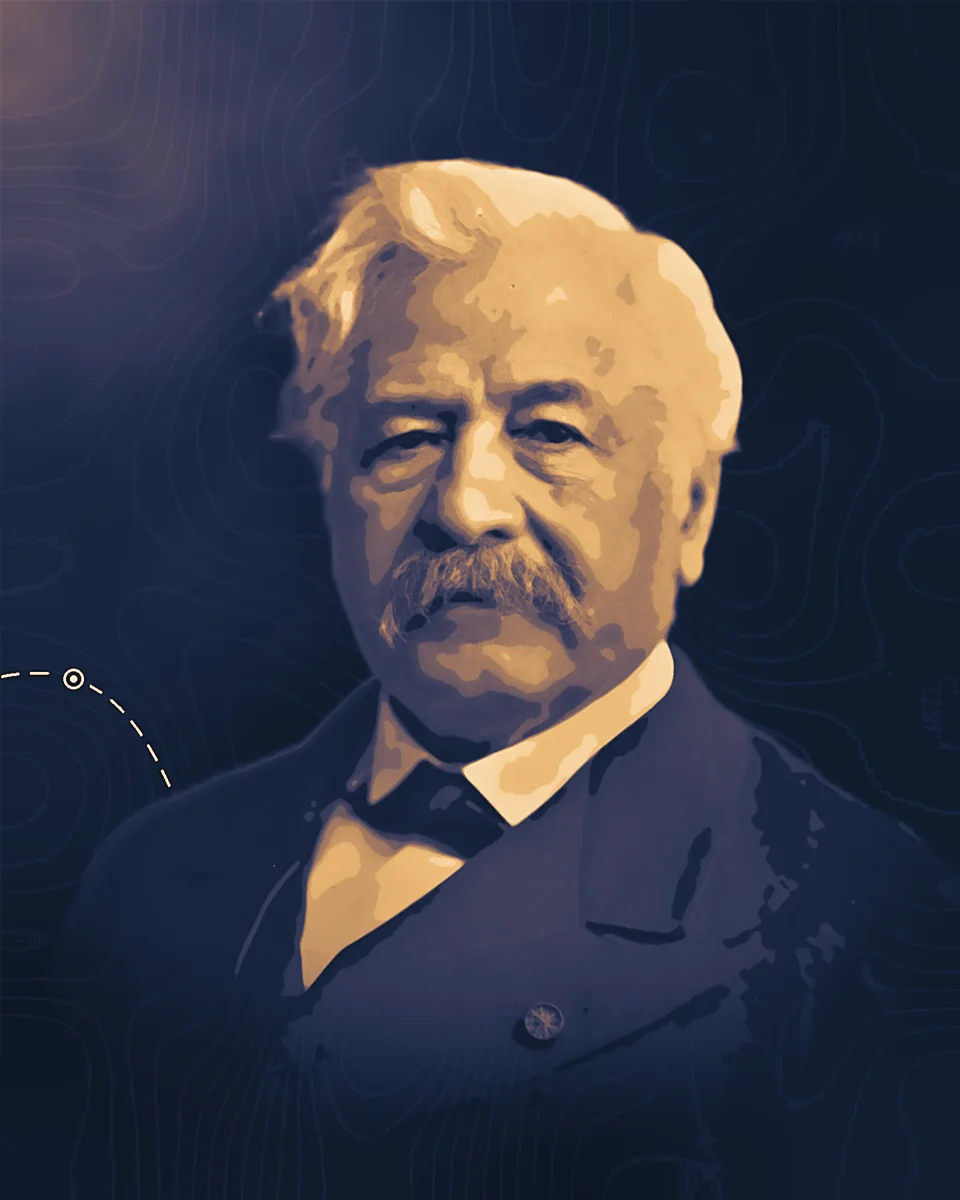
Ferdinand de Lesseps
A French diplomat who won the concession, raised the money and drove the building of the Suez Canal, then led the failed French attempt at Panama.
1805–1894
What they changed
1854
A concession to cut Suez
On 30 November 1854 the Egyptian government gave de Lesseps the right to form a company to dig a canal across the isthmus of Suez, for 99 years from its opening, with 15% of the yearly net profit to go to Egypt. A second concession of 5 January 1856 said the canal would be "open forever, as neutral passages, to every merchant vessel."
1858
A company of small shareholders
The Universal Company of the Maritime Canal of Suez was founded on 5 December 1858 with 200 million francs of capital in 400,000 shares. Britain and the Ottoman government would not back it, and the money came mostly from small French shareholders, with 44% from the viceroy of Egypt, by the account of the French research agency CNRS.
1859
Dug by forced labour
Digging began at what is now Port Said on 25 April 1859. The viceroy supplied corvée labour, the old Egyptian system of drafting peasants for public works, and conditions were soon denounced as close to slavery. Of the 400,000 peasants mobilised between 1859 and 1862, tens of thousands are thought to have died, by the historian Caroline Piquet's account to CNRS; there are no reliable records. After Britain protested and the Ottoman government ordered a halt, Napoleon III arbitrated between the company and Egypt in 1864, and the company turned to foreign labourers and dredging machines.
1869
Two seas joined
The canal, 164 km long, opened on 17 November 1869 and joined the Mediterranean to the Red Sea. Egypt went bankrupt in 1875 and sold its shares to Britain, and Egypt nationalized the canal in 1956.
1879
A sea-level canal for Panama
At a congress in Paris in May 1879, de Lesseps's speech carried the vote, 74 to 8, for a canal through Panama at sea level, with no locks; the engineer Godin de Lépinay's plan for a lock canal got no serious hearing. His Compagnie Universelle, founded that August, sent its first engineers to Colón in January 1881. Yellow fever, malaria and landslides in the Culebra Cut wore it down. He agreed to locks only in October 1887, the company failed, and all work stopped on 15 May 1889. The Panama Canal Authority sums it up: "His own charisma turned out to be his enemy."
Life
Ferdinand de Lesseps was born at Versailles on 19 November 1805 and made his career as a French diplomat. CNRS describes him as "very close to the Viceroy of Egypt," and in 1854 he obtained the Suez concession. He wrote his own account of its first years in Letters, Journal and Documents, which the Académie française gave a prize in 1876.
The canal was not his work alone. The digging was done first by Egyptian peasants drafted by the state and then by contractors, foreign labourers and new dredging machines, and the cost in lives is unknown: CNRS notes that Egypt's president Gamal Abdel Nasser later cited 120,000 deaths, a figure no archive supports. CNRS calls the canal "this symbol of European imperialism, which was built by the Frenchman Ferdinand de Lesseps."
Suez made him famous. He received the Grand Cross of the Légion d'honneur in 1869, joined the Académie des sciences in 1873 and was elected to the Académie française on 21 February 1884.
Panama ruined him. More than 19,000 men, mostly from Jamaica and other West Indian islands, worked on the French canal at its height in 1884, and engineers, directors and their families died of yellow fever. After the company's collapse Ferdinand and his son Charles were found guilty of fraud and mismanagement and sentenced to five years. The Panama Canal Authority says the sentence was never carried out because the statute of limitations had run out; the Académie française says it was because of his age and health. Charles was also convicted of bribery and served part of a one-year sentence. Ferdinand de Lesseps died on 7 December 1894, aged 89.
Read more
4 accounts
The Suez Canal: Letters and Documents Descriptive of Its Rise and Progress in 1854–1856, Ferdinand de Lesseps, 1876.
His own record of how the concession was won, in English translation.
archive.org
Recollections of Forty Years, volume 2, Ferdinand de Lesseps, 1887.
His memoirs, in English.
archive.org
The French Canal Construction, Panama Canal Authority, undated. A dated history of the French attempt, from the 1879 congress to the sale to the United States.
pancanal.com
The Turbulent History of the Suez Canal, Laure Cailloce with the historian Caroline Piquet, CNRS News, 2020.
On the concession, the corvée and what the canal meant for Egypt.
news.cnrs.fr