Industries / Figureheads
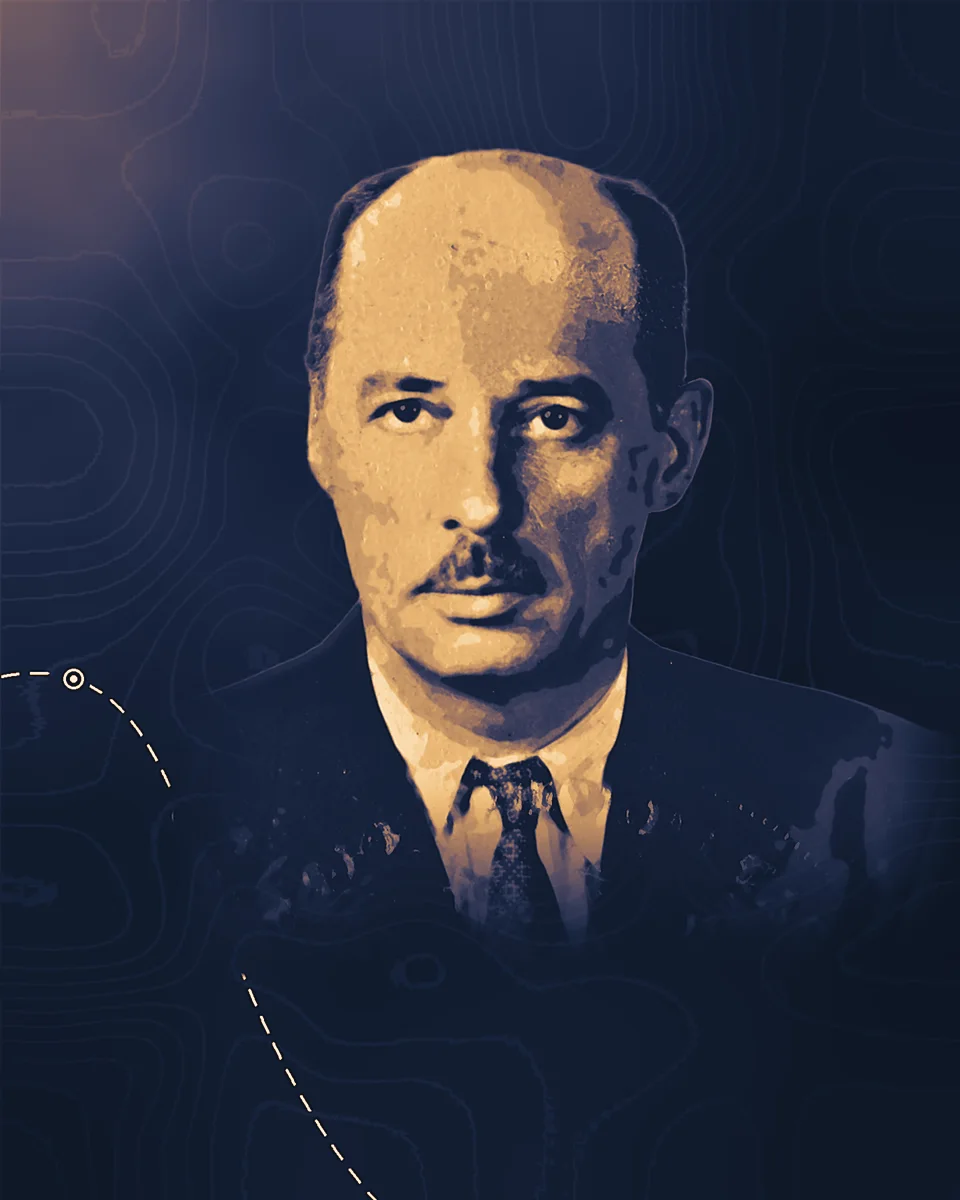
Eugène Houdry
He built the first catalytic cracker to run at full scale in a refinery, and showed that a catalyst fouled with carbon could be burned clean and used again.
1892–1962
What they changed
1920s
A catalyst burned clean
Working in France to make gasoline from lignite, a brown coal, Houdry found his catalysts were soon poisoned by carbon. He showed that the carbon could be burned off and the catalyst used again. In 1927 he made gasoline from crude oil over a clay of aluminum silicate.
1937
Catalytic cracking at scale
On 31 March 1937 Houdry Unit Eleven Four started at Sun Oil's Marcus Hook refinery in Pennsylvania. It could crack 15,000 barrels a day of heavy residue and gave 48% of its feed as gasoline of 81 octane, by the account in Invention & Technology. The catalyst sat in fixed beds: oil ran through one bed for about ten minutes until coke built up, then the bed was steamed and the coke burned off with hot air while the oil went to another.
1942
Aviation fuel for the war
By 1942, 14 Houdry units were making high-octane aviation gasoline for the US armed forces, by the Science History Institute's count. Invention & Technology says Houdry units made 90% of the catalytically cracked aviation fuel of the Allies in the first two years of US involvement, and that their output rose from 40,000 barrels a day in 1941 to 373,000 in 1944.
Life
Eugène Jules Houdry was born in France on 18 April 1892. His family owned a structural-steel firm, Houdry et Fils. He took a degree in mechanical engineering at the École des Arts et Métiers and joined his father's business in 1911. In the First World War he served as a lieutenant in the French Army's tank corps. He was wounded at Juvincourt in 1917 and received the Croix de Guerre.
France produced little oil, and after the war Houdry, a keen follower of motor racing, looked for a way to make gasoline from the country's lignite. The idea was not his first: in 1922 he learned of gasoline made from lignite over a nickel-cobalt catalyst by E. A. Prudhomme, a pharmacist in Nice. In 1923 Houdry became president of a company formed to develop it, the Société Anonyme Française pour la Fabrication d'Essences et Pétroles, which gave Prudhomme a laboratory and three chemists at Beauchamp. A lignite plant at Saint-Julien-de-Peyrolas made gasoline in 1929 but lost money, and the government withdrew its funding. By then Houdry had turned to heavy oils and silica-alumina catalysts.
In 1930 Harold Sheets of the Vacuum Oil Company gave him a 15-day trial at Paulsboro, New Jersey. He passed it, and the Houdry Process Corporation was formed. When Vacuum merged with Socony in 1931 the new company gave the work less support, and in 1933 Houdry found a second backer in Arthur E. Pew of Sun Oil. Sun paid $450,000 for a large unit at Marcus Hook, and the French group, Pew and Socony-Vacuum came to own the corporation in thirds. A Socony-Vacuum unit at Paulsboro began cracking 2,000 barrels a day in June 1936, and the Marcus Hook unit followed in March 1937. Houdry became a United States citizen on 16 January 1942.
His process did not last. Fixed beds had to stop for each regeneration, and the heat from burning the coke was hard to use. Warren K. Lewis and Edwin R. Gilliland of MIT, consulting for Standard Oil of New Jersey, found a way to move the catalyst between a reactor and a regenerator without stopping, and fluid catalytic cracking, started in 1942, made the original Houdry method obsolete. Penn State's refining course says fluid cracking has replaced all the earlier catalytic cracking processes. In 1948 Houdry resigned as president of the Houdry Process Corporation, saying he "wasn't interested in working further to cut the price of gasoline".
sciencehistory.orgcourses.ems.psu.educourses.ems.psu.eduinventionandtech.com
After France fell in 1940 he founded a group in the United States called France Forever, and during the war he worked on a one-step process to turn butane into butadiene for synthetic rubber. After early studies of smog in Los Angeles he founded Oxy-Catalyst in Wayne, Pennsylvania, in 1950 to clean engine exhaust with catalysts. The Science History Institute notes that lead in gasoline poisoned such catalysts until it was taken out of fuel. He received the Perkin Medal of the Society of Chemical Industry in 1959 and died on 18 July 1962.
Read more
4 accounts
The Wizard of Octane, Tim Palucka, Invention & Technology, Winter 2005.
A long, detailed history of his French years, the Paulsboro trial and the Marcus Hook unit.
inventionandtech.com
Eugene Houdry, Science History Institute, undated. A short biography from the institute that holds the Eugene Jules Houdry Collection, compiled by his colleague G. Alex Mills.
sciencehistory.org
The Houdry Process, American Chemical Society, 1996.
The booklet for the National Historic Chemical Landmark at Marcus Hook.
tracesdefrance.fr
Houdry Catalytic Cracking, Penn State FSC 432 course, undated. How the fixed-bed reactors, the swing cycle and the regeneration worked, and why the heat was wasted.
courses.ems.psu.edu