Industries / Figureheads
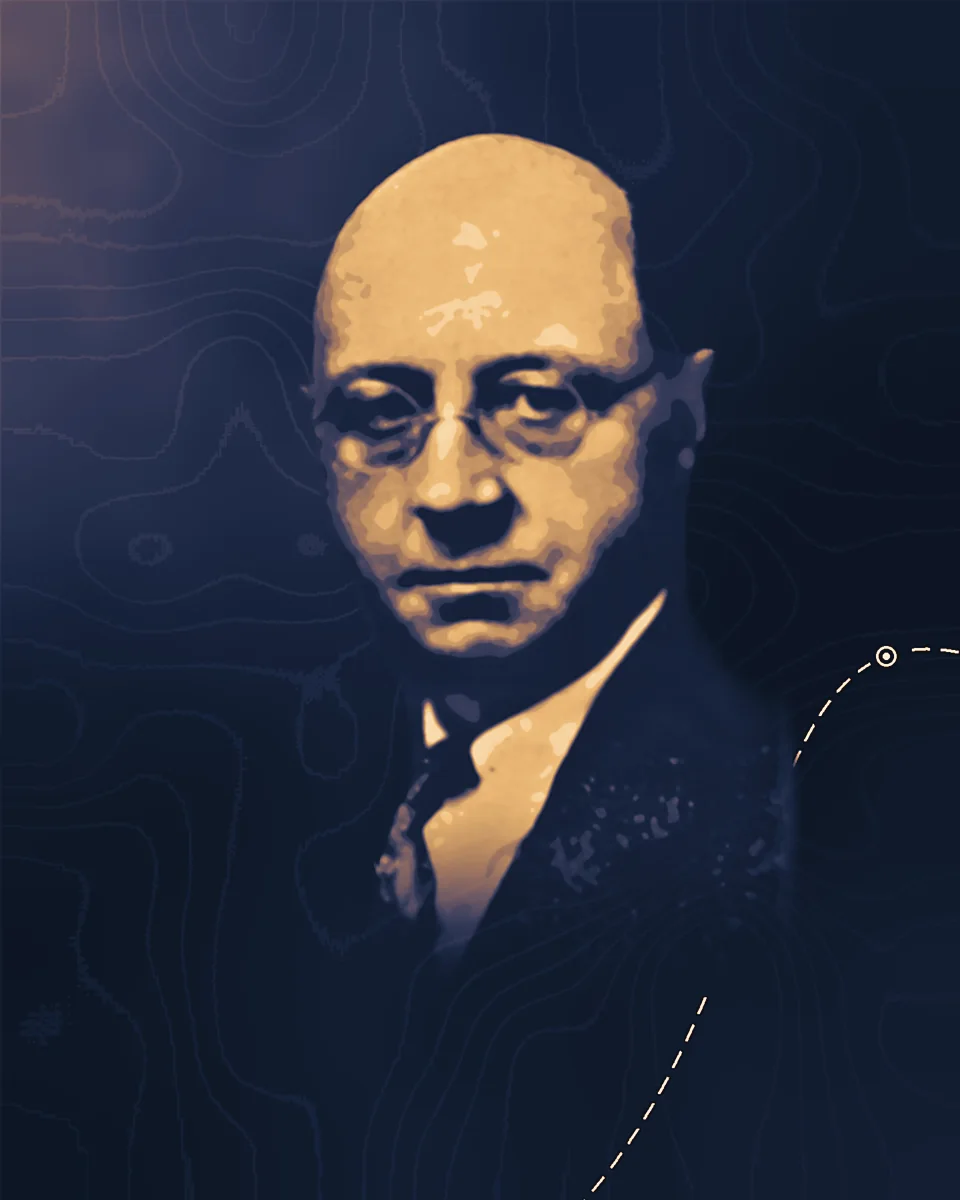
Clarence Birdseye
He turned quick freezing into a packaged product that shops could sell, with the machines, cartons and display cases it needed.
1886–1956
What they changed
1924
Fish frozen in a carton
Birdseye founded General Seafoods at Gloucester, Massachusetts, and worked out a way of packing dressed fish in cartons and freezing the contents between two refrigerated surfaces under pressure. A flat pack touched cold metal on both sides, so it froze through quickly.
1929
The patents sold
The Postum Company and the Goldman Sachs Trading Corporation bought the patents and assets of his company for a reported 22 million dollars. Postum later bought out its partner and took the name General Foods, and the product was sold as Birds Eye.
1930
Frozen food in ten shops
In March 1930 General Foods began a test sale of packaged quick-frozen meat, fish, fruit and vegetables in ten stores in Springfield, Massachusetts. A trade paper reported on 26 March that shoppers had a choice of 21 cuts of meat and that more than 1,000 customers bought on good days.
1930
A definition of quick freezing
In the same paper Birdseye defined quick freezing as freezing fast enough that the ice crystals formed in the food are too small to cause noticeable damage. He listed what still spoiled frozen food in storage: drying out, fat going rancid, and crystals growing when the temperature rose. He asked for a rectangular, moisture-proof package held at or below 0 °F.
1934
Freezer cases for shops
Few shops could keep food frozen. Birdseye's company contracted with the American Radiator Corporation to make low-temperature display cases and leased them to retailers for about 8 dollars a month. In 1944 it leased the first insulated railroad cars to carry frozen food across the country.
Life
Clarence Birdseye was born in Brooklyn, New York, on 9 December 1886. He studied biology at Amherst College and left without a degree when money ran short. From 1910 to 1912 he worked as a field naturalist for the Biological Survey of the US Department of Agriculture.
In 1912 he went to Labrador, where he traded furs for five years. He saw local fishermen freeze their catch by throwing it onto the ice, and he froze fish, caribou and rabbit himself to feed his wife and infant son. Food frozen fast in the deep cold tasted fresh weeks later. He concluded that slow freezing forms large ice crystals that damage food and that fast freezing does not.
He did not invent quick freezing, and his own trade said so at the time. The paper that printed his portrait in 1930 noted that freezing processes had been patented in the United States as far back as 1871, and it named rival methods then in use, among them one by Harden F. Taylor, formerly of the US Bureau of Fisheries. A later history records a British patent for freezing fish in 1842. What Birdseye added was a packaged product and the chain around it.
His first company, Birdseye Seafoods, started in 1922 with haddock fillets frozen in a New Jersey icehouse, and went bankrupt because shoppers did not understand the product. He borrowed against his life insurance to start again at Gloucester in 1924. Frozen food stayed a small trade through the 1930s and grew when canned goods ran short in the Second World War.
He kept inventing: an infrared heat lamp, a harpoon gun without recoil, a way of drying food quickly. Business Leader Profiles credits him with some 300 patents in the United States and abroad. From 1953 to 1955 he worked in Peru on making paper from sugarcane waste and had a heart attack there. He died in New York City on 7 October 1956.
Read more
4 accounts
Clarence Birdseye Tells of Problems Which Confront New Industry, Clarence Birdseye, Electric Refrigeration News, 26 March 1930.
His own account of what quick freezing is and what still went wrong in storage, printed beside reports of the Springfield test sale.
archive.org
Method of preparing food products, Clarence Birdseye, US patent 1,773,079, filed 1927 and granted 1930.
The patent the National Inventors Hall of Fame cites for him: food frozen in its sale package between refrigerated plates.
patents.google.com
Birdseye, Clarence, Business Leader Profiles for Students, Gale, undated. A full life with the dates of his companies, the sale and the later inventions.
encyclopedia.com
Birdseye Invents Quick-Frozen Foods, Nancy A. White, EBSCO Research Starters, 2021.
Sets his work beside the earlier freezing patents and the machines he built.
ebsco.com