Industries / Figureheads
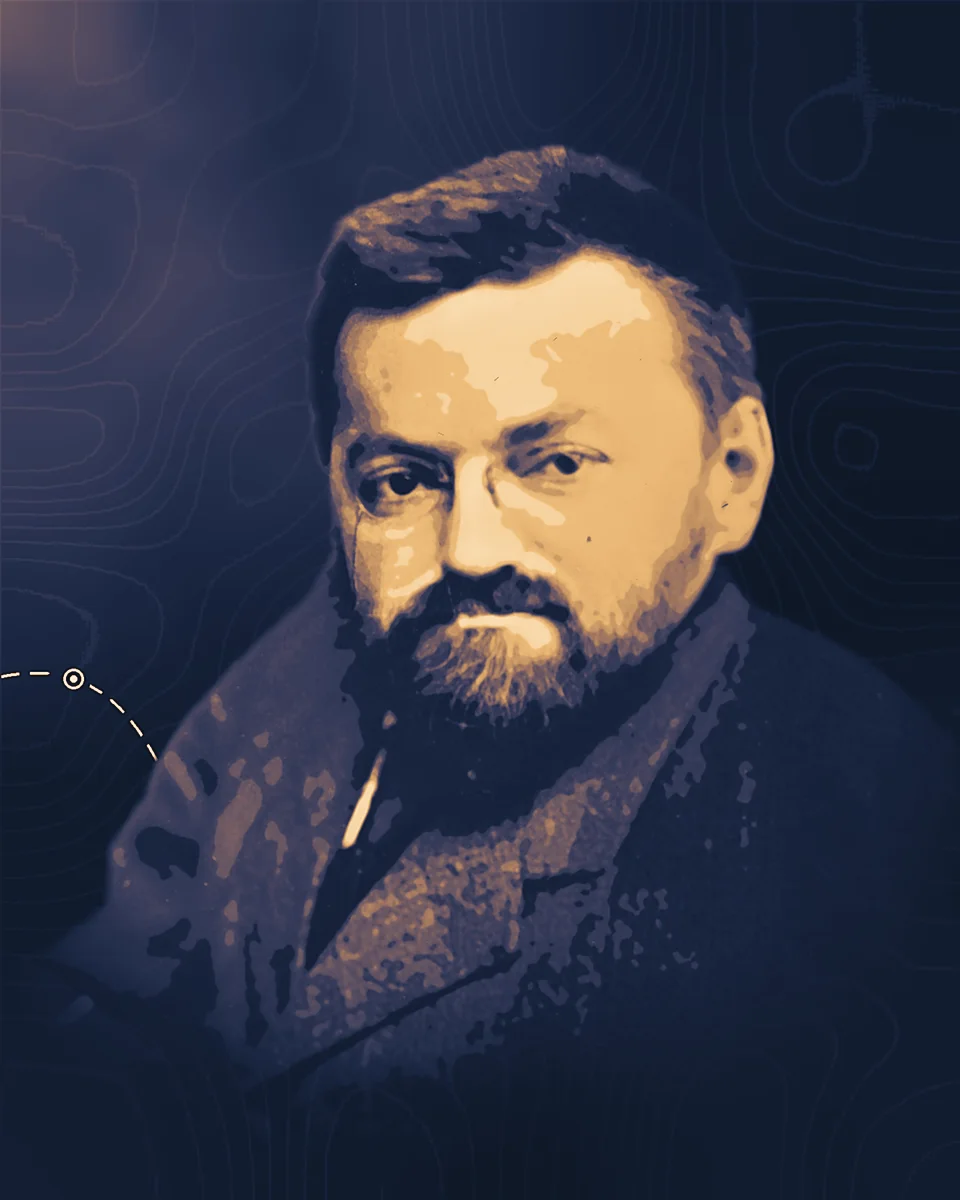
Charles Proteus Steinmetz
He found the law that predicts the power lost in the iron of transformers and motors, and taught engineers to work out alternating-current circuits with complex numbers, as simply as direct-current ones.
1865–1923
What they changed
1892
A law for iron losses
Iron in a transformer or an AC motor uses up power each time its magnetism reverses, an effect called hysteresis, which heats the machine and lowers its efficiency. Steinmetz recalled that designers simply built a machine, tested it, and "tried again" when the loss was too high. Working for Rudolf Eickemeyer in Yonkers, he fitted published measurements and then his own tests, and found that the loss rose with the 1.6th power of the magnetization: roughly, it trebles each time the magnetization doubles. He read the first part of "On the Law of Hysteresis" to the American Institute of Electrical Engineers (AIEE) on 19 January 1892, and IEEE's history site says the paper marked "a new epoch in electrical science."
1893
Complex numbers for AC
An alternating current changes from moment to moment, and engineers had to treat it as a function of time, which made the arithmetic heavy. Steinmetz represented each current and voltage by one complex number, which, he said, "made alternating current calculations practically as simple as direct current calculations." He gave the method to the International Electrical Congress in Chicago in 1893, where, Hammond writes, no one grasped it, and spread it through AIEE papers and his 1897 textbook, Theory and Calculation of Alternating Current Phenomena. His biographer Ronald Kline says it "changed the way engineers calculated AC circuits and machines".
1909
Surges on long lines
His Theory and Calculation of Transient Electric Phenomena and Oscillations, drawn from his course at Union College, dealt with short-lived effects such as the starting currents of transformers, short circuits and lightning. In its preface he wrote that where "hundreds of miles" of overhead lines and underground cables are joined, the charging currents of lines and cables "require careful study". Union College calls it the classic work on surges in AC circuits and machines, and he counted it among his three main technical achievements.
1921
Lightning for testing arresters
By the late 1890s he was studying lightning on power systems, and he found that the damage was done not by the lightning itself but by the system's own power, which broke loose after the stroke. His lightning generator at General Electric was working by the autumn of 1921, giving, in his words, "ten thousand amperes at over one hundred thousand volts" for a hundred-thousandth of a second, so lightning arresters could be tested under something like real strokes. F. W. Peek Jr. ran similar tests at GE's Pittsfield laboratory at up to two million volts. Steinmetz showed his machine to reporters in March 1922.
Life
He was born Carl August Rudolph Steinmetz in Breslau, Germany, now Wrocław in Poland, on 9 April 1865. By the Smithsonian's account he was born with kyphosis, a curve of the upper spine that his father and grandfather also had, and stood about four feet tall. He never married, fearing that his children would be born like him. He studied mathematics at the University of Breslau.
As a student he joined the Socialist Party. His authorized biographer, John Winthrop Hammond, writes that after the police arrested his friend Lux and the editor of a socialist paper Hammond calls The People's Voice, Steinmetz took on their work and came under watch. His doctoral thesis, on geometry, was accepted early in 1888, but before the degree was conferred friends warned him that the public prosecutor was preparing a case, and in May 1888 he left for Austria and then Zurich. The National Inventors Hall of Fame says he had written "an outspoken editorial criticizing the government". Ronald Kline, as Union College reports him, adds other reasons for leaving: he was behind with his fees at Breslau, and life at home with his father, stepmother and their daughters was tense. In Zurich he studied at the Polytechnic and wrote his first scientific papers, one of them a mathematical theory of the transformer.
He crossed to New York in the steerage of the French liner La Champagne with a Danish fellow student, Oscar Asmussen, who paid his fare. The ship docked on 1 June 1889. Immigration officers at Castle Garden were about to send him back, poor, ill and speaking little English, until Asmussen, who spoke English and showed money, vouched for him. On 10 June 1889 he began work for Rudolf Eickemeyer's firm in Yonkers, New York. Between 1889 and 1893 he took the name Charles Proteus, after the shape-changing sea god his professors had nicknamed him for, and in 1894 he became a US citizen.
General Electric bought Eickemeyer's business in 1892. In 1893 Steinmetz joined GE's calculating department at Lynn, Massachusetts, under H. F. Parshall, moved with it to Schenectady, New York, in 1894, and stayed for the rest of his life; by 1900 he was the company's chief consulting engineer. He applied for more than seventy patents before 1900 and took out sixty-three from 1903 to 1913. He was president of the AIEE from 1901 to 1902. From late 1902 he also ran Union College's electrical engineering department part-time for ten years, and he was its professor of electrophysics from 1913 to 1923.
He rejoined the Socialist Party in 1911. In 1912 Schenectady's Socialist mayor put him on the Board of Education, which elected him president, and IEEE's history site says he kept that post under later administrations until his death. Union College credits his two terms with $800,000 in bonds that built three new schools and enlarged three others, and with free school supplies, more playgrounds and better medical care for pupils. In 1913 he became president of the city's board of parks and city planning. In 1922 he ran for New York State Engineer on the Socialist and Farmer-Labor ticket and lost, and in the spring of that year he wrote to Lenin offering technical help. By 1922, Union College reports, he had concluded that socialism would never work in America. The Steinmetz Electric Motor Car Company, formed by investors in 1920 to build electric trucks and cars, folded after his death when a shareholder's lawsuit showed it had misstated how many it was making.
He made a family by adopting Joseph LeRoy Hayden, his laboratory assistant, as his son. Hayden, his wife and their three children lived with him in the house he built on Wendell Avenue in Schenectady. In the autumn of 1923 the family travelled west by train. Back home on Wendell Avenue, on 26 October 1923, he was found dead in bed; doctors said his heart had failed in his sleep. He was 58.
Read more
5 accounts
On the Law of Hysteresis, Charles Proteus Steinmetz, Transactions of the American Institute of Electrical Engineers, vol. 9, 1892.
The paper that set out his law of iron losses, in IEEE's archive.
doi.org
Theory and Calculation of Transient Electric Phenomena and Oscillations, Charles Proteus Steinmetz, McGraw Publishing Company, 1909.
His book on surges, waves and lightning on power lines and cables.
archive.org
Charles Proteus Steinmetz: A Biography, John Winthrop Hammond, The Century Co., 1924.
The authorized life, written with facts Steinmetz supplied and with a foreword by his adopted son.
archive.org
Charles Steinmetz: Union's electrical wizard, Union College, 1998.
A short life drawing on Ronald R. Kline's biography Steinmetz: Engineer and Socialist, from the college where he taught.
muse.union.edu
Charles Proteus Steinmetz, the Wizard of Schenectady, Gilbert King, Smithsonian Magazine, 2011.
His disability, his household and his lightning work.
smithsonianmag.com