Industries / Figureheads
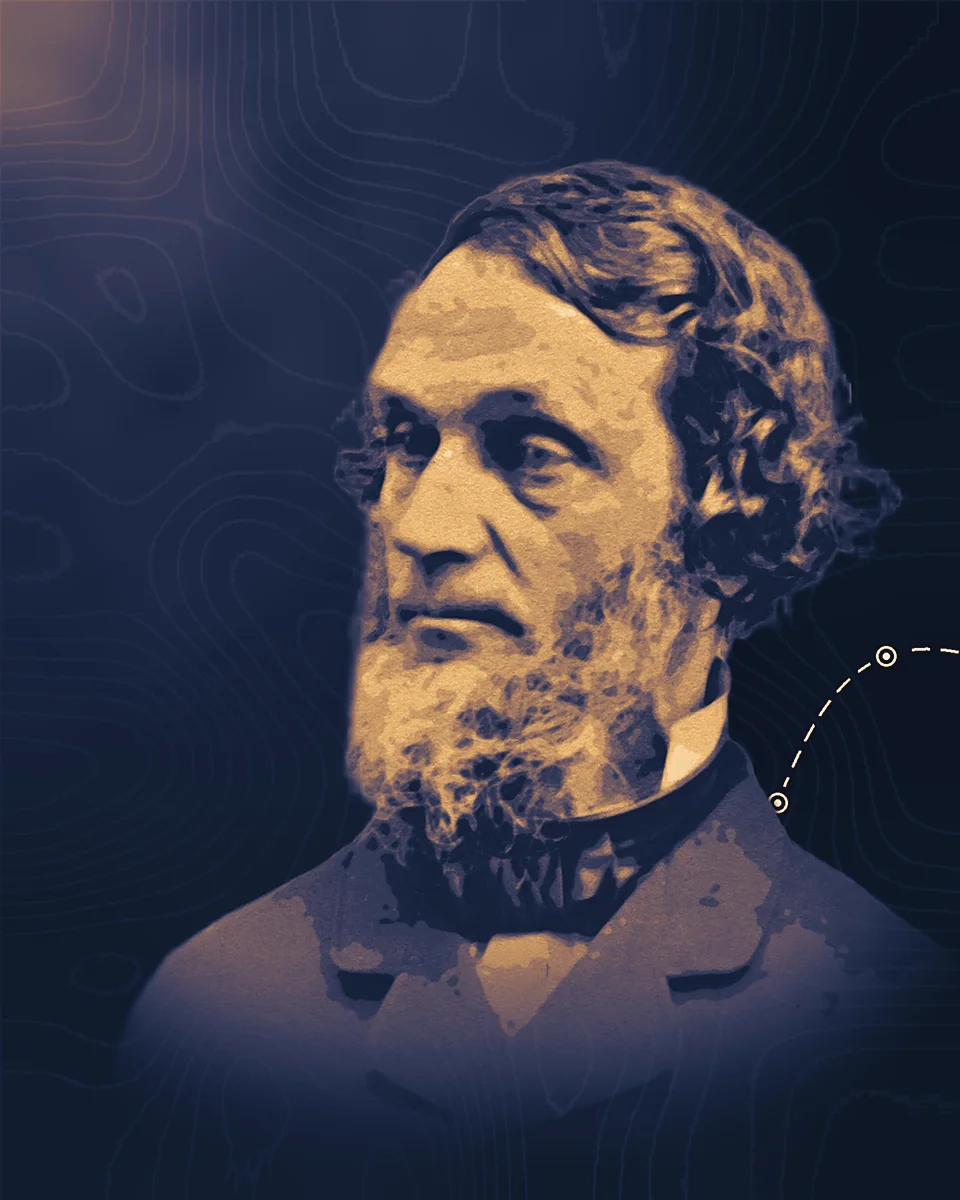
Charles Goodyear
He found that heating rubber with sulfur makes it tough and stable in heat and cold, the step now called vulcanization.
1800–1860
What they changed
1839
Heat and sulfur cure rubber
Raw rubber went soft and sticky in summer and stiff and brittle in winter. At Woburn, Massachusetts, Goodyear found that rubber mixed with sulfur did not melt on a hot stove. It came off tough. Almost every rubber product since, from tires to seals, is cured this way.
1844
US patent 3,633
After about five more years of trials, he was granted the patent on 15 June 1844. It claims rubber combined with sulfur and white lead, and the exposure of the product to a high heat, which the description puts between 212 and 350 degrees Fahrenheit (100 to 177 °C).
1840s
An industry on licence
Goodyear did not build a large works of his own. He licensed the patent to manufacturers, and Connecticut History counts many rubber companies that worked under his licence at Naugatuck, among them the firm that became Uniroyal.
1852
The patent holds in court
In Goodyear v. Day, the federal circuit court in New Jersey granted a permanent injunction against a rival maker on 28 September 1852. Daniel Webster argued for Goodyear and Rufus Choate for the defence. Justice Grier wrote that the defendant "has signally failed in the attempt to show that himself or any other person discovered and perfected the process" before Goodyear.
Life
Charles Goodyear was born in New Haven, Connecticut, on 29 December 1800, the son of a hardware store owner, and was raised in Naugatuck. The family's hardware business failed in 1830. In 1834 he visited the Roxbury India Rubber Company in New York and took up the problem of rubber goods that melted in summer and cracked in winter. Connecticut History records that he spent many nights in debtors' prison in these years.
His first results did not last. A nitric acid treatment of 1836 gave a smooth, dry surface, but the rubber underneath still failed. The use of sulfur was not his idea alone. The court record in Goodyear v. Day says Nathaniel Hayward found in 1838 that adding sulfur to the gum improved it and patented that in 1839, and that Goodyear bought the patent. What Goodyear added was the heat. The story that the discovery was an accident at a stove is told by the Lemelson Center at MIT and by the Linda Hall Library, which says he "supposedly" found it that way.
He lost Britain. Before his American patent was granted, samples of his cured rubber reached England, and Thomas Hancock, who had examined some of them, took out a British patent in November 1843. Goodyear challenged it in the British courts and lost. The Linda Hall Library calls the question of who came first "a contentious subject".
The patent did not make him rich. He spent what he earned on lawsuits against infringers at home and abroad and on costly displays at exhibitions. The Lemelson Center says he spent two weeks in a French debtors' prison before Napoleon III gave him the Cross of the Legion of Honor. His health had suffered from years of work with nitric acid and caustic chemicals. He died in New York City on 1 July 1860, owing about 200,000 dollars.
The Goodyear Tire and Rubber Company was founded in Akron, Ohio, in 1898 and named after him. He and his family had no part in it. The National Inventors Hall of Fame inducted him in 1976.
Read more
5 accounts
Gum-Elastic and Its Varieties, with a Detailed Account of Its Applications and Uses, and of the Discovery of Vulcanization, Charles Goodyear, 1853.
His own account, printed in New Haven for private circulation.
archive.org
Goodyear v. Day, Circuit Court, District of New Jersey, 1852.
The court's opinion in the "great India rubber case", with the history of the invention as the court found it.
law.resource.org
Charles Goodyear, William B. Ashworth Jr., Linda Hall Library, 2025.
A short illustrated life by a historian of science.
lindahall.org
Noble Obsession: Charles Goodyear, Thomas Hancock, and the Race to Unlock the Greatest Industrial Secret of the Nineteenth Century, Charles Slack, Hyperion, 2002.
A book-length account of both men and their dispute.
si.edu
Trials of an Inventor: Life and Discoveries of Charles Goodyear, Bradford K. Peirce, 1866.
The first biography, written six years after his death.
archive.org