Industries / Figureheads
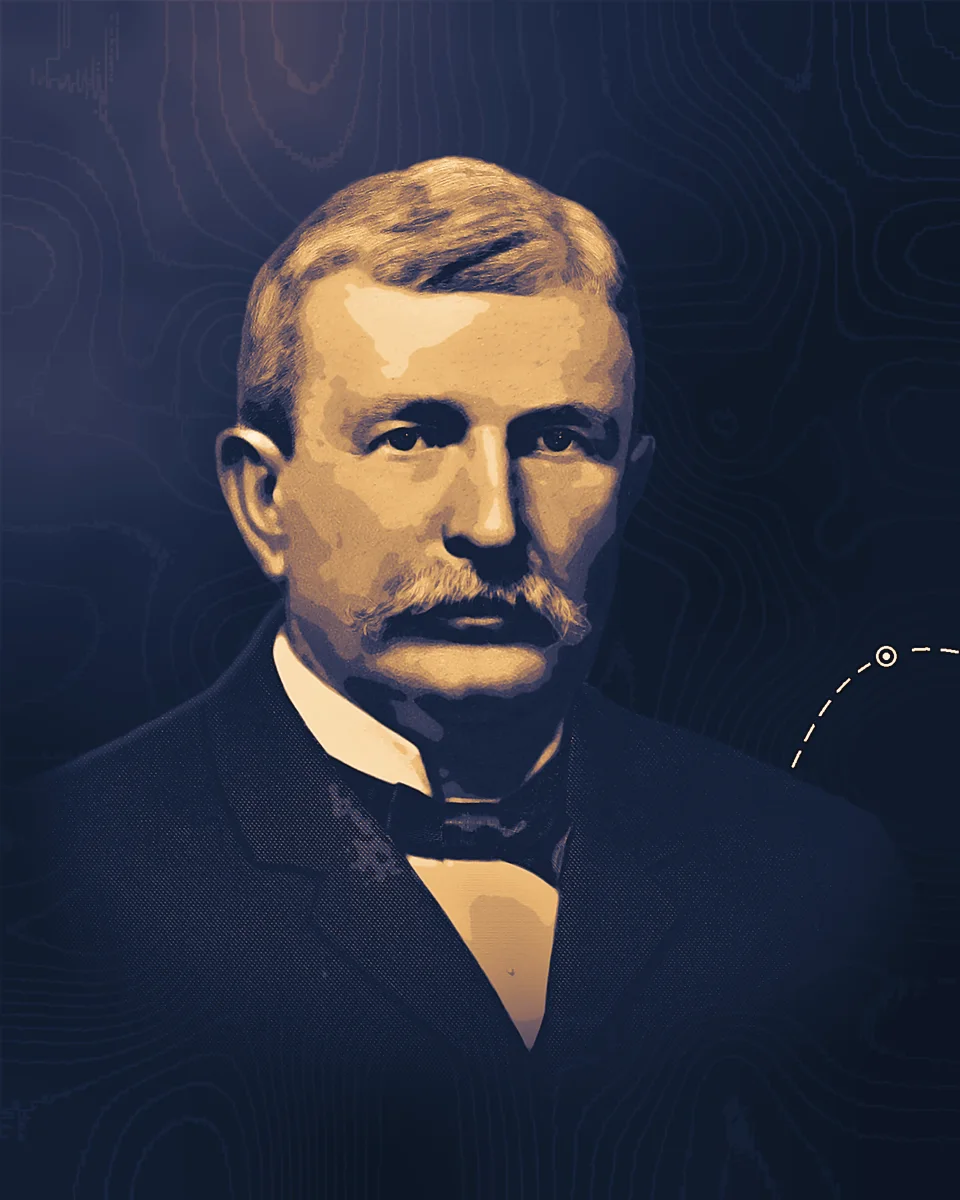
Benjamin Holt
His Stockton company built the first practical track-type tractor, a crawler that spread from soft farm ground to earthmoving and road building.
1849–1920
What they changed
1904
Tracks instead of wheels
On 24 November 1904, in a peat field on Roberts Island near Stockton, California, Holt's company gave the first practical demonstration of its track-type tractor, by the account of the American Society of Mechanical Engineers (ASME). The machine ran on endless belts of linked plates, which spread its weight over soft ground where wheels sank.
1907
A patented crawler in production
ASME says the design was patented and in production by December 1907. The National Inventors Hall of Fame, which inducted Holt in 2006, gives the patent as US 874,008 and says the machine was known as the "Caterpillar".
1908
Gasoline in place of steam
By 1908, the Hall of Fame says, Holt was able to replace steam engines with gasoline-powered tractors. ASME's landmark, a Holt machine of 1918 kept at the Haggin Museum in Stockton, is listed as the "earliest track-type gasoline-powered tractor, influencing designs worldwide."
1914
Crawlers go to war
From 1914 to 1918, by the Hall of Fame's figure, 10,000 Caterpillar tractors were made for the war, and Holt's tractor "contributed to the design of the British tank."
1925
The crawler outlives the farm
After Holt's death his company merged with its rival, the C. L. Best Tractor Company, in 1925, which the Hall of Fame records. The plaque that the American Society of Agricultural Engineers put up at the Haggin Museum in 1982 says the track-type tractor opened new land to farming and "later revolutionized earth moving and military vehicles," and ASME names construction and road building among the trades it changed.
Life
Benjamin Holt was born on 1 January 1849 in Merrimack County, New Hampshire, the seventh of eleven children of William K. and Harriet Parker Holt. His father ran a lumber business with several sawmills. From 1868 Benjamin and his brothers made wagon spokes and hubs, and in 1873 he set up his own plant at Concord, New Hampshire, making wheels and running gear.
In 1883 he moved to Stockton, California, where he and his brother Charles began making wheels and wagon parts as the Stockton Wheel Company. It was renamed the Holt Manufacturing Company in 1892, with Benjamin as president. The firm made combined harvesters, which cut, threshed and cleaned grain in one pass, including a side-hill model for uneven ground, and large steam traction engines before it turned to tracks.
The track was not Holt's idea alone. In 1904, the same year as the Roberts Island test, David Roberts of Richard Hornsby and Sons in Grantham, England, patented a crawler track, and the Tank Museum in Bovington says British soldiers may have coined the word "Caterpillar" watching the Hornsby machines. The same museum traces the British tank to the Pedrail and to the Bullock Creeping Grip Tractor company rather than to Hornsby. The Stockton county history of 1923 tells a local story that the British officer E. D. Swinton conceived the tank after seeing a Holt tractor in Belgium; no source outside it was found for that.
Holt married Anna Brown, daughter of the San Joaquin County farmer Benjamin Brown, in 1890. By 1923 the business had two large plants, at Stockton and at Peoria, Illinois. He died suddenly at St. Joseph's Home on 5 December 1920.
Read more
4 accounts
History of San Joaquin County, California, George H. Tinkham, 1923.
The county history's long sketch of Holt, written just after his death, with his portrait.
archive.org
History of the State of California and Biographical Record of San Joaquin County, J. M. Guinn, 1909.
A shorter sketch from his lifetime, with the firm's history.
archive.org
Holt Caterpillar Tractor, landmark 60, American Society of Mechanical Engineers, 1981.
The landmark record of the Haggin Museum's 1918 tractor and the 1904 test.
asme.org
Benjamin Holt, National Inventors Hall of Fame, 2006.
The induction record, with the patent and the wartime figures.
invent.org