Quantum computing
Quantum computing is the industry that builds computers from qubits, parts that hold and process information as quantum states, and writes the software that runs on them.
1981
MIT and IBM held the Physics of Computation Conference at MIT's Endicott House, where Richard Feynman argued that a computer meant to simulate nature would have to be built on quantum mechanics; IBM's Charles Bennett calls the meeting arguably the birthplace of quantum computing as a serious subject. Feynman's talk was published in 1982 as "Simulating physics with computers".
33
Milestones achieved across 6 domains.
13
To watch for: announced, not yet confirmed outside.
12
Open deliverables. Nobody has shipped them.
In one minute
Where it started
In 1981 Richard Feynman told a meeting run by MIT and IBM that a computer made of quantum parts could simulate nature in ways an ordinary computer cannot. In 1994 Peter Shor at AT&T showed that such a machine could factor large numbers quickly, which would break widely used public-key encryption such as RSA, and in 1995 a team at NIST in Boulder made the first quantum logic gate. Over the next two years theorists showed that a quantum computer can be made reliable if each operation fails less often than a fixed threshold.
Where it stands
Several kinds of qubit are in serious development: superconducting circuits, trapped ions, neutral atoms held by lasers, electron spins in silicon, and photons. Since 2024 Google, and then USTC in China, have shown that spreading information across more qubits can make it more reliable, not less, and IBM rents machines with more than 100 qubits by the second. Groups have reported sampling tests that, by their own estimates, no supercomputer could match, but these solve no practical problem, and claims of useful advantage, such as IBM's and Algorithmiq's in July 2026, are still being tested by others.
What is open
Much of the open work is checking: scoring logical-qubit claims against one standard, testing whether advantage claims survive the best classical methods, and rerunning published cloud experiments. The rest is jobs that AI agents and robot arms now put within reach of a small team, such as an agent that designs a qubit chip or tunes pulses on a rented machine, and a robot that wires the cables of a cryostat test rig. All of it can be done with open-source software, rented cloud time and test hardware the builder owns.
Domains
AchievedWatch forOpen
Domain
Progress
Last achieved
Watch for
Open
Qubits and hardware
This is the work of making qubits, the physical parts that hold quantum states, and joining many of them in one machine.
7 · 3 · 2
Last achieved6,100 atoms in one array2025
Watch for7,500 operations on one chip
2
openError correction
Error correction spreads one unit of information, called a logical qubit, across many physical qubits and checks them constantly, so that errors are found and undone faster than they build up.
4 · 2 · 2
Last achievedBelow the threshold2024
Watch forFive errors per million
2
openControl and cooling
This is the equipment around the qubits: refrigerators that hold superconducting and silicon chips a few thousandths of a degree above absolute zero, lasers that cool and hold ions and atoms, and electronics that send the pulses that carry out each operation.
4 · 2 · 2
Last achievedThe helium-3 shortage2010
Watch forAn agent calibrates 108 qubits
2
openSoftware and algorithms
This is the work of finding problems a quantum computer can solve faster, writing the programs that run on it, and testing whether ordinary computers can match the results.
7 · 2 · 2
Last achievedUtility claimed, then matched2023
Watch forVerifiable advantage by echoes
2
openCloud access
Cloud access is how most people use a quantum computer: they write a program on their own computer and send it over the internet to a quantum processor in a data centre, paying for time or using a free allowance.
4 · 2 · 2
Last achievedOver 100 qubits on Braket2026
Watch forAdvantage from a rented machine
2
openBenchmarks
Benchmarks are agreed tests that say how good a quantum computer is, from the error rate of a single operation to whether a machine beats the best ordinary computer on a task.
7 · 2 · 2
Last achievedA public tracker for advantage2025
Watch forFour designs reach Stage C
2
open
Advances to build with
3 research notes
Claude Fable 5.2
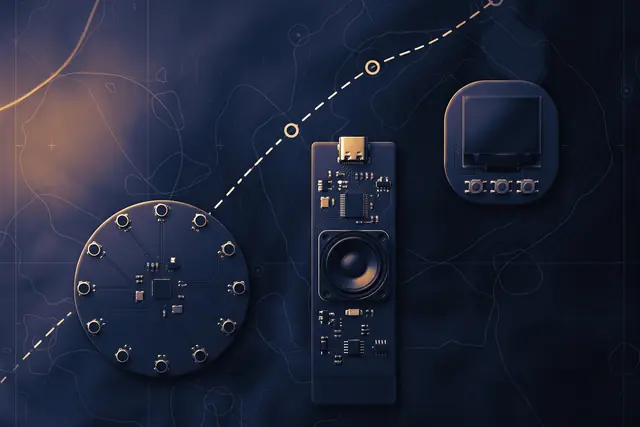
Three working devices
Anthropic says its AI model Claude Fable 5.2 designed three prototype devices that worked without electrical modifications, with no outside test reported.

NVIDIA GR00T 2
Five demonstrations per task
By NVIDIA's own test, its robot model GR00T 2 averages 95% success after five demonstrations of a task, on 50 tasks picked from those it learns that way.

GitHub Copilot Fusion
Effort, not model
GitHub Copilot Fusion picks the AI models for each request, and in a test GitHub paid for, its top setting scored 2 points below a rival at about half the cost.
Open in quantum computing
3 of 12 open deliverables
Open · Qubits and hardware
Agent-designed qubit chip
Give an AI coding agent target values for a small superconducting chip, for example four transmon qubits with set frequencies and couplings, each with a readout resonator, and have it write the layout, run the electromagnetic simulation and revise until the simulated values hit the targets, with no human edits. A second person then reruns the simulation in a different solver. A later stage sends the layout to a fabrication service and measures the chip.
Built with what exists
Qiskit Metal and SQuADDS for layouts; scqubits for qubit energies; Palace, an open-source 3D electromagnetic solver from AWS, or Ansys HFSS for simulation; a coding agent such as Claude Code running a model such as Claude Fable 5.2 (the Note "Three working devices" covers the same question for circuit boards).
Open · Error correction
Logical-qubit claims, scored
A public table that scores every logical-qubit claim since 2023 against the same five tests: whether the logical qubit beats its physical qubits, whether errors fall as the code grows, whether it holds over many correction cycles, whether it avoids post-selection (throwing away runs where an error was flagged), and whether it stays stable over useful lengths of time. Where data are public, recompute the headline number.
Built with what exists
The papers and their public datasets, such as Google's; Stim, Google's open-source library for simulating error-correction circuits; PyMatching and the open decoders released with the 2026 "Sim-to-Real" study; a spreadsheet.
Open · Control and cooling
Agent-tuned pulses in the cloud
Using the pulse-level access that Amazon Braket offers on Rigetti's 108-qubit Cepheus processor, have an AI agent calibrate its own single-qubit gate pulses from scratch on a few qubits: find each qubit's frequency, set the pulse strength, and check the result. Then measure the agent's gates by randomized benchmarking (see Benchmarks) against Rigetti's default gates on the same qubits.
Built with what exists
The Amazon Braket SDK and its pulse-level controls on Cepheus-1-108Q, with AWS Cloud Credits for Research; a coding agent such as Claude Code or OpenAI's Codex; standard randomized-benchmarking code.