Industries / Figureheads
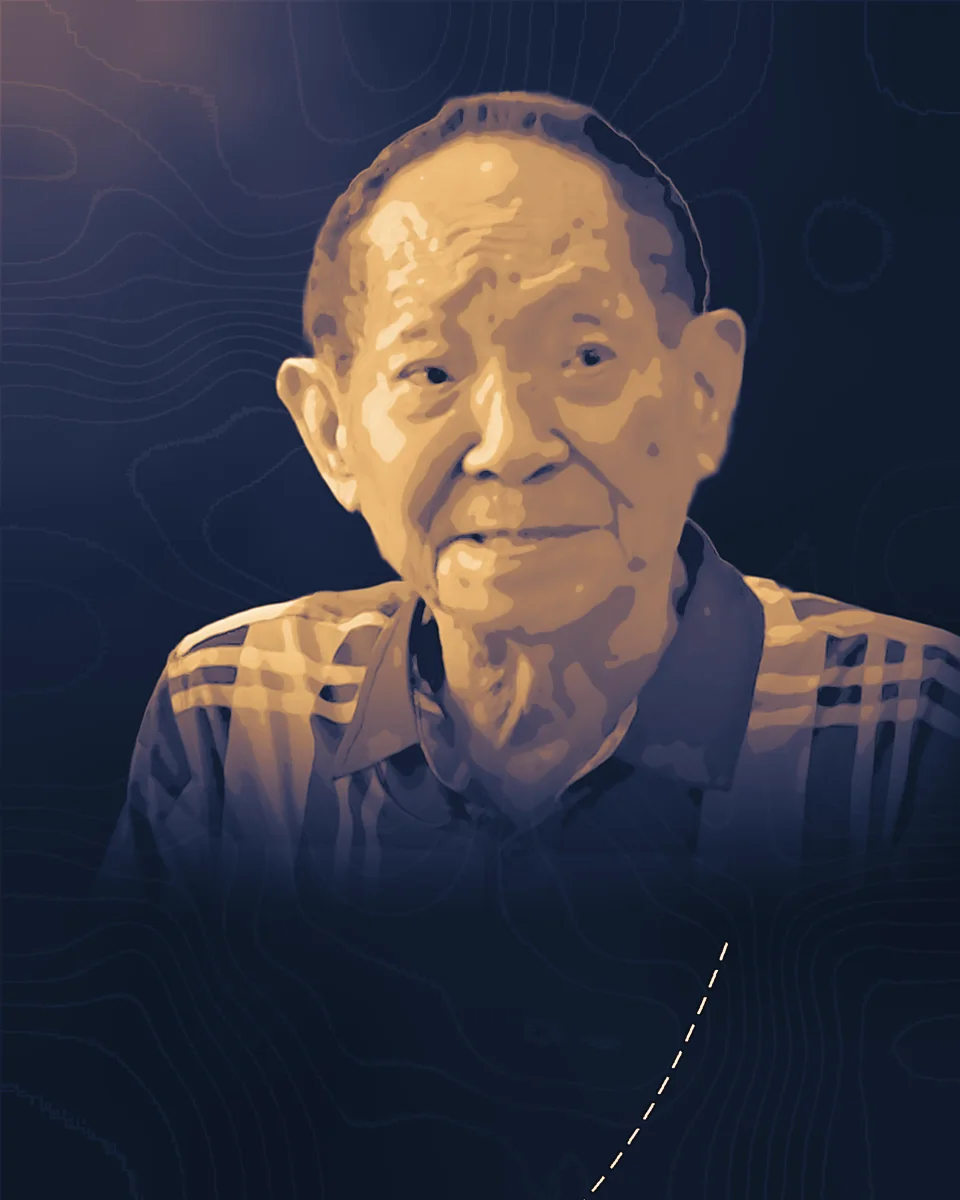
Yuan Longping
He led the work that made hybrid rice a field crop, raising yields about 20 percent.
1930–2021
What they changed
1966
Male-sterile rice reported
A rice flower pollinates itself, so crossing two varieties by hand, flower by flower, could never supply a farm with seed. In 1964 Yuan and a student searched the paddies for plants with no working pollen, called male-sterile, which can only set seed with pollen from another plant. He reported them in the Chinese Science Bulletin in April 1966 and proposed breeding hybrids from them.
1970
A wild plant on Hainan
The first male-sterile plants did not breed reliably. Late in 1970 Yuan's assistant Li Bihu found a male-sterile wild rice plant beside a ditch at Nanhong Farm in Sanya, on Hainan Island. Yuan named it "wild abortive", and a 2007 review in the Annals of Botany says it remained the main source of male sterility in China's hybrids.
1973
Three lines complete
Hybrid seed in bulk needs three lines of rice: a male-sterile line, a maintainer that reproduces it, and a restorer that pollinates it to give fertile hybrid seed. Yuan dated the full set to 1973, and the Magsaysay award citation gives 1974. The restorers were found among varieties the International Rice Research Institute (IRRI) had sent to China, by IRRI's account.
1976
Hybrids in farmers' fields
Commercial production of hybrid rice began in China in 1976. The Wolf Foundation says rice yields "were generally enhanced by 20 percent", and the 2007 review counted hybrids on more than half of China's rice land.
1995
Two lines instead of three
In 1973 Shi Mingsong found a rice plant in Hubei province, Nongken 58S, that is male-sterile when days are longer than 14 hours and fertile when they are shorter, so it needs no maintainer line. Yuan proposed moving to this two-line method in 1986 and led the national program from 1987, and two-line hybrids have been grown since 1995.
pmc.ncbi.nlm.nih.govpmc.ncbi.nlm.nih.govpmc.ncbi.nlm.nih.gov
Life
Yuan Longping was born on 7 September 1930 in Beiping, as Beijing was then called. He studied agriculture at a college outside Chongqing, graduated in 1953 and was sent to teach at Anjiang Agricultural School in rural Hunan. He lived in the Hunan countryside through the famine that followed the Great Leap Forward of 1958 to 1960 and saw the bodies of people who had starved. From 1960 he worked on rice.
When the Cultural Revolution began in 1966, posters at the school denounced him as an enemy of the revolution. He was spared after officials who had read his 1966 paper wrote in support of the research. By the account his biographers give, he was later sent to work in a coal mine and came back after his assistants Li Bihu and Yin Huaqi telegraphed the State Science Commission in Beijing.
Hybrid rice was not one man's work. The historian Sigrid Schmalzer read the Chinese journals of the early 1970s and found research institutes and farm extension offices in many provinces working on it together, and large numbers of farmers trained to produce the seed. Those journals name Yuan's school and not Yuan, whose name did not appear in print between his 1966 paper and Mao's death. Schmalzer dates the story built around him to the two years after Mao's death in 1976, and also writes that Hunan's place in the record "owes first and foremost to his efforts". The Wolf Foundation credits "a decade of cooperative research efforts among hundreds of rice scientists" under his leadership.
The method has a cost that IRRI's own history states: seed saved from a hybrid crop gives a poor, uneven crop, so farmers must buy new seed every season.
Yuan moved to the Hunan Academy of Agricultural Sciences in 1971 and in 1984 became the first director general of the national hybrid rice research center in Changsha, a post he held until he died. The technology went to the United States in 1979, and he gave breeding material to IRRI in 1980. By 2001 his center had trained 350 scientists from 25 countries, by the Magsaysay Foundation's count.
He received the Ramon Magsaysay Award in 2001 and, in 2004, the Wolf Prize in Agriculture, shared with Steven Tanksley, and the World Food Prize. He was elected to the US National Academy of Sciences in 2006. He was nominated three times for the Chinese Academy of Sciences and never elected, and he never joined the Communist Party. He kept visiting the research station on Hainan until a fall in March 2021, and died in Changsha on 22 May 2021, aged 90.
rmaward.asiawolffund.org.ilricetoday.irri.orgnature.comcbgg.hapres.com
Read more
6 accounts
Yuan Longping (1930–2021), Shellen X.
Wu, Nature, 2021. An obituary by a historian of China, with the famine, the Cultural Revolution and the science in two pages.
nature.com
Yuan Longping, hybrid rice, and the meaning of science in the Cultural Revolution and beyond, Sigrid Schmalzer, Endeavour, 2017.
A history from the Chinese journals of the 1970s, showing how many people did the work and how the story came to center on one man. This is the author's preprint.
sigridschmalzer.org
Yuan Longping: hybrid rice is on the way to fulfilling its potential, Ling Wang, Science Bulletin, 2015.
An interview at 84, with his own account of the years 1964 to 1973.
sciengine.com
Yuan Longping, Ramon Magsaysay Award Foundation, 2001.
The award citation and a short life, written while he was still working.
rmaward.asia
A hybrid history, Rice Today, International Rice Research Institute, undated. How the three lines work, what IRRI's varieties added and what the seed costs farmers.
ricetoday.irri.org
Progress in research and development on hybrid rice: a super-domesticate in China, Shi-Hua Cheng and colleagues, Annals of Botany, 2007.
A technical review of the hybrids, their parent lines and the area they cover.
pmc.ncbi.nlm.nih.gov