Industries / Figureheads
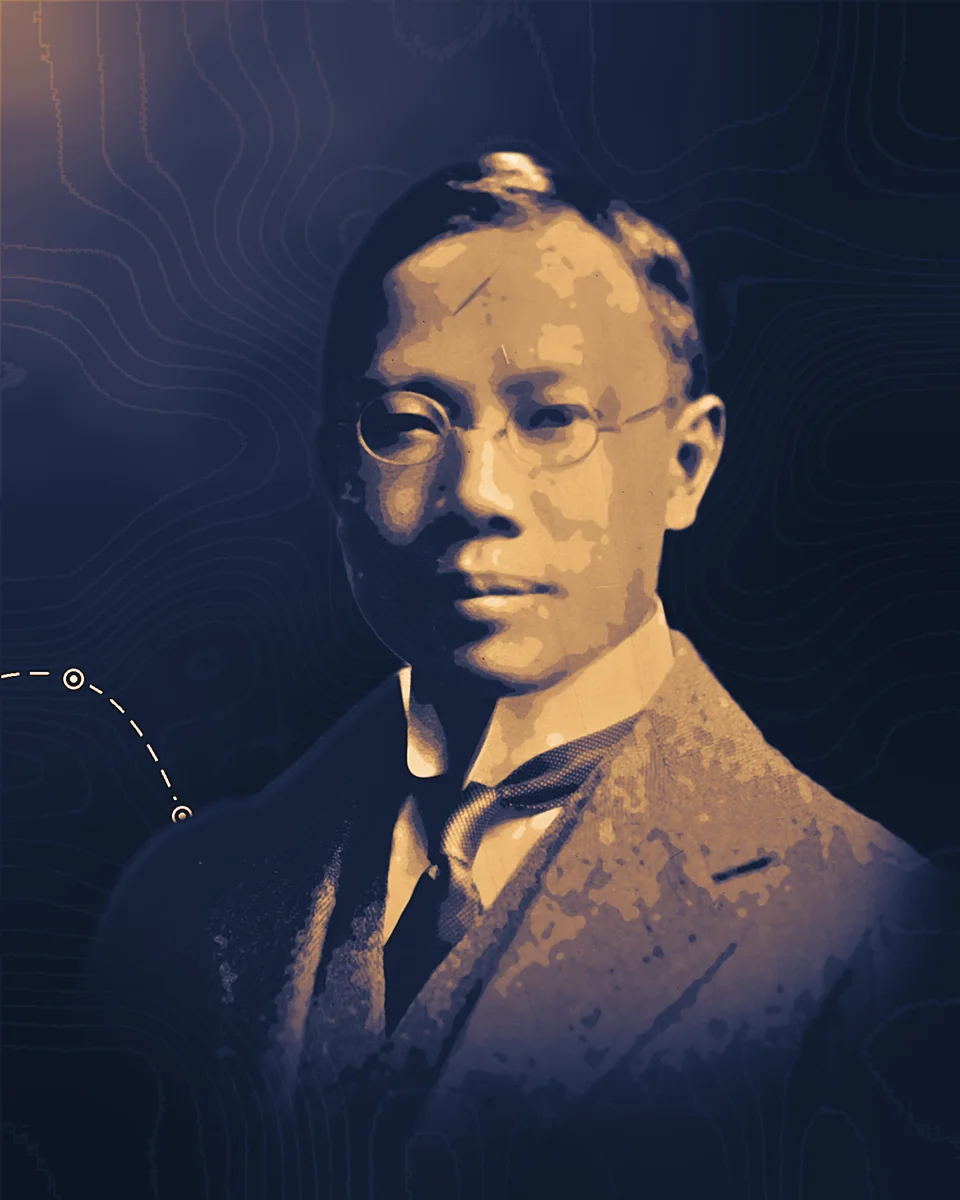
Wu Lien-teh
He led China's fight against the Manchurian plague of 1910–11 with isolation, masks and cremation, then built the country's first standing public health and quarantine services.
1879–1960
What they changed
1911
Plague stopped by isolation
Pneumonic plague, the form that spreads from person to person through the lungs, broke out in northern Manchuria in the autumn of 1910. China sent Wu to Harbin in December. He had the sick taken to hospital, their homes disinfected and contact with them forbidden; the government sent about 1,200 soldiers to control travel, above all on the railways, and 600 police searched door to door. The last case was recorded on 1 March 1911, after an outbreak that killed an estimated 60,000 people.
1911
Cremation for the plague dead
In late January 1911 Wu found more than 2,000 unburied bodies at Harbin, frozen in ground too hard to dig. Cremation was taken as desecration, so he took local officials to the burial ground and petitioned the throne. An imperial edict allowed it, and mass cremation began on 31 January 1911, the Lunar New Year.
1911
A cheap gauze mask
The plague staff at Fuchiatien relied "almost entirely on the use of a mask for protection". At the plague conference his colleague Dr. Fang described the one they preferred to more than ten metal-framed designs: an oblong pad of wool between two layers of surgical gauze, tied round the head with three tails, at about 2.5 cents each, and the team recommended it "should be universally adopted". Wu's biographers call it a forerunner of the N95 respirator.
1911
A plague conference in China
China invited the eleven foreign powers in Peking to send specialists to a conference at Mukden, now Shenyang, from 3 to 28 April 1911, and Wu chaired it. Delegates included Shibasaburo Kitasato from Japan, Richard Strong from the United States and Daniil Zabolotny from Russia. A 2022 history in Le Infezioni in Medicina calls it the first international scientific congress held in China.
1912
A standing plague service
The North Manchurian Plague Prevention Service, with Wu as director, was put on a firm basis on 1 October 1912, paid for with 78,000 roubles a year of Harbin's customs revenue. Its tasks were to stop plague returning, to research its link with marmots, and to bring general sanitary measures to the region. Its isolation hospital at Harbin took its first patients on 16 December 1912.
1930
Quarantine in Chinese hands
China created the National Quarantine Service in 1930, based in Shanghai and staffed by Chinese personnel, with Wu as its first director. It took back quarantine control of the major ports, which had been run under foreign supervision, was linked by cable to the League of Nations' Eastern Bureau, and sent weekly reports to the League.
Life
Wu Lien-teh was born in Penang, in British Malaya, on 10 March 1879, the son of a goldsmith from Taishan, China, and was first named Ngoh Lean Tuck. He won the Queen's Scholarship from the Penang Free School and entered Emmanuel College, Cambridge, in 1896; the Singapore Medical Journal's authors call him the first Chinese to graduate in medicine there. He did research in bacteriology under Ronald Ross at the Liverpool School of Tropical Medicine and on malaria and tetanus at the Pasteur Institute in Paris.
Back in Malaya from 1903 he studied beriberi among tin miners at the Institute for Medical Research in Kuala Lumpur and went into private practice in Penang. He campaigned against opium, at a time when its sale paid much of the colony's revenue, and in 1906 organized an anti-opium conference in Ipoh attended by about 3,000 people. In 1907 he was fined for having an ounce of opium tincture in his clinic, which he said had come in a cupboard he bought with the practice. In 1908 he went to China, where he became vice director of the Imperial Army Medical College in Tianjin.
The measures were severe, and the disease was not curable. Those who fell ill all died, the Chinese quarter of Harbin lost a quarter of its population, households where someone died were isolated and their belongings burned, and contacts were quarantined in railway cars, 120 of them lent by the Russian authorities. Wu did not work alone: Chinese, Russian and Japanese doctors ran their own measures along the railways their governments controlled, and a French doctor, Dr. Mesny, died of the plague after visiting a hospital without a mask.
He went on to build Western medicine in China. He helped form the National Medical Association in 1915, serving as secretary and then as president from 1916 to 1920, fought cholera in the north-east in 1920–21, and with K. Chimin Wong wrote a History of Chinese Medicine (1932). He held traditional Chinese medicine to be of historical and cultural value only, while urging that its study go on beside modern medicine. In 1935 he became the first Chinese doctor nominated for the Nobel Prize in Physiology or Medicine.
Japan's invasion ended his work in China. He was held and questioned as a spy by the Japanese in Manchuria in 1931, and in 1937 he left for Malaya and did not see China again; his first wife, Ruth, and two of their sons had died there. He opened a clinic in Ipoh that treated the poor without charge, was kidnapped by resistance fighters in 1943 and freed for a ransom, and finished his autobiography, Plague Fighter, in 1959. He died in Penang on 20 January 1960, aged 80. The Lancet named a prize for him and its founder, the Wakley–Wu Lien Teh Prize, in 2019.
pmc.ncbi.nlm.nih.govpmc.ncbi.nlm.nih.govpmc.ncbi.nlm.nih.gov
Read more
6 accounts
Report of the International Plague Conference held at Mukden, April 1911, Bureau of Printing, Manila, 1912.
The conference's own record, with Wu's addresses from the chair and his staff's paper on the gauze mask.
archive.org
Plague fighter: the autobiography of a modern Chinese physician, Wu Lien-teh, W. Heffer and Sons, 1959.
His own account of his life.
archive.org
North Manchurian Plague Prevention Service reports (1911–1913), edited by Wu Lien-teh, 1914.
The service's first reports, with its founding memorandum, hospitals and research on marmots.
archive.org
Dr Wu Lien-teh: modernising post-1911 China's public health service, K.
H. Lee, D. T. Wong, T. M. Ho and K. H. Ng, Singapore Medical Journal, 2014. A full biographical essay from his Malayan beginnings to his death.
pmc.ncbi.nlm.nih.gov
The Manchurian pandemic of pneumonic plague (1910–1911), S.
N. Michaleas and colleagues, Le Infezioni in Medicina, 2022. A history of the outbreak and the international response to it.
pmc.ncbi.nlm.nih.gov
Plague masks: the visual emergence of anti-epidemic personal protection equipment, Christos Lynteris, Medical Anthropology, 2018.
An anthropologist's study of how masks were invented in the 1910–11 outbreak.
europepmc.org