Industries / Figureheads
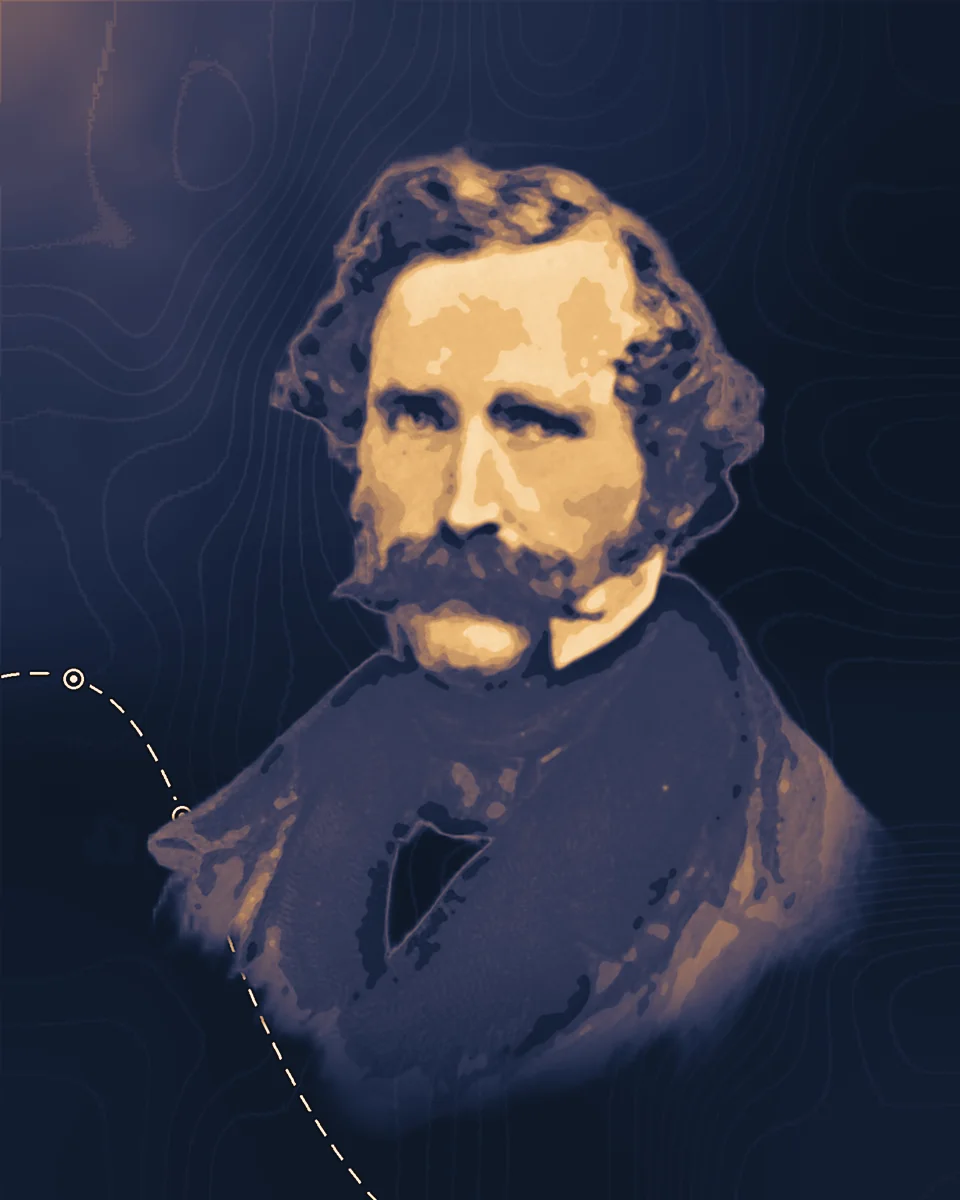
William T. G. Morton
A Boston dentist, he gave the ether at the public operations of 1846 that made surgeons take up anaesthesia, then fought for years to own the credit and the patent.
1819–1868
What they changed
1846
Ether in the dental chair
On 30 September 1846 Morton gave ether to a patient in his Boston dental office and pulled a molar without pain. On the advice of the Harvard chemist Charles T. Jackson he poured the ether on a handkerchief held over the mouth and nose. That gave a light, short effect, enough for a tooth but not for an operation.
1846
An inhaler for longer operations
For a surgical operation Morton needed a deeper and longer effect. With advice from Augustus Gould, a Boston physician he lodged with, he ordered an inhaler from a local glassmaker: a glass globe holding sponges soaked in ether, with a valve in the mouthpiece so the patient breathed in through the vapour and out into the room. The historian Howard Markel counts this way of controlling the dose as Morton's real contribution. Paul Firth's 2022 study of the hospital records notes that Morton had never used it before 16 October.
1846
Ether in the operating theatre
On 16 October 1846, at Massachusetts General Hospital in Boston, Morton gave ether to Edward Gilbert Abbott while the surgeon John Collins Warren tied off a mass of blood vessels under his jaw. Abbott did not react to the first cut but moved and cried out later, and the witnesses found the trial suggestive rather than conclusive. The next day George Hayward removed a fatty tumour from a woman's arm under ether with clearer success, and on 7 November he amputated a leg. Henry Bigelow published the four operations on 18 November, and by the end of December ether was in use in Britain and France.
1846
A patent on ether
US patent 4,848, "Improvement in surgical operations", was issued on 12 November 1846 to Jackson and Morton of Boston, with Jackson assigning his share to Morton. Morton called it "Letheon", but it was soon shown to be ordinary sulphuric ether. Doctors held that it was wrong to profit from a discovery that benefited everyone, the patent was ruled unenforceable, and he never received royalties.
patents.google.comcollection.sciencemuseumgroup.org.ukpbs.org
Life
William Thomas Green Morton was born on 9 August 1819 in Charlton, Massachusetts, the son of James and Rebecca Morton. He studied at the Baltimore College of Dental Surgery, the world's first dental school, from 1840 and left without a degree. From 1842 he practised dentistry in Hartford, Connecticut, for a time in partnership with Horace Wells. In 1844 he enrolled at Harvard Medical School, which he did not finish, and heard the chemist Charles T. Jackson lecture on how breathing sulphuric ether could make a person insensible.
collections.nlm.nih.govcollection.sciencemuseumgroup.org.ukpbs.org
He was not the first to take away the pain of an operation with a gas. Crawford Long, a physician in Jefferson, Georgia, removed a growth from the neck of James Venable under ether on 30 March 1842 and used it several more times, but published only in 1849. Wells first used nitrous oxide for dentistry in December 1844, and a few weeks later tried to show it in Boston, probably at the end of January 1845 in a public hall on Washington Street. The gas did not fully stop the pain of the tooth being pulled, and the demonstration was judged a failure. Firth's study concludes that the Boston operations of 1846 were not the first successful public use of an inhaled anaesthetic, but that Bigelow's report of them was what started anaesthesia in general use.
pmc.ncbi.nlm.nih.govcollection.sciencemuseumgroup.org.ukeuropepmc.orgpmc.ncbi.nlm.nih.gov
Morton then set out to be known as the only discoverer. He dismissed the part of Jackson, who had suggested ether to him, and derided Wells's work. Firth, writing from the hospital's own department of anaesthesia, calls him "a serial fraudster and con artist". An authorized biography of 1859, written to support his claim, is the first source for the story that Warren turned to the audience and told them that "this is no humbug". Firth found no earlier evidence for it; Warren had died in 1856 and could not confirm or deny it.
He spent his last years trying to get Congress to pay him for the discovery. A bill introduced in 1852 would have given him $100,000 as a national testimonial on condition that he gave up his patent, and nothing was ever paid. Wells, Long and Jackson all pressed claims of their own. Morton farmed in Wellesley, Massachusetts, in his last years and died in New York City on 15 July 1868, aged 48, with little money.
collections.nlm.nih.govcollection.sciencemuseumgroup.org.ukpbs.org
Read more
6 accounts
Ether Day Revisited: The Surgical Records of Edward Gilbert Abbott, Paul G. Firth, Annals of Surgery Open, 2022.
The hospital's own records of the patient, transcribed and read against the received story.
pmc.ncbi.nlm.nih.gov
Insensibility during Surgical Operations Produced by Inhalation, Henry J. Bigelow, 1846.
The report of the four Boston operations that spread the method, in an 1847 reprint.
pmc.ncbi.nlm.nih.gov
Horace Wells' demonstration of nitrous oxide in Boston, R. P. Haridas, Anesthesiology, 2013.
What 21 statements and 5 newspaper notices show of the failed demonstration before Morton's.
europepmc.org
Tarnished Idol: William Thomas Green Morton and the Introduction of Surgical Anesthesia, Richard J. Wolfe, 2001.
A book-length chronicle of the ether controversy by a former curator at Harvard's Countway Library.
wellcomecollection.org
Biographical sketch of Dr. William T. G. Morton, reprinted from Physicians and Surgeons of America, about 1896.
The case for Morton as his supporters made it, with his honours and the petitions to Congress.
collections.nlm.nih.gov
The painful story behind modern anesthesia, Howard Markel, PBS NewsHour, 2013.
A historian's short account that gives Morton credit for the inhaler.
pbs.org