Industries / Figureheads
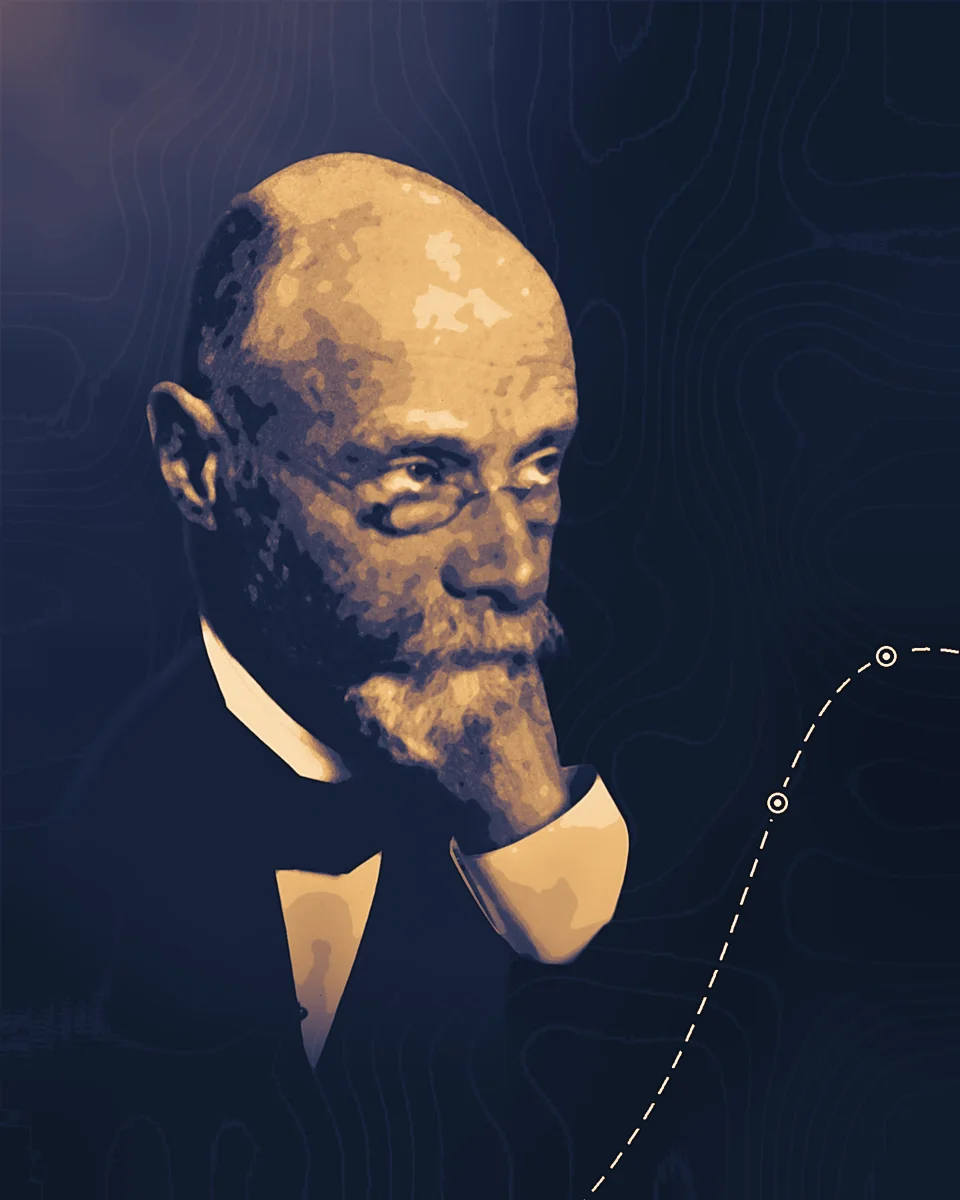
Willem Einthoven
He built the string galvanometer in Leiden, which drew the heart's electric current as a clear trace and made the electrocardiogram a clinical test.
1860–1927
What they changed
1895
Five waves named
Einthoven began with a capillary electrometer, a mercury-filled glass tube whose meniscus moves with voltage, the instrument Augustus Waller had used for the first human heart recording in 1887. It was too slow to follow the heartbeat, so Einthoven corrected its traces by calculation, and in 1895 picked out five deflections, which he named P, Q, R, S and T. The names are still used.
1902
The string galvanometer
To avoid the calculations he built a new meter: a thin silver-coated quartz thread hung between two electromagnets, which moved when the heart's current passed through it, its shadow magnified and recorded on photographic paper. An article of 1902 shows it recording the five waves in a person directly. The Nobel Foundation dates the instrument to 1903. The first apparatus weighed about 270 kg, filled two rooms, took five people to run and needed water cooling.
pmc.ncbi.nlm.nih.govpmc.ncbi.nlm.nih.govnobelprize.orgpmc.ncbi.nlm.nih.gov
1906
Heart traces by telephone
His laboratory stood about 1.5 km from the Leiden hospital. At the suggestion of his colleague Johannes Bosscha he joined the two by telephone cable and recorded patients' hearts at a distance. E. M. Vilela and N. Bettencourt call this the first "telecardiogram", from his paper of 1906.
1900s
Three leads, one standard
Einthoven recorded the trace from three leads, read on three axes across the front of the body, and drew the heart's electrical axis as a vector in an equilateral triangle, the start of vectorcardiography. He also set standards for calibrating the trace and for its recording speed.
1924
A Nobel Prize alone
He received the Nobel Prize in Physiology or Medicine "for his discovery of the mechanism of the electrocardiogram", after seven earlier nominations. The physiologist A. V. Hill had proposed that Thomas Lewis of University College London share it, because Lewis's work on heart rhythms gave the instrument its clinical use. The prize went to Einthoven alone.
Life
Willem Einthoven was born on 21 May 1860 in Semarang, Java, then in the Dutch East Indies. His father, an army medical officer and later parish doctor in Semarang, died when he was six, and four years later his mother took the six children to Utrecht. He entered the University of Utrecht in 1878 to study medicine, worked under the physiologist F. C. Donders and took his doctorate in 1885. The same year he was appointed professor of physiology at Leiden, and he took up the chair in 1886, after qualifying as a general practitioner. He worked in Leiden for the rest of his life.
The electrocardiogram was not his discovery, and he said so. Waller, a physiologist in London, had recorded the heart's current in an animal in 1883 and in a person in 1887, and Einthoven credited him with the first human ECG. When he learned that the French engineer Clément Ader had built a similar, far less sensitive instrument for communications in 1897, he cited Ader in his 1901 paper. Waller doubted the method's worth. In 1911 he wrote that he did not imagine electrocardiography "is likely to find any very extensive use in the hospital". Einthoven saw the clinical use from the start.
pmc.ncbi.nlm.nih.govpmc.ncbi.nlm.nih.govpmc.ncbi.nlm.nih.gov
Others carried the instrument into hospitals. Lewis bought a string galvanometer, took it to London and used it to sort the irregular heart rhythms, giving names such as "auricular fibrillation". The Cambridge Instrument Company built a version weighing about 23 kg (50 pounds), and by 1935 the Sanborn Company had cut the weight to about 11 kg. The Leiden laboratory became a place scientists from all over the world came to visit.
He learned of the Nobel Prize in October 1924 while travelling in the United States. He wanted to share the prize money with his former assistant Van de Woerd, found that he had died, and gave half of it to Van de Woerd's two sisters, who were living in poverty.
He married his cousin Frédérique de Vogel in 1886, and they had four children. Their son Willem, an electrical engineer, built a vacuum version of the string galvanometer for wireless signals and ran the radio laboratory at Bandung in Java. Einthoven died in Leiden on 29 September 1927, aged 67, of cancer.
Read more
6 accounts
The String Galvanometer and the Measurement of the Action Currents of the Heart, Willem Einthoven, Nobel lecture, 11 December 1925.
His own account of the instrument and what it showed.
nobelprize.org
Willem Einthoven: biographical, Nobel Foundation, from Les Prix Nobel. The life written at the time of the award, with his family and his other research.
nobelprize.org
Einthoven's String Galvanometer: The First Electrocardiograph, Moises Rivera-Ruiz, Christian Cajavilca and Joseph Varon, Texas Heart Institute Journal, 2008.
A short history from Waller's electrometer to the portable machines.
pmc.ncbi.nlm.nih.gov
Monitoring and modulating cardiac bioelectricity: from Einthoven to end-user, T. De Coster and colleagues, EP Europace, 2024.
A centenary review that sets Einthoven's work beside Waller's and follows it to the present.
pmc.ncbi.nlm.nih.gov
Commemorating the 1924 Nobel Prize awarded to Willem Einthoven, Carol Ann Remme and Katja Odening, EP Europace, 2024.
On his nominations and the case made for Thomas Lewis.
pmc.ncbi.nlm.nih.gov
Willem Einthoven (1860-1927): Father of Electrocardiography, H.
A. Snellen, Kluwer, 1995. The book-length life, with his ancestors and contemporaries.
archive.org