Industries / Figureheads
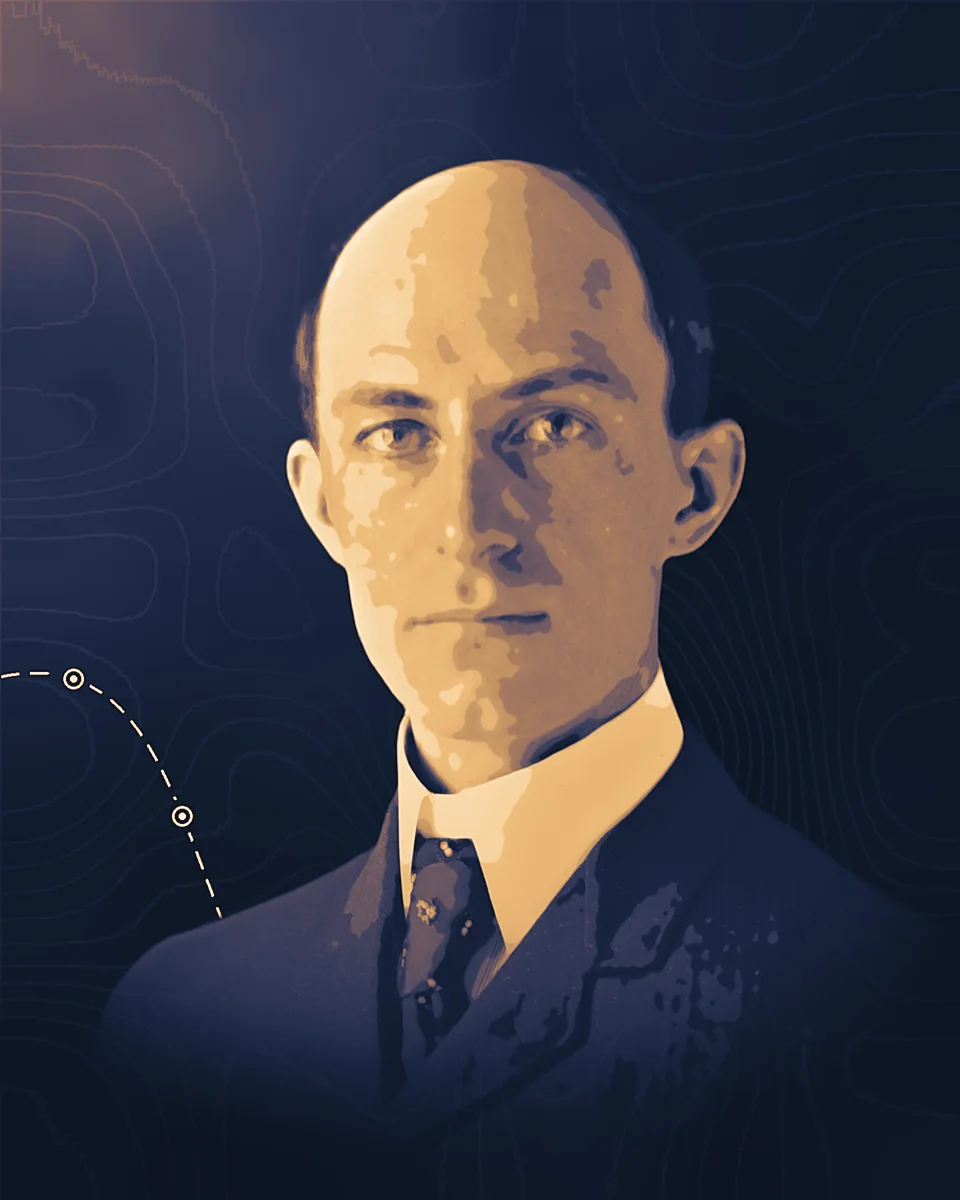
Wilbur Wright
With his brother Orville he made the airplane steerable about three axes and designed it from wind-tunnel measurements, which is still how aircraft are engineered.
1867–1912
What they changed
1901
A wind tunnel for design
The brothers' 1901 glider made about a third of the lift that published tables predicted. They built a small wind tunnel with two balances, one for lift and one for drag, and tested between one and two hundred small metal wings from September to December 1901. The 1902 glider and the 1903 propellers were designed from those numbers. The Smithsonian counts "the use of a wind tunnel and flight testing as design tools" among the basic techniques of modern aeronautical engineering that began with the Wrights.
1902
Control about three axes
The brothers rolled their gliders by twisting the wing tips in opposite directions, which they called wing warping. The 1902 glider added a movable vertical tail, so the pilot could control roll, pitch and yaw together. The Linda Hall Library calls this three-axis control "the key innovation that made controlled, sustained flight possible." They made between 700 and 1,000 glides that year.
1903
Powered flight at Kitty Hawk
On 17 December 1903 the Wright Flyer made four flights at Kitty Hawk, North Carolina. Orville flew the first, 36 m in 12 seconds. Wilbur flew the fourth and longest, 255.6 m in 59 seconds. The Smithsonian calls the propellers the new feature of the machine: the brothers treated them as rotating wings. Their mechanic Charles Taylor helped build the twelve-horsepower engine.
1906
A patent on control
US Patent 821,393, granted on 22 May 1906, covered the brothers' way of controlling a flying machine. Between 1909 and 1917 they sued other builders, Glenn Curtiss above all. The courts held that Curtiss's ailerons, hinged flaps at the wing tips, used the patent's principle. During the First World War American makers formed a patent pool with the government's approval, the suits stopped and royalties fell to one percent.
1908
Flights shown in Europe
In 1908 the brothers made their first public flights. Wilbur went to France to demonstrate the airplane to buyers there and became a celebrity, while Orville flew for the US Army.
Life
Wilbur Wright was born on 16 April 1867 near Millville, Indiana, the third of seven children of Milton Wright, a churchman, and Susan Koerner. The family moved to Dayton, Ohio, before his high-school class graduated, so he never received his diploma. In the winter of 1885 to 1886 a hockey injury kept him at home for three years.
In 1889 he and his younger brother Orville opened a printing shop, and in 1893 a bicycle repair and sales shop, which became their living. The death of the German glider pilot Otto Lilienthal in 1896 renewed their interest in flight. In 1899 they wrote to the Smithsonian Institution for a reading list and began what the Smithsonian calls a four-year program of research and development.
The work rested on other people's. The brothers began with Lilienthal's lift tables and an old figure for air pressure called the Smeaton coefficient, and their wind tunnel was built to check both after the gliders fell short. Charles Taylor, the mechanic in their bicycle shop, helped build the 1903 engine.
In 1909 the brothers and a group of industrialists formed the Wright Company, with a factory in Dayton and Wilbur as its first president. He led the patent suits in the United States and Europe, which the National Park Service says had mixed results. The US Centennial of Flight Commission's history says the court battles drained both sides' money, and that the Wright family blamed Curtiss for the decline in Wilbur's health.
He fell ill with typhoid fever in early May 1912 and died at the family home in Dayton on 30 May 1912, aged 45. He never married. His father wrote in his diary: "A short life, full of consequences."
Read more
5 accounts
1903 Wright Flyer, Smithsonian National Air and Space Museum, object record read in 2026.
The museum's account of the four-year program, the wind tunnel, the propellers and the four flights.
airandspace.si.edu
The Papers of Wilbur and Orville Wright, including the Chanute-Wright letters, Ayer reprint, 1998.
The brothers' letters, diaries and notebooks, with their correspondence with Octave Chanute.
archive.org
Wright 1901 Wind Tunnel Tests, NASA Glenn Research Center, web page read in 2026.
How the tunnel and its two balances worked and what the brothers measured.
grc.nasa.gov
Wilbur Wright's Life Story, US National Park Service, Dayton Aviation Heritage National Historical Park, read in 2026.
A short sourced life from the park that keeps the family's sites.
nps.gov
Patent Wars, Linda Hall Library, digital exhibition Flying Machines, read in 2026.
The 1906 patent and the suits against Curtiss, with the documents shown.
lindahall.org