Industries / Figureheads
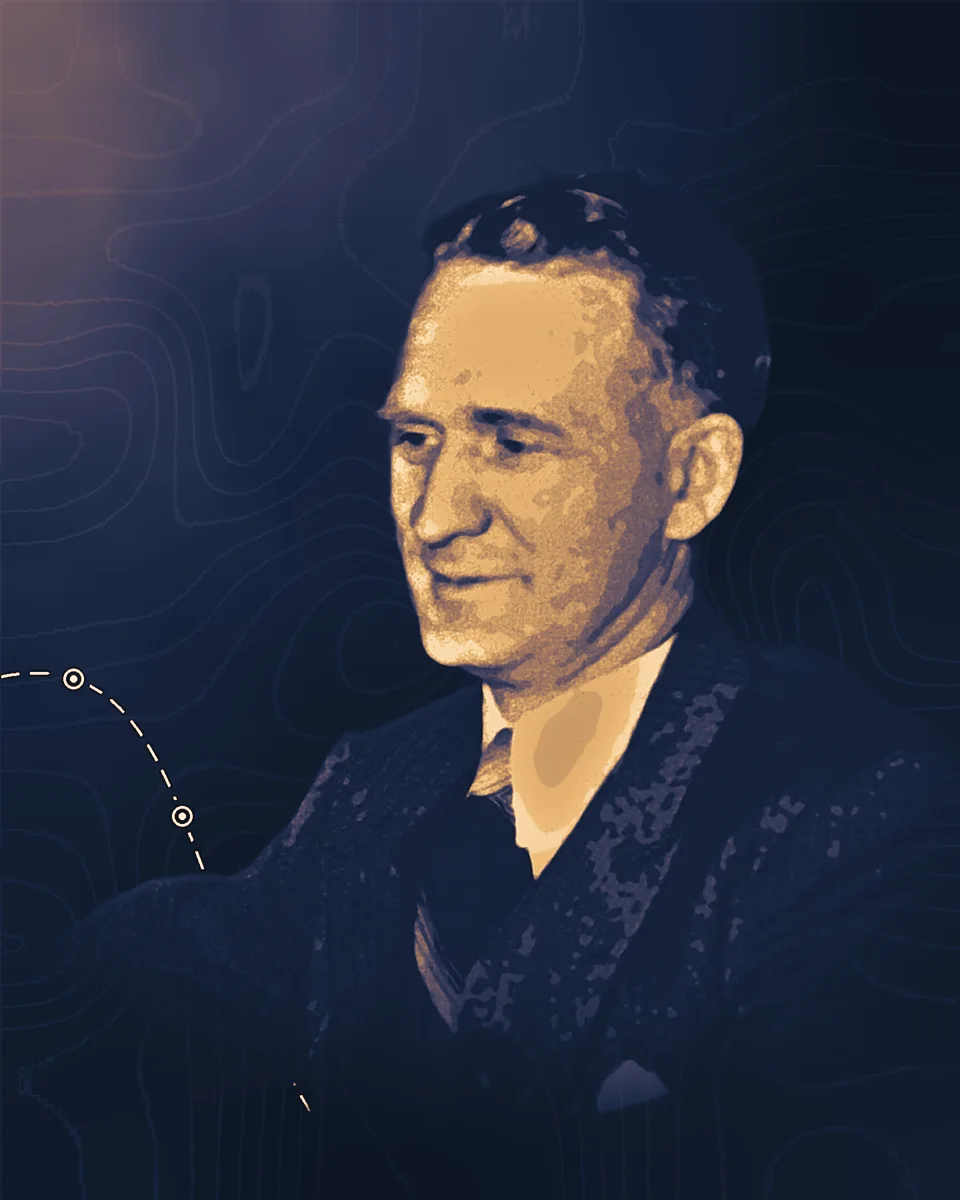
Walter Zinn
He designed the first reactor to make electricity and, as first director of Argonne National Laboratory, set the United States to developing both water-cooled power reactors and the breeder.
1906–2000
What they changed
1942
Builder of the first pile
Zinn had built experimental lattices of uranium for Enrico Fermi at Columbia University. In Chicago he completed the construction of Chicago Pile-1, the first reactor, which sustained a chain reaction on 2 December 1942, and he stood with Fermi at the instruments that day. He went on to build the second and third piles.
1946
A laboratory for reactors
Argonne National Laboratory, outside Chicago, was inaugurated in July 1946 with Zinn as its first director. Alvin Weinberg of the laboratory at Oak Ridge called him "a model of what a director of the then-emerging national laboratories should be."
1951
Electricity from a reactor
Zinn was responsible for the basic design of Experimental Breeder Reactor I in Idaho, planned from 1945 and built from 1949. On 20 December 1951 it lit a string of four light bulbs, the first electricity from a nuclear plant. In 1953 it showed that a reactor can breed, which means making more nuclear fuel than it uses.
1950s
Boiling water put to test
He supervised the BORAX experiments, which showed that a reactor cooled by boiling water would shut itself down safely under accident conditions. The boiling water reactor became one of the two main kinds of power reactor.
1956
Reactors as a business
After leaving Argonne he founded General Nuclear Engineering in Florida, which designed and built pressurized water reactors. Combustion Engineering bought the firm in 1964 and he headed its nuclear division until 1970.
Life
Walter Henry Zinn was born on 10 December 1906 in Kitchener, Ontario, Canada. He took a bachelor's degree in mathematics at Queen's University in 1927 and a master's in 1930, then went to Columbia University in New York, where he received his doctorate in physics in 1934. He taught at the City College of New York from 1932 to 1941 and became a United States citizen in 1938.
He kept a research laboratory at Columbia, and in 1939 he and Leo Szilard published measurements showing that a uranium atom gives off neutrons when it splits, the condition for a chain reaction. In early 1942 the work moved to the University of Chicago. Weinberg describes him as Fermi's "executive officer", the man who organized the heavy experimental work. When Fermi left for the plutonium works at Hanford, Zinn was left in charge of the reactor site outside Chicago that became Argonne.
As director he pressed for the breeder, in the belief, shared with Fermi, that uranium was scarce. Weinberg credits his "persistent advocacy" of Experimental Breeder Reactor I with setting the American programme on two paths at once: reactors cooled by ordinary water, and the fast breeder. Weinberg also notes that far more uranium was later found than anyone expected in 1942, so that the quick development of the breeder "may be unnecessary." Under Zinn, the American Nuclear Society records, Argonne hired women and African-Americans into professional posts and positions of authority, which other laboratories of the time did not.
He and Captain Hyman Rickover, who ran the Navy's reactor programme, did not get on. Argonne had been given the job of designing the submarine reactor, whose layout was the work of Harold Etherington of Argonne, and Rickover insisted that the Argonne group take its orders from him. Zinn, by Weinberg's account, "could not tolerate two bosses for the same reactor."
He left Argonne in 1956. He was the first president of the American Nuclear Society in 1955, served on the President's Science Advisory Committee from 1960 to 1962, and received the Atoms for Peace Award in 1960 and the Enrico Fermi Award in 1969. He died on 14 February 2000 in Clearwater, Florida.
Read more
4 accounts
Walter Henry Zinn, 1906–2000, Alvin M.
Weinberg, Biographical Memoirs of the National Academy of Sciences, volume 85, 2004. A memoir by a physicist of the same programme, frank about Zinn's quarrel with Rickover and about the breeder.
nap.nationalacademies.org
Walter H. Zinn, American Nuclear Society, undated. The society's life of its first president.
ans.org
Experimental Breeder Reactor I, American Society of Mechanical Engineers, landmark 39, 1979.
The record of the reactor he designed.
asme.org
CP-1 Goes Critical, US Department of Energy, Office of History and Heritage Resources, undated. The day of the first chain reaction, with Zinn at the console.
osti.gov