Industries / Figureheads
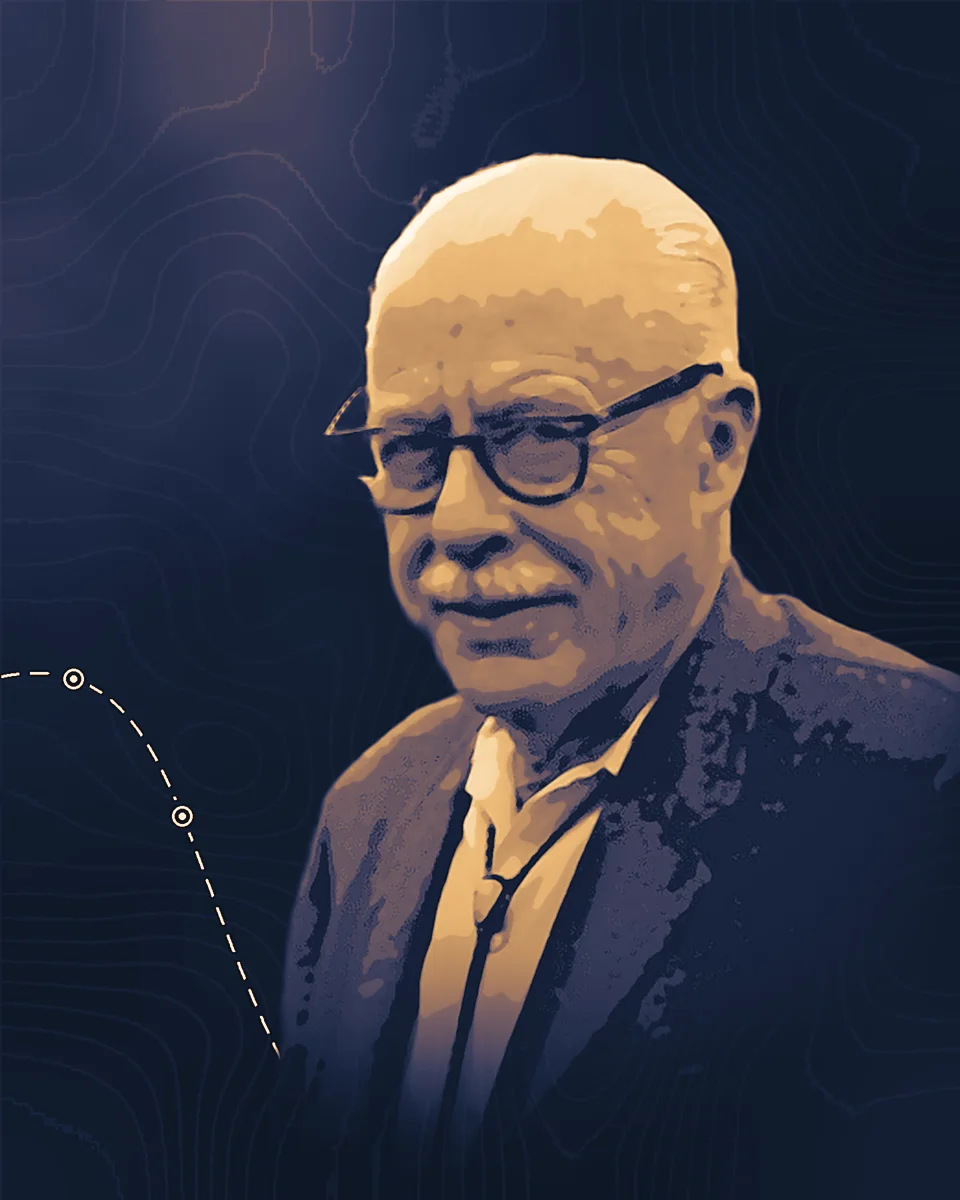
Walter Brattain
He built and ran the experiments that gave the first transistor, made with John Bardeen at Bell Labs in December 1947.
1902–1987
What they changed
1930s
Rectifiers studied at the surface
A rectifier lets current pass in one direction only. At Bell Labs Brattain studied how rectifiers of copper oxide, and later silicon, behaved at their surfaces, and the Nobel Foundation credits him with discovering the photo-effect at the free surface of a semiconductor, in which light on the surface produces a voltage.
1947
The first transistor
On 16 December 1947 Brattain wrapped gold foil around a plastic wedge, slit the foil at the tip with a razor to make two contacts a hair apart, and pressed them onto a slab of germanium. A small signal on one contact came out larger at the other. The germanium was high-purity material from Purdue University.
1947
Speech made louder
On 23 December Bardeen and Brattain showed the device to Bell Labs managers as an amplifier of speech. Brattain wrote in his notebook the next day that "a distinct gain in speech level could be heard" and put the power gain at "the order of a factor of 18 or greater".
1948
Patent and production
The patent for the device, filed in June 1948 and granted on 3 October 1950, names Bardeen and Brattain. Bell Labs announced it on 30 June 1948 under the name transistor, and the Computer History Museum says many thousands were made as the "Type A" transistor.
Life
Walter Houser Brattain was born on 10 February 1902 in Amoy, China, now Xiamen, where his father was teaching. The family went home to Washington State the next year, and he grew up in Spokane and on a homestead near Tonasket, where the family farmed, ran cattle and milled flour. He took a degree at Whitman College in 1924, a master's at the University of Oregon in 1926 and a doctorate at the University of Minnesota in 1929. He spent about a year at the US National Bureau of Standards, then joined Bell Telephone Laboratories in 1929.
For more than ten years he worked with Joseph Becker on the surfaces of solids: first the emission of electrons from hot tungsten, then copper-oxide rectifiers. Shortly before the war he studied early silicon detectors for radar. During the war he spent two years on airborne instruments that found submarines by their magnetism.
In 1945 Bell Labs formed a solid-state department under William Shockley and Stanley Morgan. Its semiconductor group at first held Brattain and Gerald Pearson, both experimenters, the chemist Robert Gibney and the engineer Hilbert Moore, and John Bardeen joined that fall. Brattain took surfaces as his part. He said later, "I cannot overemphasize the rapport of this group." Bardeen worked out the theory, and Brattain built the tests, which in December 1947 produced the first transistor.
The device of 1947 was soon replaced. Within about a month Shockley proposed the junction transistor, a sturdier design that the industry adopted. Shockley then steered the group toward his own ideas, by Bardeen's account, and Bardeen left Bell Labs in 1951. A history written for the PBS film on the transistor says Brattain refused to work for Shockley again. He stayed at Bell Labs and went on studying semiconductor surfaces, with C. G. B. Garrett and P. J. Boddy. Brattain, Bardeen and Shockley shared the 1956 Nobel Prize in Physics in equal thirds, "for their researches on semiconductors and their discovery of the transistor effect".
nationalacademies.orgnasonline.orgweb.archive.orgnobelprize.org
He retired from Bell Labs in 1967 and went back to Whitman College to teach physics. There he studied how potassium ions pass through thin films of fat, as a model of a living cell's wall. He married Keren Gilmore in 1935; she died in 1957, and in 1958 he married Emma Jane Miller. He died in a nursing home in Seattle on 13 October 1987, of Alzheimer's disease.
Read more
5 accounts
Surface properties of semiconductors, Walter H. Brattain, Nobel lecture, 1956.
His own account of the surface work before and after the transistor.
nobelprize.org
Walter Houser Brattain 1902–1987, John Bardeen, National Academy of Sciences Biographical Memoirs, volume 63, 1994.
A memoir by the man who shared the bench and the prize.
nationalacademies.org
Scientist of the Day: Walter Brattain, Benjamin Gross, Linda Hall Library, 2020.
A short life with the notebook entry for the December demonstration.
lindahall.org
How the First Transistor Worked, Glenn Zorpette, IEEE Spectrum, 2022.
What the gold foil and the germanium did, with drawings.
spectrum.ieee.org
1947: Invention of the Point-Contact Transistor, Computer History Museum, undated. The museum's short history, with the original papers listed.
computerhistory.org