Industries / Figureheads
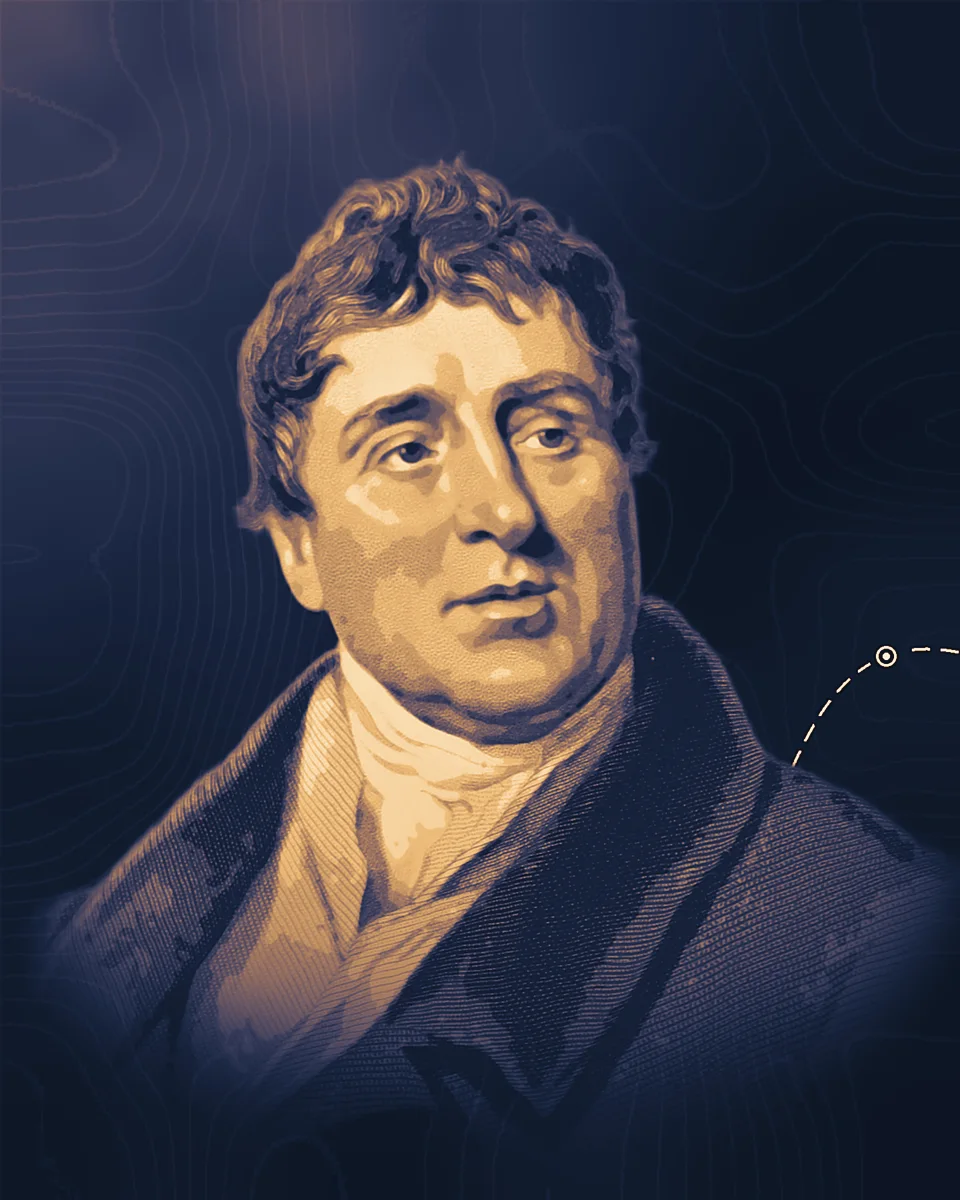
Thomas Telford
A stonemason who became the engineer of Britain's longest roads, its iron aqueducts and the Menai suspension bridge, and the first president of the Institution of Civil Engineers.
1757–1834
What they changed
1805
An aqueduct of iron
Canal aqueducts had held their water in a bed of puddled clay on heavy masonry, which frost cracked; Telford wrote that some had fallen down, "even in the works of the justly celebrated Brindley." At Pontcysyllte in Wales he carried the Ellesmere Canal 120 feet above the River Dee in a cast-iron trough on slender stone piers, opened in 1805. UNESCO, which made the aqueduct and its canal a World Heritage Site in 2009, calls it "the first great masterpiece of the civil engineer Thomas Telford."
1803
Roads into the Highlands
After Telford's survey and report on the Scottish Highlands, Parliament appointed a commission in 1803 to build roads and bridges there, with half the cost met by the districts served, and Telford as its engineer. By Samuel Smiles's count, 920 miles of road and 1,200 bridges were built in eighteen years.
1808
Sweden's cross-country canal
Count Baltzar von Platen asked Telford to survey a canal across Sweden. Telford spent August to October 1808 there and staked out the route, by his own account and von Platen's. The Göta Canal opened in two parts, in 1822 and about 1832, and was dug largely by some 58,000 soldiers drafted over the years, by the canal company's figures.
1816
A road on hand-set stone
For the 69 miles of new Carlisle to Glasgow road, under an Act of 1816, Telford set his gradients no steeper than about 1 in 30. He laid a bottom course of stones 7 inches deep, each set by hand with its broad end down, then a 7-inch top course of broken hard stone no larger than would pass a 2.5-inch ring, with a cross drain every 100 yards. Smiles compares this with John McAdam's lighter method of broken stone alone.
1820
Head of the new institution
Young engineers had formed the Institution of Civil Engineers in London in 1818. They asked Telford to be its president, and he took up the office on 21 March 1820. Smiles says he watched over the society's growth for the rest of his life. His gravestone in Westminster Abbey calls him "President of the Institution of Civil Engineers."
1826
The Menai Strait spanned
Telford's suspension bridge from the Welsh mainland to Anglesey, built from 1819, carried the London to Holyhead road on chains of wrought-iron bars over a main span of 579 feet, which the American Society of Civil Engineers calls the longest attempted at the time. The first mail coach crossed on 30 January 1826. Its 24-foot deck had no stiffening and moved badly in wind; it was strengthened in 1840, and a steel deck replaced the timber one in 1893.
Life
Thomas Telford was born on 9 August 1757 at Glendinning in Eskdale, Dumfriesshire. His father, John Telford, a shepherd, died a few months later, and his mother, Janet Jackson, brought him up. He was apprenticed to a stonemason, worked as a mason in Edinburgh, and in 1782 went to London, where he cut stone at Somerset House. He then ran building work at Portsmouth Dockyard.
When the Portsmouth work was finished in 1787, the member of Parliament for Shrewsbury, William Pulteney, a man from Telford's own parish, brought him to Shropshire to alter Shrewsbury Castle. There he became Surveyor of Public Works for the county, in charge of its roads, bridges and gaol. In 1793 the Ellesmere Canal's committee made him engineer of that canal. "Telford becomes a civil engineer" is the heading his editor put on the page.
Credit for the Ellesmere works is shared. Telford consulted William Jessop, Smeaton's former pupil, on the aqueduct, and Smiles records that a writer named Hughes claimed for Jessop the idea of using iron at Pontcysyllte, a claim Smiles thought made "without sufficient reason." The Menai chains were made by the ironmaster William Hazledine, who tested every bar.
He went on to the Caledonian Canal through the Great Glen, harbours on the Scottish coast, the road from London to Holyhead, docks, bridges and fen drainage. The Caledonian Canal was a commercial failure, which Smiles says disappointed him. Late in life he grew deaf and began the account of his works that his executor, John Rickman, published in 1838.
Telford died at 24 Abingdon Street, Westminster, on 2 September 1834, and was buried in the nave of Westminster Abbey on 10 September. A marble statue of him by E. H. Baily, of 1839, stands in the abbey's St Andrew's chapel.
Read more
4 accounts
Life of Thomas Telford, Civil Engineer, Written by Himself, edited by John Rickman, 1838.
His own account of his works, with the editor's supplement and notes; the plates were issued as a separate atlas.
archive.org
Lives of the Engineers, volume 2, Samuel Smiles, 1861.
The long Victorian life of Telford, from Eskdale to Westminster Abbey, after lives of Smeaton and Rennie.
archive.org
The Life of Thomas Telford, Samuel Smiles, 1867.
The same life revised and issued on its own, with a history of roads and travel in Britain.
archive.org
Pontcysyllte Aqueduct and Canal, UNESCO World Heritage Centre, 2009.
The case for listing the aqueduct, with its place in the history of iron in structures.
whc.unesco.org