Industries / Figureheads
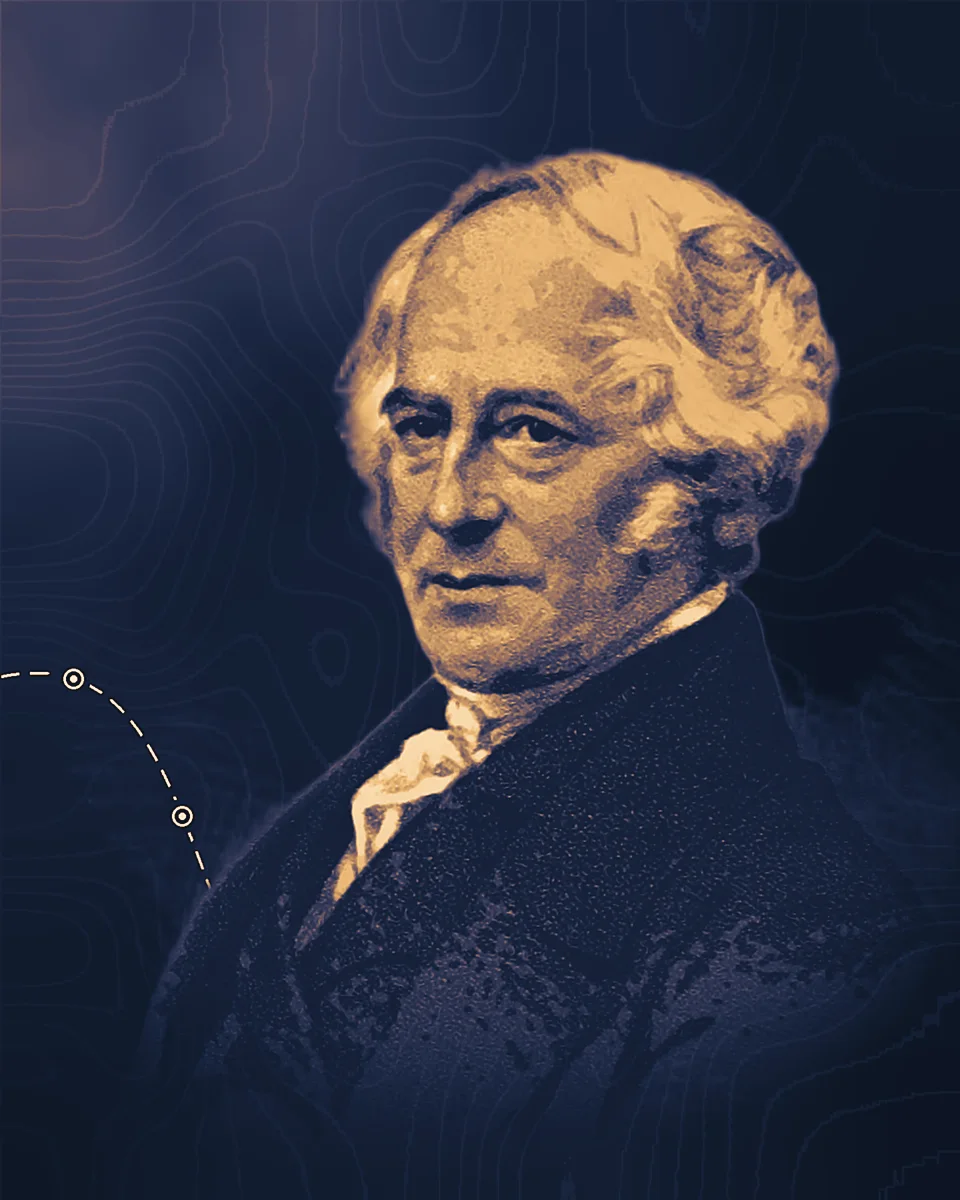
Thomas Hancock
He built the first machine that worked raw rubber into a usable mass, and he took out the British patent for curing rubber with sulfur.
1786–1865
What they changed
1820
The masticator
Hancock built a small machine in which a toothed roller turned inside a toothed drum and tore scraps of rubber until they joined into one warm, soft lump that could be pressed in a mold. Tadmor and Gogos's textbook on polymer processing opens its history with this machine, built "to reclaim scraps of processed natural rubber". He wrote that the first charge was two ounces (57 g), and that by 1857 his Manchester machines took 180 to 200 pounds (82 to 91 kg) each.
1820s
Rubber worked without solvents
Before the masticator, rubber goods were cut from the raw lumps that arrived from Brazil, or made from rubber dissolved in a solvent. Hancock pressed his masticated rubber into blocks and cut sheets and threads from them, and called the summer of 1820 "the origin and commencement of the india-rubber manufacture". Mixing rubber by working it in a machine is still the first step in a rubber factory.
1831
Partner to Macintosh
Charles Macintosh of Glasgow had patented a waterproof cloth in 1823: two layers of fabric stuck together with dissolved rubber. Hancock wrote that he obtained a licence under the patent early in 1825, and he became a partner in Charles Macintosh and Co. in 1831, by Grace's Guide's account.
archive.orggracesguide.co.ukcollection.sciencemuseumgroup.org.uk
1843
The British sulfur patent
Hancock's patent for changing rubber by heating it with sulfur passed the great seal on 21 November 1843, weeks before Charles Goodyear's patent in the United States. The Dictionary of National Biography says Hancock "first showed that sulphur alone is sufficient to effect the change". His friend William Brockedon proposed the name "vulcanization", and Hancock adopted it.
c. 1843
Hard rubber
The same patent covered a second product. Rubber heated with sulfur for longer and at a higher temperature turned into a hard, horn-like material, later called vulcanite or ebonite, which was molded into combs, pen barrels and electrical insulators.
Life
Thomas Hancock was born on 8 May 1786 in Marlborough, Wiltshire, a son of James Hancock, a timber merchant and cabinet-maker. He came to London and worked with his brother John in coach-building. About 1819 he turned to rubber, then called caoutchouc or india-rubber, which reached England in small amounts from South America. His first patent, dated 29 April 1820, used strips of rubber as springs in gloves, braces and other clothing.
gracesguide.co.ukcollection.sciencemuseumgroup.org.uklindahall.org
Cutting those strips left scrap, and the masticator was his way to use it. He did not patent the machine. He wrote that he pledged his workmen to secrecy and that the machine "was called 'a pickle'" to disguise it, and that the secret held for twelve or thirteen years, until about 1832. A workman then gave it away. He ran the work from Goswell Mews in London and, after joining Macintosh, from Manchester as well.
The sulfur patent is the disputed part of his record. Charles Goodyear had found in the United States in 1839 that heat and sulfur cured rubber, and had not yet patented it. Hancock's own book says that in the early autumn of 1842 Brockedon showed him "some small bits of rubber" brought from America by an inventor's agent, and gave him two small pieces. Hancock wrote that the pieces showed him for the first time that the change was possible, and that he then found the method by his own experiments. Goodyear later challenged the patent in the British courts and lost. The historian William Ashworth of the Linda Hall Library calls the question of what Hancock took from the samples "a contentious subject".
He took out sixteen patents on rubber between 1820 and 1847. In 1857 he published his own account of the trade, with the patents printed in full at the back. The Dictionary of National Biography, written in 1890, calls him the "founder of the indiarubber trade in England". He died on 26 March 1865 at Stoke Newington, London. The Science Museum Group's record says his London business passed to his nephew and former assistant, James Lyne Hancock.
Read more
4 accounts
Personal Narrative of the Origin and Progress of the Caoutchouc or India-Rubber Manufacture in England, Thomas Hancock, 1857.
His own account, with drawings of the machines and the text of his patents.
archive.org
Hancock, Thomas (1786–1865), R.
B. Prosser, Dictionary of National Biography, volume 24, 1890. The national biography's entry, by a historian of patents.
en.wikisource.org
Thomas Hancock, William B. Ashworth Jr., Linda Hall Library, 2024.
A short illustrated life by a historian of science, with the dispute over vulcanization.
lindahall.org
Hancock Family Collection, Science Museum Group, undated. The archive record of the family's business papers, which include his brothers' work.
collection.sciencemuseumgroup.org.uk